
Falmouth, MA – We celebrated the 50th running of the Asics Falmouth Road Race last year. But as with all such runnings and anniversaries, there is always a single year gap between the two. The actual 50th anniversary year is nigh in 2023. Here’s a rewrite of my column from last year celebrating this American Classic road race.
Each August when the Falmouth Road Race weekend came around on old Cape Cod, traffic along the town’s picturesque Main Street clogged tighter than an NFL fan’s descending arteries. A quick scan from the sidewalk revealed license plates from the entire eastern seaboard lined up bumper to bumper as suntanned elbows propped out open car windowsills, and shouts of recognition arched out over rooftops.
Shops bannered summer sales along the colorfully decorated sidewalks, displaying their wares on tables and racks to lure the moseying passersby. Up the road, the line at the Dairy Queen window was only slightly less stalled as anxious hands awaited Blizzards and quickly dripping soft-serve cones.
With the Cape in the final throes of high summah (sic) season, the mood around town was both electric and not a little elegiac. That’s because the leading edge of fall always seemed to tinge the race night air as the long line of red taillights headed for home past Sippewissett up Rte. 28 North.
But in the last few days leading up to the event, whether in the days at the old Gus Canty Rec Center, or today at the Falmouth High School, a neighborly white clapboard feeling prevailed as visitors poured in from around the country to pick up race numbers and attend the expo.
Past years race tee shirts identified the Falmouth veterans, smiles brightened by framing sunglasses. And there, in the center of the maelstrom, was the Falmouth race crew answering the endless (mostly repetitive) questions, handing out goody bags, and directing the army of young volunteers.
Though onetime Brothers Four bartender Tommy Leonard founded the great race back in 1973 on his 40th birthday, it was the tireless work of the people of Falmouth who steered the seven-mile road classic through the shoals of obscurity to the safe harbor of legend over its first five decades. Their legacy is one no salute can fully capture, even as the memories remain vivid and enduring, nonetheless.
For the first forty years, four individuals ushered Tommy’s dream into reality, too caught up in their never-ending tasks to take part in the laid-back summer revelry all around them.
Marching from desk to desk at the old Rec Center on Main Street like an army sergeant was its long-time director, Rich Sherman. His volunteer tee shirt dripped with sweat as it hung loose from a pair of wrinkled khaki shorts in the heavy air of the non-air-conditioned room. While recognizing new arrivals, he assisted young volunteers who did their best for another visiting race entrant. It was Rich’s stint as director of the Falmouth Recreation Department in the 1970s that marked him as the operations man with a steady hand on the tiller.
At another desk, co-director John Carroll rested his head on one hand while he cradled the telephone with the other, finalizing the field for Saturday evening’s Falmouth Mile, an event he championed since 1997 at the Falmouth High School track.
“When T.L. approached me about doing the race, I was teaching five classes of English at Falmouth High School, and coaching girls cross country, boys and girls’ indoor track, and the boys’ outdoor teams,” recalled John. “I took over the girls’ outdoor team in ’74.”
John’s tenure as head coach at Falmouth High and then the Falmouth Girl’s Track Club made him the obvious choice to head up athlete recruitment for the road race over the years. And no race in America had better pro fields than Falmouth’s, as its calendar date in late August lent it an end-of-the-summer championship quality. A victory at Falmouth was a must to secure Road Runner of the Year honors, a coveted title once bestowed by magazines that used to cover the sport of running seriously.
To give you an idea of the depth of the fields back in the early days, in 1980, the year New Zealand’s Rod Dixon became the first non-American champion, Falmouth’s 44th-place finisher, Mark Murray of Boston, ran 34:58, sub-5:00 per mile pace. Egos were in short supply in this racing universe.
Perhaps less visible than their husbands, but no less vital to the event’s success, were Lucia Carroll and Kathy Sherman. Lucia hovered in the background, making sure that all the office dominoes were in place and falling fast and true. Hers was a thankless task that had taken the previous several months to stand up properly. Then, after the race, she also played host and gatekeeper at the press and medical tents past the Falmouth Heights finish line, jobs requiring the temerity of a sinner and the patience of a saint.
While Rich, John, and Lucia worked upstairs at the expo, Rich’s wife Kathy buzzed around downstairs, overseeing merchandise sales, while checking preparations for the VIP luncheon on Saturday afternoon. In the early years, they held the party at the Carroll’s home until the Shermans assumed the hosting duty at their place just off the racecourse. Then, as the race and the party continued to grow, Kathy moved the proceedings to the elegant Coonamessett Inn.
The Carrolls and Shermans handed over the reins of the race in 2011, having established a blueprint from which today’s Executive Director Jennifer Edwards and her crew along with board president Scott Ghelfi and the race committee have continued to work as the scope and popularity of their race added an ever-growing list of necessities that most people were unaware of, but without which no race could ever happen.
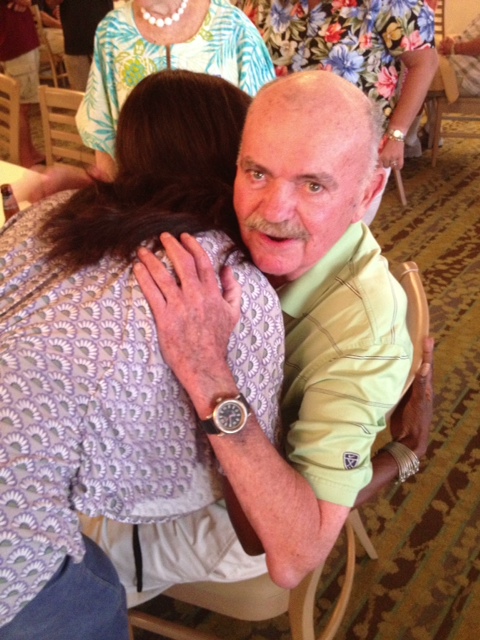
Yet less we forget, t was the magical Tommy Leonard who actually envisioned this American classic when he excitedly watched Frank Shorter win the Olympic Marathon gold medal in Munich, Germany, on Sunday 10 September 1972.
Tommy got so caught up in Shorter’s Olympic run watching from behind the bar at the Brothers Four, that he stopped serving his patrons and began calling the race as Frank opened a commanding lead after 15 kilometers. Not long after, Tommy’s fertile imagination took flight.
“It was late on a Saturday night,” Tommy recalled in an interview conducted for my old Runner’s Digest radio show in Boston. “I was sitting at the bar with my feet up on a chair having a cold one. And I’m looking out over Martha’s Vineyard Sound, and the water was shimmering in the silvery moonlight as Roberta Flack softly sang First Time Ever I Saw Your Face in the background.
“I was with Captain Red Caviar—Cavanaugh, we called him Red Caviar — from the Captain Kidd (in Woods Hole), and it all just came into being. I’m a bit of a romantic, and with this scenario I said, ‘I’d really like to do something for the Falmouth Girl’s Track Club, and I started putting all of it together. The conception was right there at the Brother’s Four.”
A year later, 92 bedraggled people came together in a rainstorm on Tommy’s 40th birthday to raise money for the Falmouth Girl’s Track Club in a seven-mile race from bar to bar – the Captain Kidd in Woods Hole to the Brother’s Four in Falmouth Heights. Who could have guessed that network executives would one day feature the race on CBS Sports Spectacular and ESPN, as it came to be known as The Great American Road Race?
Sure, Tommy’s infectious charm set the tenor, and through his friend Steve Liquori, recruited America’s premier miler, brother Marty Liquori, to come race in 1974 after a stint on the European track circuit. Marty arrived thinking he was in town for a 7-mile fun run, unaware that a young up-and-coming distance man from the newly formed Greater Boston Track Club would use the second Falmouth Road Race to catapult himself into the public eye with a no-contest romp against the famous track star.
Then, after Bill Rodgers exploded to even greater fame with his unexpected American record win at the 1975 Boston Marathon, Tommy matched him up that summer against the very man who had inspired the Falmouth race in the first place, Olympic Marathon champion Frank Shorter.
As much as anything else, it was the Frank against Bill duels in Falmouth from 1975 to 1978 that fueled the running boom. Frank won the first two meetings, Bill the two after that.
“I’m not surprised by the event’s success, though,” Tommy once told me. “I remember telling Joe Concannon (the late, great Boston Globe sportswriter and good friend of T.L.’s) ‘We’re going to have 5000 runners here or I’ll do a swan dive off the Bourne Bridge!’”
Well, Tommy’s guess came up well short of the mark. So, he never had to take that Greg Louganis leap into the Cape Cod Canal. But whenever the suggestion arose that he deserved credit for what the race had become, T.L. would instantly redirect the praise to the Carrolls and Shermans or another person or agency that had believed in his vision.
“No, no, no,” he would say in all earnestness. “It was Captain Red Caviar, and Selectman John DeMello, Jr.; (Police Captain) John Fereira, and Billy Crowley (who sponsored Frank Shorter in 1975),” and the list would go on and on.
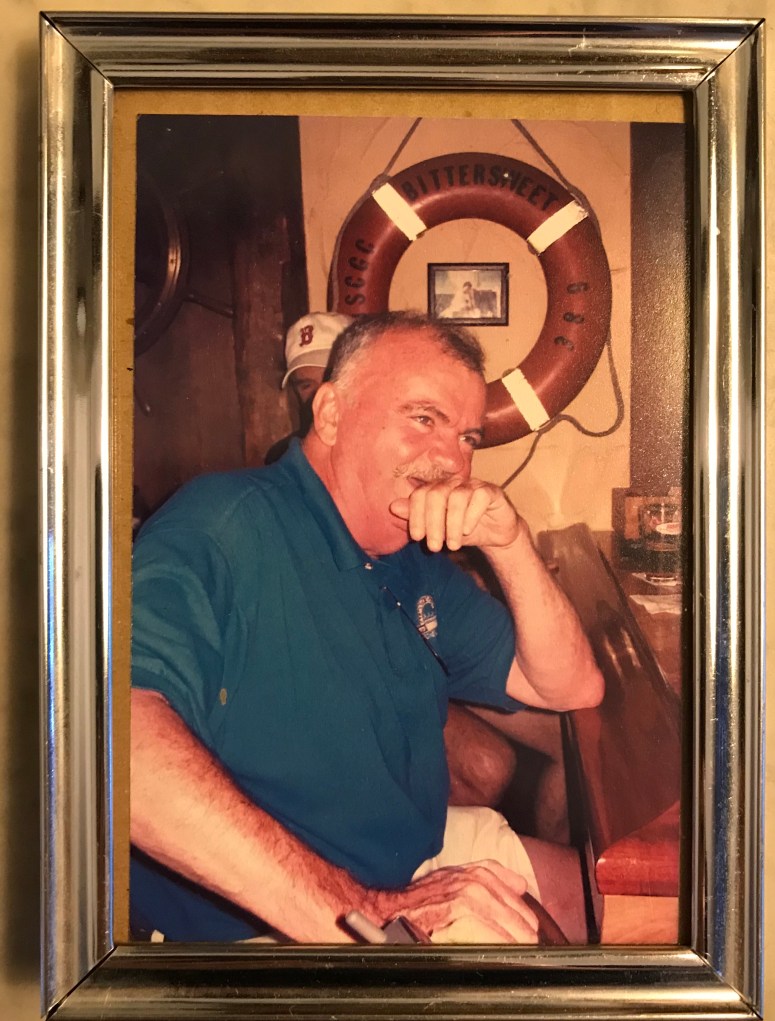
The human desire to be lauded was never part of Tommy’s make up. Maybe it’s because he had been an orphan, but all T.L. ever wanted to do was bring people together. It was just another quality that endeared him to so many people.
TOMMY’S FAVORITE FALMOUTH – 1980
“When Rod Dixon and Greg Meyer, Herb Lindsay, Bobby Hodge and Ric Rojas came over the hill by the Brothers Four, that’s when I almost fell off the Brother’s rooftop with a handful of shingles and a drain pipe. George Robards (Brother’s owner) grabbed me by the scruff of the collar. I couldn’t contain myself. And with the powder puff clouds in the background, that was one of the most exciting races I ever saw.”
We lost Tommy in January 2019 after 85 remarkable years. But his spirit will forever infuse the event.
This 50th anniversary of Falmouth, thousands of fortunate souls will once again make the pilgrimage from Woods Hole to Falmouth Heights, though both defending champions, Ben Flanagan and Keira D’Amato will miss the action as they represent their countries at the World Athletics Track & Field Championships in Budapest, Hungary.
Ben will race the 5000m for Canada. Keira will look to better her 8th place finish last year in Eugene, Oregon in the women’s marathon for the USA.
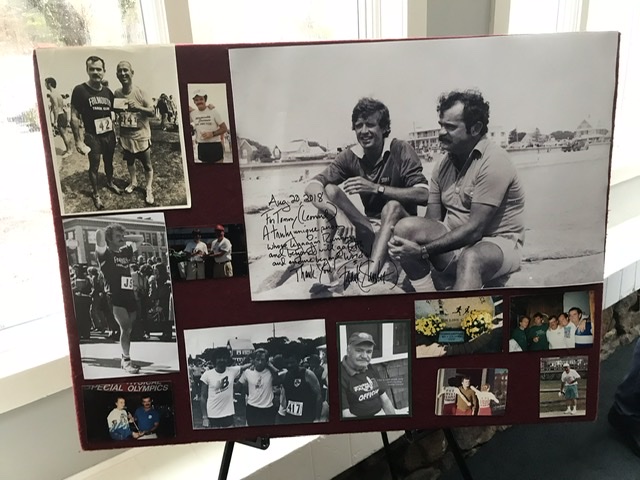
It will be a running family reunion, you can be sure. Those of us who still remember the early years will return to tell stories and lift glasses at the Quarterdeck on Main Street, later from the Crow’s Nest overlooking the finish at Falmouth Heights.
As 1978 race runner-up, Olympian Mike Roche, posted on Facebook today: “I think I speak for alot of folks when I say I wish we could use the “Way-Back” machine for one more vintage Falmouth RR. Complete with the flatbed press truck, Bill D’s and Brownies’s hotdog extravaganza, rock ‘n’ roll on the ball field, Perrier to pour over our heads at the finish; a Running Woodstock on the Cape. This will be my 47th? I forget.”
Looking out across Vineyard Sound, it’s easy to recall the stories that define this gem of a race. It still shimmers, like the moonlit Sound that sparkled in Tommy’s eyes those many, many years ago.
END
 tonireavis.com
Awesome. I graduated Falmouth H.S. and I ran track for Mr.Carroll, after graduation I joined the USN. ( retired). Thank you Mr. Carroll
Toni – you captured the feel of the event precisely, a race ‘where everyone knows your name!”
I had a “Dr. Appointment ” for 25 years on the Thursday before Falmouth. The appointment was really a day trip to Falmouth to pickup our bibs. Stops at the Boat House, Captain Kids and finally the Quarter Deck to celebrate another year of good Cape Cod fun. Heading over tomorrow with friends. We won’t be picking up a bib, but looking forward to seeing old friends and cold pints. Cheers
There’s nothing like it, Toni. What a great summary. You know it’s my favorite. Looking forward to toeing that start line for my 45th consecutive, hopefully placing in my age group. See you soon!