
As I have been watching coverage of the World Athletics Championships in Budapest, I thought to myself, whatever else you want to say about track and field, at least it hasn’t gone soft like so many other sports have by relaxing its rules to increase the video-game-like level of display for fans.
Yes, we live in the Super Shoe era, but that doesn’t compare to the most egregious offender in rules relaxing, the NBA, which has completely eliminated hand-check defense, palming, traveling, etc. They capitulated to the And1 generation and turned the game into a playground version of B-ball. Then hoot and holler about how great the offensive players are these days. Well, Duh!
But then, just as I was applauding Athletics for staying true to its form, for the second time in recent championship history, we had two athletes decide NOT to compete for the win and instead agree to share a gold medal. Man, this everyone-is-a-winner disease just keeps infecting more and more aspects of life, doesn’t it?
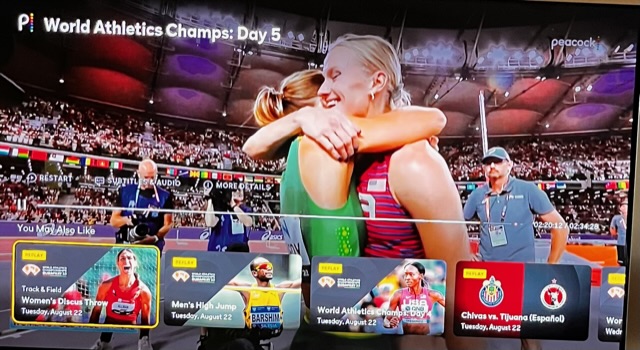
Capping Day 5 competition, American Katie Moon and Australian Nina Kennedy matched each other vault for vault through 4.90m in the women’s pole vault. Exciting stuff, with Kennedy clearing two personal best national records along the way. Then both missed all three attempts at 4.95, which would have equaled Moon’s PB.
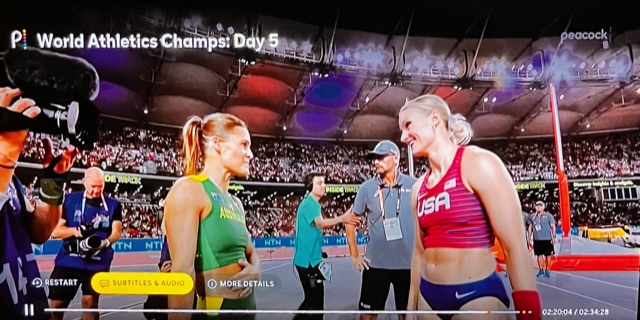
Then, rather than go through the jump-off protocol of old, where they would take a fourth attempt at 4.95, and if they missed again, drop the bar to 4.90, 4.85 etc. until somebody cleared and somebody missed, they had the choice to share the gold medal. Who wouldn’t take a gold medal if given the choice!? Imagine, being awarded the top prize for NOT competing!
Same thing happened with Italy’s Marco Tamberi and Qatar’s Mutaz Barshim at the Olympic high jump in Tokyo 2021. Both cleared 2.37m, then missed at 2.39m. Rather than preparing for a jump-off, Tamberi asked the official if they could both get a gold medal. When the official told him that was possible, if they both agreed, what would you have done? In Budapest, Moon & Kennedy (hell of a law firm name, BTW) were offered the same choice with the same result.

OK, let’s applaud friendship and sportsmanship, but if you decide not to go for the gold, you’re sharing the silver medal. The choice should be simple: go for the gold, or share the silver, but we’re not giving out two gold medals for people who choose not to compete. If you choose NOT to compete, then the gold stays vacant.
On the track, 1/100th of a second will separate the gold from the silver or even 1/1000th a second, but we’re deciding a victor. Why in the vertical jumps do they get to decide to share gold medals? Because of the risk? Both women made good first attempts at 4.95, but the second and third tries weren’t close. Both athletes showed fatigue. But isn’t the risk assumed by the choice to enter?
In the long jump, triple jump, javelin, hammer, discus and shot put, if the longest throw or jump is equal between two athletes, they look at who had the second, or third, or even fourth best performance in the series to determine a champion. But somebody’s getting gold, someone else silver. But in our modern world, it’s all lilacs and butterflies rather than honest hard-nosed competition.
There has to be a way to discern a champion without turning the event into lions and gladiators. How about length of pole? Who went highest with the shortest pole? The honorable thing to do if you’re tied would be to root for your fellow competitor in the jump-off. But agreeing to share the top prize instead of competing for it? I don’t get it. I guess that’s why I’m a grumpy old man who’s on his way out.
END
 tonireavis.com
they stop competing….
Toni, you curmudgeon! The Olympic creed – “The most important thing in the Olympic Games is not to win but to take part, just as the most important thing in life is not the triumph but the struggle. The essential thing is not to have conquered but to have fought well.” Nuff said.
Kevin,
You are right, of course. Just don’t want this agreeing to tie to become a trend. Plus, there would still be honor in matching silver medals as a symbol of their “struggle”, while acknowledging the gold would remain vacant. Thanks for contributing.
TR
Marschall and Nilsen tied for 3rd in the men’s PV. Does that mean they both got 4th and neither should get a medal or should officials stopped the competition and made them do a jump-off before proceeding?
Greg,
They didn’t choose to stop competing. There is no jump-off protocol for the minor medals, just for gold. That’s the difference.
TR
A shorter pole doesn’t mean an easier or harder jump – it just means different strengths. Some vaulters succeed with their speed on the runway while others rely more on their upper body strength.
I couldn’t agree more, Toni. I thought the whole idea of athletics was competition. Going one step further, I am going to harken back to an old post of yours from SEPTEMBER 3, 2021. Problem solved with incredible accuracy and simplicity. You’re welcome.
Toni, I’d be interested in your reaction to intentional ties in road races, ala Frank Shorter and Kenny Moore in the ‘72 Olympic Trials marathon.
Jonathan, I believe the Olympic Trials Marathon is one race where, money aside, a tie for first can be understood. The idea is to finish in the top three to qualify for the Olympic Games. Therefore, first, second, or third gains the same distinction, that being Olympian. Again, in these days, there’s money on the table, so it might make a difference to go for the win. But I was at the Nike OTC Marathon in 1979, calling the race for KPNW radio. Friends Jeff Weff Wells and Tony Sandoval were flying. I had to finally pull away on my motorcycle side car in a final mile heading toward Hayward Field. My last report said “one of these guys is going to make a move any minute now, and we will find out who when we see who enters the stadium first. But neither made a move. Instead, they ran in together holding hands at 2:10:20! It was an incredibly fast time for the day, and the fact that the two men had tied made me wonder how fast one of them might’ve gone had he really pushed it. Probably no more than 10 seconds difference, but still, in the days when there was no money on the line, I could see the sportsmanship gesture of tying more easily. But in something like the World Championships or the Olympic Games, it’s eyeballs out, going for the victory. Anything less, to me, is unsatisfying. The event is staged as a competition, not an exhibition. That should mean something. You honor the event, and your competitors by giving it your all. Even when the one you beat is your best friend. But that’s just me.
I do think that it is interesting that certain parts of track have become so brutal and utterly uninterested in any sort of compromise (one false start Mr. Bolt? YOu’re out. 0.999 reaction time Mr. Allen, when clearly the blocks were off for everyone in Eugene? you’re out.) And yet… the jumpers go back to a time when, frankly, winning a tie is still winning. Moon and Kennedy were the two best vaulters out there, period, with no questions about it. I don’t have a problem with them both winning – the jump off, with tiring athletes and diminished vaults would benefit no one, including the audience on TV (and fatigue could lead to a higher chance of injury anyway in such a difficult event). I am reminded that NO ONE likes soccer games decided on penalty kicks. What I don’t get is why the winner wasn’t determined on the earlier misses. With both athletes failing to clear 4.95, why didn’t it go back to earlier misses and passes? Isn’t that a key part of hte vaulting strategy?