There’s a frisson created when the right people gather in the right room, quaffing the right drinks, listening to the right music. Sometimes it just comes together through pure serendipity, of its own accord, and party-goers talk about what a great time they had for months.
But more often than not, a great party relies on a host or party-planner who had the intention and responsibility to bring the right elements together to ensure that their guests had a grand time.
Hosts and guests may both attend the party, just as bartenders and patrons are both in a tavern. But hosting an event, like bartending, is a completely different proposition, one of service.
The distinction between host and guest is similar to that between a professional and amateur athlete. Both participate, but one has an added responsibility to make sure the event is successful because in its success lies his or her own.
Pro athletes are “The Show”. In that leading role, they have to assist beyond simply performing well. They also have to help publicize and promote the event in order to generate the money they hope to win. And the predicate for that is fan/sponsor interest.
Since the early 1980s, when the sport of athletics first wrenched free from its shamateur past and entered open prize purse competition, so-called professional runners have been under no obligation to contribute to the building or promotion of the sport, only to providing its athletic excellence.
In the latter, they have outdone themselves – though the scourge of drugs has tainted more than a little of their excellence. But in the former, they have come up woefully short. And there’s no public relations enhancing drug you can take to make the job any easier.
While there may well be an inclination by some athletes to assist in promotion, there has been no institutional blueprint drawn to facilitate any such inclination. Nor have there been lessons provided on how an athlete might fulfill the obligation. For the vast majority of athletes, there is no requirement whatsoever to assist like there is in other sports.
Accordingly, the sport has always connected with the public haphazardly, mostly by the fortune of a particular personality, someone like a Bill Rodgers, Grete Waitz, Usain Bolt or Eliud Kipchoge. But that’s a quixotic, catch-as-catch-can way to build a fan following.
In one sense, a major marathon does not differ much from a major prize fight, except by having a larger group of athletes involved. Top runners train the same as boxers and UFC fighters do, spending months sequestered in camps training for one fight.
But a truly professional sport brings its athletes out of their cocoons periodically and parades them in front of media and fans. It produces backstories, websites, all-access 24/7 programs to gin up interest in the coming competition.
Running, for its part, sends out a press release listing the field weeks before the race. Then stages a one-hour press conference the Friday before the big race on Sunday.
By the time the field assembles on the starting line, the public has no idea who any of these individuals are, or, at best, perhaps one or two. But the vast majority get lumped into broad generalities that blur any distinction between them.
On top of which, when every event has a “race director” and what’s called an “elite athlete coordinator”, what’s missing is the role of race promoter, a person like Al Franken, for instance, who used to promote indoor and outdoor track meets in Southern California for three decades to enormous success.
Today, the concept of race promoter as distinct from race director has been all but lost. And in that loss, in part, we see the decline in interest in the game. While we see wide promotion of the event, there is precious little promotion of The Race.
Most of the first generation of Running Boom race directors emerged from competitive backgrounds where race promotion was both of personal interest, and part and parcel of their job.
Today, it’s fair to say, the vast majority of second generation race directors have emerged from the event side and therefore do not look upon the competition in quite the same visceral way as their predecessors.
As for what makes a sport professional: money, let’s not even pry open that Pandora’s box in running. Nobody talks about it, because there’s nothing much really to talk about. As such, there is very little rooting interest in the competition’s outcome.
Now consider the fact that, beyond the wrath of Mother Nature (Boston Marathon 2018), there’s no home team lining up as favorites to win any more.
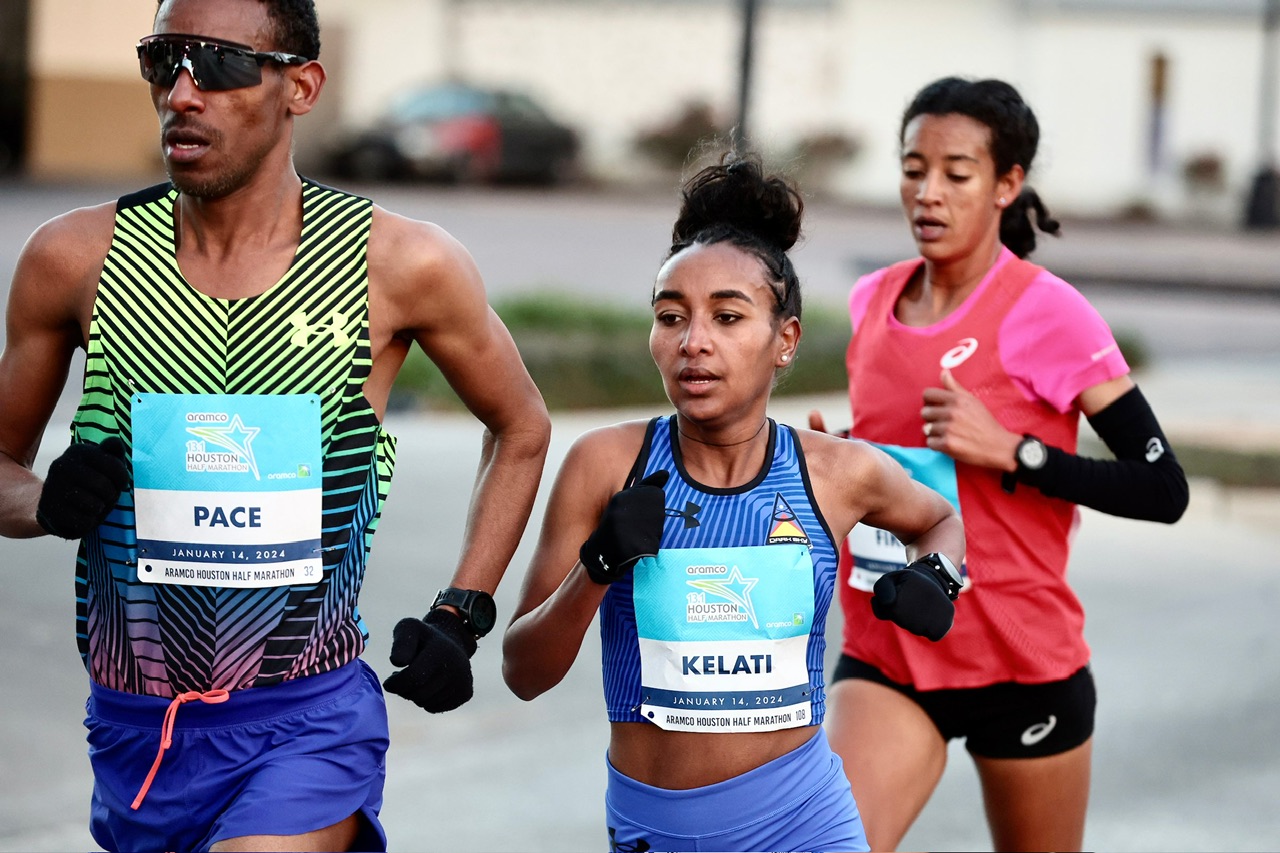
Weini Kelati on her way to AR in Houston (photo by Kevin Morris)
We just saw Weini Kelati break the half-marathon American Record in Houston yesterday (66:25). Yet she finished in fourth place nearly 2 minutes behind the race winner, Sutume Kebede (64:37).
Athletes from the horn of Africa completely dominate the sport. And that’s fine; we are dealing with a meritocracy, after all. Beyond that, however, the athletes from that part of the world are taught, and uphold, a completely different set of cultural standards in terms of public comportment – read deferential and soft-spoken.
This calculus makes properly staging and promoting the sport even more imperative to make up for its inherent deficiencies. Things like team and/or city affiliations and sponsor endorsements beyond shoe companies would help offset the domination of culturally distinct groups not directly affiliated with a foreign fanbase.
Instead, the sport has focused attention on the clock and record books or, more often, in road racing, on the human interest stories of the slower, amateur runners.
And with the new shoe technology, the chances for records have increased dramatically, thereby reducing the need to promote the individuals even more.
Despite the architecture of an international governing body and 200+ NGBs tasked with developing the sport, there is no organization whose job it is to promote the professional sport. In that sense, every event is on its own.
There is also a distinction between developing the sport and promoting it. One is more closely tied to an amateur ethic, while the other is more suited to professional considerations. But with a single organization in charge of both? As we have seen, neither will be fully served.
Every other sport has developed both amateur and professional wings to steady their flight and divvy up focus and responsibilities. Athletics has steadfastly refused to abandon its cradle-to-grave, amateur-and-pro, every event under one umbrella formulation. And no group of events or athletes since the early 1980s has attempted to institute a new professional model.
In the end, running has developed a series of individual events competing for the same pool of relatively anonymous athletes who are never professionally promoted or compensated, and who, much too often, are later found to have used PEDs. And we wonder why people think our sport is broken and boring?
Everyone is a guest at these running parties, but there are no promoters ginning up interest in the competition. Doesn’t mean we can’t have fun. Just that no one is responsible when we don’t.
Some interesting analogies here, and a great summation of the overlap of job responsibilities in our professional sport, a sport that increasingly looks amateur in execution. The World marathon majors, for instance, have a real problem: their product, while solid (well-run races in 6 big cities of the world) suffers from terrible media presentation across the board. It would be as if the NFL didn’t centralize contracts and so, while all the teams competed together, each little hamlet would get to decide how to promote football, how to televise, how to spotlight it. No consolidated media presence, nothing to keep attention on the stars of the sport, nothing to MAKE stars of the sport, just a ton of runners, training on their own, lining up in NYC or Boston, with little connection to any other aspect of the sport of running. Its an odd business model, and increasingly, one that is working on some levels and crashing horribly on others.
We need, and its likely too late, but there is a lot of airtime to fill and the potential for resurrection is always there, an outfit that has real media savvy, that employs people to be media savvy and builds this sports interest within the United States and world outside of the Olympics. I brought up Abbott as a likely candidate: tehy’re professional and have a vested (financial) interest in getting the world Majors to be done better, not as races, but as media, creating a better presence that links the Kipchoges of the world to the 3-hour marathoners. I’d love to see it, and its not Max and USATF since they have failed miserably to do any of this, but I’m not holding my breath.

 tonireavis.com
Some interesting analogies here, and a great summation of the overlap of job responsibilities in our professional sport, a sport that increasingly looks amateur in execution. The World marathon majors, for instance, have a real problem: their product, while solid (well-run races in 6 big cities of the world) suffers from terrible media presentation across the board. It would be as if the NFL didn’t centralize contracts and so, while all the teams competed together, each little hamlet would get to decide how to promote football, how to televise, how to spotlight it. No consolidated media presence, nothing to keep attention on the stars of the sport, nothing to MAKE stars of the sport, just a ton of runners, training on their own, lining up in NYC or Boston, with little connection to any other aspect of the sport of running. Its an odd business model, and increasingly, one that is working on some levels and crashing horribly on others.
We need, and its likely too late, but there is a lot of airtime to fill and the potential for resurrection is always there, an outfit that has real media savvy, that employs people to be media savvy and builds this sports interest within the United States and world outside of the Olympics. I brought up Abbott as a likely candidate: tehy’re professional and have a vested (financial) interest in getting the world Majors to be done better, not as races, but as media, creating a better presence that links the Kipchoges of the world to the 3-hour marathoners. I’d love to see it, and its not Max and USATF since they have failed miserably to do any of this, but I’m not holding my breath.