
The important thing about a running stride is not how it compares with others, it’s how it compares with itself before, during, and after fatigue sets in. Like an effective golf swing that holds steady from holes one to eighteen, rounds one to four, the question – is it repeatable and efficient? – is paramount. If it is, then it can manage well in competition, irrespective of its aesthetic value.
Beyond its stringent physical stresses, the Marathon is an emotional event. Even more so at an event on the scale of the U.S. Olympic Marathon Trials.
Athletes have poured months of focus and effort into preparation, hoping to come to the start uninjured (and we feel for those who came up short in that first prerequisite), and then, to burn the fuel pyre they’ve built in training to a mere cinder through the course of the competition on race-day. Any disruption, therefore, can be ruinous.
That supposition may well come into play on Saturday morning in Orlando at the 2024 U.S. Olympic Marathon Trials. Watch closely at the aid stations. See who misses one of their aid station bottles, as racers have predicated their performance on ensuring everything goes step-by-step along a predictable arc.
But it’s those runners who can adapt to the unforeseen who become Olympians.
That’s why Eliud Kipchoge‘s Nike Sub-2 and INEOS-1:59 exhibitions in 2017 & 2019 were so tightly controlled: run on a loop course, with repeating pacers, laser lights, and aid bottle handlers. Yet such concision was also why those exhibitions weren’t record eligible. There were no imponderables, no unforeseen glitches, no RACING; everything was set up for a predictable success.
In fact, for his last world record in Berlin 2022, 2:01:09, Kipchoge had a designated aid station bottle handler hopscotching the course on a bike to ensure his fluids were received with clockwork efficiency. The handler was so good (and noticeable) he became a noted sidebar story to Kipchoge’s record run.
In American marathons, such assistance would be considered a rules infraction. But it gives you an idea how important such things are in a modern world of marathon running.
RACING VS PACING
One thing we always find out at any Trials is who can really race, especially in those trials where time was not a consideration and top three was all. You can’t concentrate fully for over two hours; you have to pick your spots. And picking your spots, making critical tactical decisions, is what true racing is supposed to be about. Some athletes are better at this than others.
If you know no one is going to do anything for 25 to 30 kilometers, you can turn off your tactical brain, and save your psychological energy, which can be enormously important.
Remember, the race is what it is, the time is what it took. Time isn’t the primary goal, it’s a secondary indicator after the order of finish.
But at these 2024 U.S. Olympic Trials, time (at least for the men) will be, or could be, a critical component in choosing the U.S. team. With the Olympic qualifying standard set at 2:08:10, only two Americans have managed to hit that time in the qualifying window, Connor Mantz (27), and his fellow BYU alum, Clayton Young (30).
That means if another man is going to represent the United States in Paris, he will have to go under 2:08:10 and finish in the top three in Orlando. If no one does, then the top two who go sub-2:11:30 will book their tickets to Paris because Mantz and Young opened up those two spots and USATF can reassign those positions to anyone they choose who has gone under the secondary standard.
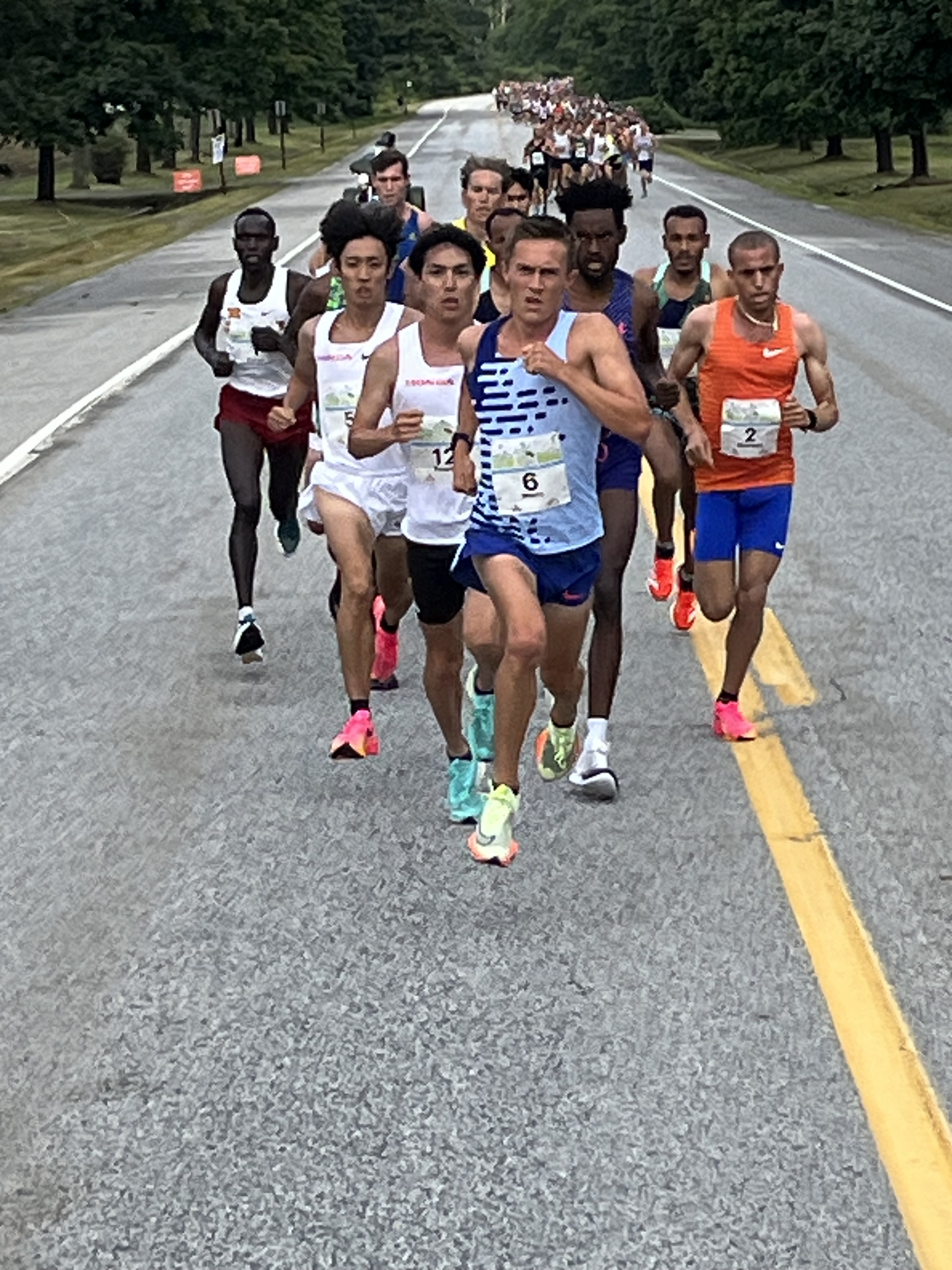
In all the races I’ve covered that featured Mr. Mantz, he has been a notable front runner. If that’s his style, then that’s his style and it would serve him well to retain it Saturday morning. Remember, nothing new on race day.
Yet since he already has the Olympic qualifying standard, does it make sense for him to take it out, and perhaps help others achieve that mark?
Several top contenders with international credentials in the field are now somewhat long in the tooth, i.e. Galen Rupp (37), Leonard Korir (37), and Sam Chelanga (38). But with debutant Paul Chelimo (33) entered, having a de facto pacer would allow the 2016 Olympic 5000m silver medalist to defer critical thinking until late in the race.
But will the veterans want someone with Chelimo’s finishing speed to be sitting in with a free ride till it suits him? It’s the ability to make critical decisions in times of stress that determines championships.
1976 marathon Olympian Bill Rodgers once said of racing the marathon, “you’re already going hard, and somebody makes a move. You might not want to go, but there is no two kilometers ahead. There’s only this, and this is for victory.“
But the quality of that move has to be determined, as well. Is it being done by a contender? Is it only a testing move? I’ve always said, when you need your wits about you the most, you have fewer of them at your disposal, because your body’s blood supply has shunted to your working muscles in the legs. And the brain, which normally takes up 20% of oxygen consumption, has less blood to make these decisions.
How many times have we been at the end of our tether in a race, looked down at our watch, and though we saw every one of those numbers, couldn’t quite compute them? That’s oxygen deprivation.
Racing means being on high alert in case somebody does something that may require an urgent response. Your mind, therefore, is engaged the entire way, at least partially. Which is enough to make a difference in this crucible. Plus, we can almost guarantee that something surprising will happen on race day.
Scientists once thought evolution followed a gradual progression until Niles Eldredge, an American biologist and paleontologist, along with Stephen Jay Gould, the Harvard-based paleontologist and evolutionary biologist, proposed the theory of punctuated equilibrium in 1972.
Distance running underwent an evolutionary (some would say revolutionary) leap at the 2016 Olympic Marathon Trials in Los Angeles. There, the silent introduction of what’s come to be known as Super Shoes, the carbon plated, energy-returning midsole foam devices that have rewritten the record books, were determinative, as those wearing the technology made the Rio team.
Eight years later in Orlando, there won’t be one contender not wearing a version of super shoes. In that sense, the field will be level for both men and women.
And though the marathon itself won’t present the same endurance challenge as it did at pre-super shoe trials, as always, the athletes will require maximum physical and mental acuity to determine the outcome. And that’s the way we’ve always wanted it. Good luck to one and all. Stride On!
END
 tonireavis.com
Toni, First I’ve heard the idea of pacers at the Trials. Interesting! …..Kevin McDermott
The men’s race is a farce …as Jon Gault wrote…
This does create a potentially awkward situation, however. Without Mantz and Young, the US would have zero guaranteed spots in the Olympic marathon. Yet if they finish outside of the top two on Sunday, the Olympic spots Mantz and Young unlocked will be used by other people.
This new provision preserves much of the drama of the Olympic Trials — the race in Orlando would be far less exciting if we knew Mantz and Young were on the team unless someone else broke 2:08:10. But it still strikes Eyestone as unfair to his athletes.
“I don’t know what the perfect solution is,” Eyestone says. “People are just running so darn fast, we just need to get more [Americans] running fast. But to just give away those fast times that people have earned to other people who do well on the Olympic Trials day in this situation doesn’t seem that fair, does it? When you have the two people who have run those times and recognizing that there’s a chance that somebody else is going to be benefiting from their hard work and their performance.
The world, or at least East Africa, has passed everyone by to the point where, with the IOC trying to limit the number of athletes at the Games, it’s becoming increasingly difficult for nations to get their athletes qualified. That’s why, in one sense, USATF should think about inserting pacers into the Olympic Trials in order to give the USA athletes the best chance possible to hit the difficult qualify standards.