
I received the following in my email yesterday.

Dear Antoni,
Do you want to have a say in the future of athletics?
We’re excited to invite you to be part of a special fan panel where your voice can make a real difference in our sport.
On Sunday 1 September, we’re testing some exciting and innovative possible new competition formats at the Fribourg Track Lab event in Switzerland – and we want to know what you think!
Here’s what we’re testing live:

Long jump take-off zone:
We’re testing out a switch from the traditional long jump board to a take-off zone, ensuring that every jump counts.

Pole vault true height / realised clearance:
The highest point an athlete clears, not the bar height, will determine the result. Each athlete gets 6 attempts.

The mile steeplechase:
A fresh, shorter twist on the classic steeplechase.
Will these innovations enhance fan and viewer excitement, or do you think they miss the mark? This is your opportunity to get directly involved in shaping the future of the sport you love. We won’t be implementing anything that doesn’t pass the test with our fans and athletes, so make sure to let us know your thoughts!/
FOLLOW-UP
After watching the Track Lab meet in Fribourg, Switzerland, the pole vault thing didn’t work at all. Setting the bar at 4 metes and then trying to determine who cleared the highest point over the bar didn’t pass the eyeball test.
Both the audience and the athletes needed the bar as a reference point. Plus, the mark they measured most times did not match up with what it looked like sitting on your couch. Besides, the pole vault isn’t one of the events that needs any changing, anyway.
The mile Steeplechase was kind of cool though.
And the long jump is easy to fix. After every jump, they always show us in slow motion where the athlete took off from, either before the board, on the board, or just past the board. And they show how many centimeters they were behind the board or in front of the board. Well, just add or subtract those numbers from the distance measured from the end of the board to the landing in the pit. There’s the real distance the athlete jumped./
But I do like that they tried something g new, just like the Mondo Duplantis vs Karsten Warholm 100 meter showdown in Zurich. Track needs exhibition events to showcase talents in new, interesting ways
Below is a column I wrote back in 2021 during the Tokyo Paralympic Games.
TAKING A MEASURE FROM THE PARALYMPICS
Today, 30 August 2021, marks the 30th anniversary of Mike Powell’s other-worldly long jump duel with Carl Lewis at the 1991 World Championships in Tokyo. In that competition, Lewis and Powell traded breaking Bob Beamon’s legendary 8.90m world record from the 1968 Mexico City Olympics, with Powell emerging as the victor by producing the still-standing world record of 8.95m on his fifth round leap, besting Lewis’s 8.91m wind-aided mark from the fourth round.
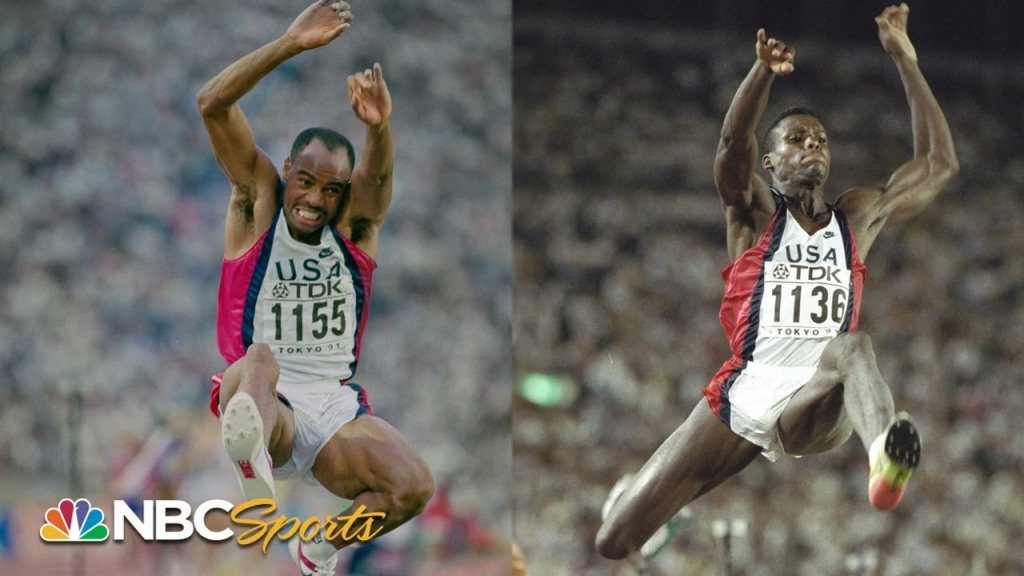
In light of this historic remembrance, I turned on the coverage from the Tokyo Paralympics this past weekend and watched the T11 long jump final for blind athletes. The lineup featured the USA’s now 5X silver medalist Lex Gillette. What I saw both intrigued me and made me wonder.
Due to the T11 athletes’ lack of sight, the rules governing their competition differ slightly from sighted competitions. Notably, the athletes had minders standing at the takeoff location clapping their hands and calling out repetitive phrases or words to give their jumpers an aural indication for their takeoff. But Paralympic rules also accommodated the athletes in another way.
Rather than having the blind athletes takeoff from behind a narrow board inserted on the runway, like in sighted competitions, T11 athletes were required to takeoff from within a wider, chalk-dusted area. Their jumps were then measured from their actual takeoff position, identified by the mark in the chalk, to their actual landing place in the sand pit. Their jumps were not measured from a one-location-fits-all board as in sighted jumping.
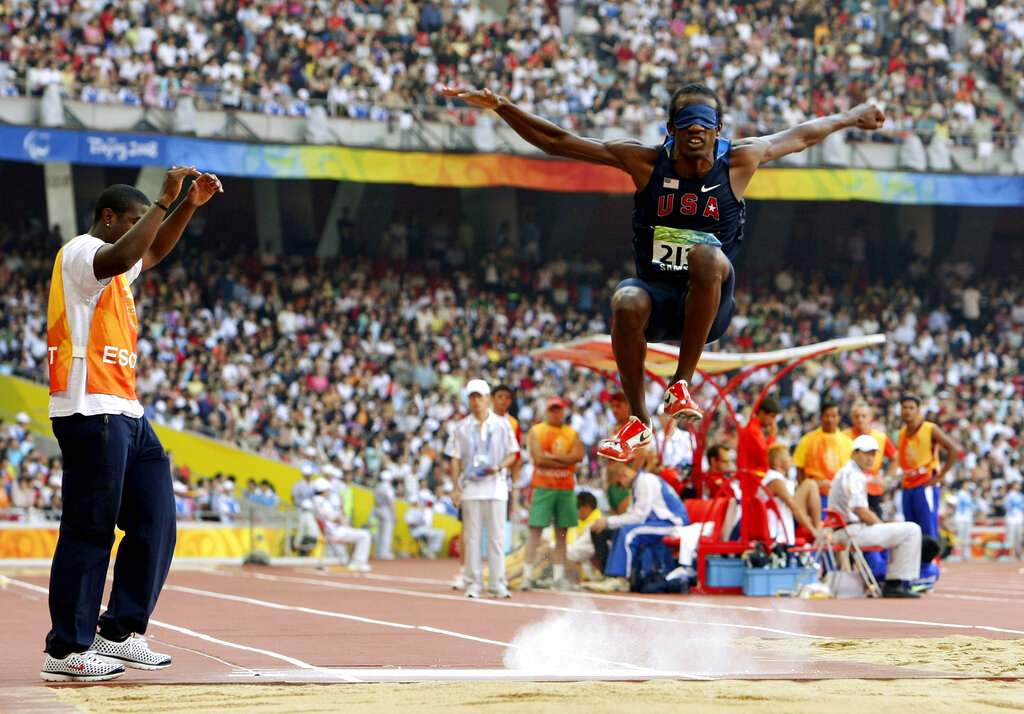
This chalked-area takeoff method allowed officials to measure the actual distance achieved while eliminating the often large distances sighted athletes miss out on due to how far behind the board they take off.
Until this pandemic cycle, the Olympic motto was Citius, Altius, Fortius, Latin for Faster, Higher, Stronger. This year in Tokyo, officials understandably added the word “Together”. But read to the original words again, faster, higher, stronger. It does not say, faster, higher, stronger “but only taking off from behind a narrow, arbitrarily designated board”.
Point being, what is the competition attempting to ascertain? If it’s who can jump the farthest, measure the damn jump from where the athletes actually take off, ala the Paralympic T11 competition.
This isn’t archery, an aiming contest, where hitting the target is the goal. It’s called the long jump and the triple jump. A wide, chalk-marked takeoff box would provide a jump-specific starting point and allow athletes to concentrate all their energy into flinging themselves as far as they could rather than dialing back to hit an arbitrary board.
Haven’t we all seen or wondered how many truly long jumps, whether in the long or triple jump, weren’t measured due to a close foul? Apocryphal or not, Carl Lewis was said to have jumped over 30 feet once on such a bare foul. And Mike Powell’s own fourth round jump in Tokyo ‘91 was a beast, but unmeasured due to a microscopic foul.
Similarly, for the high jump, if somebody wants to do a round-off and three back flips as an approach before launching off both feet in order to generate lift and height, have at it. Let’s see how high these gymnasts can fly. As long as they don’t insert a springboard under the runway, like gymnastics does in the floor exercise and women’s vault, who cares how they get up as long as it’s off their own power?
Today’s high jump is as much about who has the best technique as it is who can jump the highest. I remember the great Jackie Joyner-Kersee telling me how her coach/ husband Bobby used to say, “you have to jump 1.83m just to get over the bar at 1.80m because you have such flat flop technique.”
Athletes in 2021 don’t use the same tracks, spikes, implements, or timing devices that their predecessors did. As technology advances, the sport has always followed. They may be early adapters or late, but eventually officials accede to new technologies.
We have the capacity to actually measure the greatest long and triple jumps. Why don’t we? Is it another case where, “well, this is the way we’ve always done it?”
Perhaps the most salient argument is that World Athletics is already experimenting with the field event’s formatting this year by having the first five rounds determine the three finalists with the sixth round jump or throw deciding the podium positions, whether that jump or throw is the longest of the day.
It’s all just a game and entertainment, innit? Why not keep the experiment going? The Paralympics have shown you how to do it.
END
And here is another column that focused on the pole vault, written 3 September 2021:
MEASURING THE HEIGHT

As Olympic pole vault champion and world record holder Mondo Duplantis jack-knifed over the bar at 5.75m with room to spare during today’s Diamond League meet in Brussels, American TV announcer Paul Swangard said, “you often wish they would just measure the height he could have cleared.”
And I thought, well, why the hell don’t they?
From the poles they use, to the runway surface they run down, modern athletes have always utilized the newest technology. We have seen that progression as we’ve gone from dirt tracks to cinders to tartan to Mondo. And then, of course, there are the new super shoes.
We already have the capability in both the pole vault and the high jump to actually measure the greatest height reached by the athlete via laser technology.
The highest high jump in history may well not have been Javier Sotomayor’s 2.45m (8.03 ft.) from 1993. It could well have been a lesser bar height with a larger clearance. Same with the pole vault.
Not only would such measurements make for more interesting coverage, officials could use the technology as a tie-breaking mechanism if bar height clearance and count-back on misses didn’t create the divide like in Tokyo’s Olympic high jump.
Not to suggest this measurement be used as the primary criterion for determining competition places. Rather, use technology that does exist to illuminate the actual height attained while adding entertainment value for spectators and a method for ascertaining places in case the current tie-breaking mechanisms fail to decide the issue. As always, just asking or, in this case, agreeing.
END
I will watch with interest the possible new competition formats at the Fribourg Track Lab event in Switzerland on Sunday 1 September. What say you?
 tonireavis.com
All of these innovations are silly. The sport is great as it is.
Might as well let basketball players double dribble.
What’s the point of the bar in the high jump and pole vault if you measure height?
How about a backwards mile?
How about 125KG. 100m dash?
How about the standing long jump?
The 1 mile steeplechase would be interesting BUT it is unnecessary.
The race and jump innovations are silly and mask the real issues of terrible marketing of the existing product.
Our sport, and that includes road running, is NOT going to embraced by the youth. It skews older. Somehow being “dad” sport draws the antipathy of those responsible for it’s tepid leadership.
The recent Grand Slam reduction is another hallmark of ideologue gone astray.
Yes, Grand Slam Track failed. WHY?
GST supplicatted at the heels of a youthful, diverse, female audience that wasn’t there. Face it GST. Jamaica kickoff was dismal. The Jamaicans talk a big game but they only show up for School Champs. The recent DISMAL showing for Nationals was all you need to see.
I have been in European stadiums packed with OLDER 30+ year olds. Notice the Prefontaine crowds? They must average about 45+. ok… so lets go with that. Road Running audiences are also made up of OLDER people. (and it’s older men).
That is ok. WHY? Older people have all the money. Older people buy cars, insurance, new tires, stock options, homes, medical devices and all the other things that make the dow jones index a box score.
Marketing fixes start simple. For instance, track or road running is rarely on the news and that is because of the lack of mix zone and highlights coverage promoted by the federations. I have been involved on that side of the sport for years and it is always a struggle, not on the broadcasters side but on the FEDERATION side.
With the exception of Lord Coe, athletics is generally guided at the top by people who don’t know anything about the sport and often graft whatever expertise they accumulated within the confines of another sport onto our “Greatest of Sport”. It doesn’t work. There are other ways to market the sport. I have some idea. But this is not the place to discuss.
I get the desire to simply measure the effort, and it’s certainly appropriate for Paralympic events. Otherwise, I’ll take the answers from the origins of track and field, admittedly “the way we’ve always done it.” For the reason it was done in the first place. It was more serious back then, when the war references were the reality, not just sports cliches. Jumping across the crocodile infested moat, vault or jump over the castle walls, throw a spear or something at someone, sprint towards or away from danger, perhaps hurdling obstacles, run to deliver a message to the king, etc. had consequences. Nothing arbitrary there, with meaningful physical barriers or other constraints that defines the event. Whittling down the number of finalists was called attrition 🙂 Technological advances have always played a role in war, but I’ll admit I still want some limitations: wind speed limits for records, no spring-loaded shoes, no use of catapults or other such devices, and no PEDs. Oops, the latter still muddies the waters, with claims against vitamins, aspirin, etc. But backflips and round offs, heck yes, bring on Simone! And if it’s simply viewed as entertainment, let’s put crocs in the moat, razor wire on the castle walls, etc. Athletes won’t hold back for a more important meet, or train through, and ratings will certainly be stronger!
Rico