

As we continue to stand in awe (or doubt) of Ruth Chepngetich’s spanking new women’s marathon world record in Chicago a week ago Sunday (2:09:56), people have asked for a similar deep dive into the men’s marathon that I did for the women earlier in the week – WHAT THE NUMBERS SAY (ABOUT WOMEN’S MARATHOING)
To date, there have been 168 sub – 2:20 women’s marathons, going back to Naoko Takahashi in Berlin 2001. In round numbers, the closest approximation to a woman’s sub-2:20 on the men’s side is sub-2:05, with 197 on the World Athletics database list. That number comports, to a degree, with the time scale of sub-2:20, as well. Kenyan great Paul Tergat ran the first sub-2:05 marathon on September 28, 2003, in Berlin at 2:04:55, two years after Takahashi’s 2:19:46 on the same course.
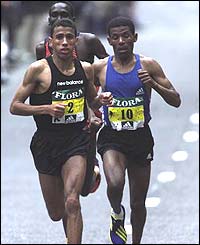
Tergat’s mark bettered that of Moroccan-born American Khalid Khannouchi, whose second world record came at the 2002 London Marathon. In that historic race, Khannouchi broke his own world record from Chicago 1999 by four seconds setting the mark at 2:05:38. Paul Tergat took second just 10 seconds behind, and debutante Haile Gebrselassie of Ethiopia, finished third in 2:06:35, a debut record at the time.
It’s one of the few times, if ever, when back-to-back-to-back marathon world record holders met in a single race and finished 1-2-3 in such close order. London 2002 remains near the top of any list of the greatest marathons ever.
Today, Khannouchi’s 2:05:38 on London ‘02 is no better than equal-344th best on the all-time list. The 100th best, 2:04:27, is 3:52 over the world record of 2:00:35. For women, the 100th best time, 2:18:54, is 8:58 slower than Chepngetich’s new 2:09:56 mark.
Even the previous women’s record, 2:11:53, is 7:01 better than No. 100. Once again, we can see how the depth of men’s running is far greater than that of women’s.
Besides any biomechanical or bioenergetic differences that may exist between males and females – I’m no expert there – I believe two factors can be identified as explaining the gaps we see in women’s running versus men’s.
The first factor is the relatively short time women have been competing at the distance compared to men. As any engineer can attest, the broader the base, the higher the peak. The raw number of performances by women is reflected in the big jumps still being made in the world record.
The first sub-3:00 women’s marathon wasn’t run until 19 September 1971 (by Beth Bonner in NYC, 2:55:12). By then, the men’s world record stood at 2:08:34, run by Aussie great, Derek Clayton in Antwerp on 30 May 1969, a record that would last 12 years, surviving the entire onslaught of the famed 1970s running boom.

To find any significant jump in the men’s record, we have to go back to Derek Clayton’s previous record, 2:09:37, history’s first sub-2:10 in Fukuoka, Japan in December 1967.
Two and a half years before Clayton‘s 2:09:37, Japan’s Morio Shigematsu won the 1965 Polytechnic Marathon in London on a point-to-point course in 2:12:00. Clayton’s record jumped that by 2:23.
Interestingly, another 2:23 margin in the world record took place at the 1958 European Athletics Championships in Stockholm when Sergei Popov of the Soviet Union won the race in a new world record, 2:15:17, chopping 2:23 off Jim Peters previous record from the Polytechnic Marathon in June 1954 where he ran 2:17:40.
On June 14, 1952, again at the famous Polytechnic Marathon, which ran from 1909 to 1996 and boasted 8 world records, we finally find a men’s performance that matches today’s women in order of time gap magnitude.
Jim Peters’ 2:20:43 world record that day, the first of four WRs he ran between 1952 and 1954, bettered the 2:25:39 set by Suh Yun-bok of Korea in Boston 1947. Peter’s mark was an improvement in the world record of 4:56.
But really, that isn’t comparing apples to apples. There were not that many marathons being run in the first 3/4 of the 20th century. Nor were there that many practitioners of the art.
The fact that the world record for men has been so closely shaved throughout history testifies to the depth on the men’s side of the ledger. Women simply haven’t had the same opportunities, and we see it reflected in their uneven progression.
Pioneers like Tegla Loroupe and Catherine Ndereba in Kenya, and Derartu Tulu and Fatuma Roba in Ethiopia, have laid the foundation for increased opportunities for girls. But it does take time.
Other than England’s Paula Radcliffe, at Nos. 7, 29, and 39, we have to go down to the 69th best time in history, 2:18:29 by American Emily Sisson in Chicago 2022, to find the first non-East African born female on the all-time marathon list.
The top non-East African born time on the men’s side, 2:03:47, was run by Morhad Amdouni of France taking second in Seville, Spain, in February 2024. The next best time lies all the way down at No. 133, by Moroccan-born El Hassan El-Abbassi, who ran 2:04:43 finishing second in Valencia 2018.
Every other time is either Kenyan or Ethiopian born, with a few Tanzanians, Eritreans, Ugandans, and Moroccans thrown it in for spice. That’s how dominant East African athletes have been in this sport.
I compared the last five women’s world record holders to try to understand how the sport has changed over time. Doing the same for men, we see the following:
Due to the untimely death of current marathon world record holder, Kelvin Kiptum, in February 2024, we can only speculate what he might have done next. So, let’s go with the last five record holders before him.

Prior to Kiptum, we had the GOAT, Eliud Kipchoge of Kenya, who dominated the marathon for more than a decade in a manner unmatched in history. The great man is not quite finished with two world records and two Olympic titles.
Before he moved up to the marathon, Eliud was a successful track runner. A world champion over 5000m in Paris 2003 at age 19, he also won the bronze medal one year later in Athens in the Olympic 5000m final, then won the silver medal in Beijing four years later. He also won the junior world cross country championships in 2003. But he really found his stride at the longer distance.
Before Kipchoge ran his first world record in Berlin in 2018, 2:01:39, his countryman Dennis Kimetto held the mark for four years at 2:02:57 from Berlin 2014.

Kimetto came out of Boston and New York City Marathon record holder Geoffrey Mutai’s training group and had no experience whatsoever on the track or cross-country. He made his first major mark winning the half marathon race at the Nairobi Marathon 2011 where he ran 61:30. Then he defeated Wilson Kipsang at the RAK Half Marathon in 60:40. He made his marathon debut in Berlin 2012, pacing for, then finishing one step behind, his training partner Geoffrey Mutai, while producing a debut record of 2:04:16.
Many people believed Kimetto could well have won that race, but allowed Mutai the honor as Mutai was also in line for the World Marathon Majors $500,000 prize with a victory that day.
Kimetto’s career arc resembled a shooting star, rising rapidly before plunging just as fast. Injuries plagued him for the rest of his career following his 2:03:45 course record in Chicago 2013.

Kimetto took the world record from Wilson Kipsang, the long-legged strider from the Keiyo District in Kenya.
Kipsang competed predominantly on the roads (10k, 10mi, half-marathon) from 2007 before moving up to the marathon in Frankfurt 2010. There, he won his debut in 2:04:57. Two years later in London, he won the bronze medal in the Olympic Marathon. His world record cane in Berlin 2013 at 2:03:23, where he scraped 15 seconds off the record set by Patrick Makau in Berlin 2011.
Makau was another pure half-marathoner who moved successfully to the marathon. Twice a silver medalist in the World Half Marathon Championships in 2007 Udine and 2008 Rio de Janeiro, Makau’s marathon world record, 2:03:38, bested that of Ethiopian superstar Haile Gebrselassie, who produced history’s first sub-2:04, with his 2:03:59 win in Berlin 2008. That bettered his previous record from Berlin ‘07 by 27 seconds.
Berlin was the site of every man’s world record between September 28, 2003 and October 7, 2023, the day before Kelvin Kiptum ran 2:00:35 in Chicago.
Our last two featured record holders are Haile G. and his great Kenyan rival Paul Tergat, who set his own marathon world record in Berlin 2003 at 2:04:55 history’s first sub 2:05.
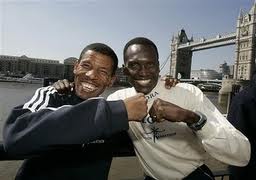
In both Haile and Paul, we have the last of the great track runners moving up in distance once their speed on the track had diminished. Both men held world records in the 5000m and 10,000m on the track and staged epic 10,000m duels in the Atlanta 1996 and Sydney 2000 Olympics, with Haile edging Paul by the barest margins in each to win gold.
It’s safe to say they did not run their maximum capabilities in the marathon when they had their top end speed still in their legs. But that is how the game has changed in recent years. With the Diamond League track circuit eliminating the 10,000m, and the real money in the sport coming at the marathon distance, that event has become the biggest attraction for runners beginning at a very early age.
It does seem just a matter of time before the two-hour barrier is broken. Kelvin Kiptum came very close in Chicago 2023 and might well have already gone under had he lived.
Sub-2 is no longer a psychological barrier, either, after Kipchoge ran 1:59:40 at the Ineos 1:59 Challenge in Vienna on 12 October 2019.
But to expect huge chunks to come off the men’s marathon world record is to ignore the last 70 years of results. Even with the new super-shoe technology that has been out since 2016, and more widely in use since 2019, the men’s world record has only improved in modest increments. So, unless we’re due for some new version of punctuated equilibrium in shoe design or nutritional support…but you never know. Onward!
END
 tonireavis.com
I really enjoyed reading this insightful post. Daniel Dantas
Great piece, as always Toni. I appreciate how you paint in the contextual and historical details around the asymptotic progression of the WR on the men’s side vs the steep, almost sharp progression on the women’s side. It was also cool to hear some of your past reporting and a quote from Amby Burfoot mentioned on “The Real Science of Sport Podcast” at the end of their analysis of Ruth Chepngetich’s incredible new record. It was a great episode and aligns with much of your commentary in your latest two posts.
Of course, you are correct. I have made the correction. Many thanks for the quick eye.
Toni
Dear Sir,
I was a bit puzzled by the following statements: ” We have to go all the way down to the 69th best time in history, 2:18:29 by American Emily Sisson in Chicago 2022, to find the first non-East African born female on the all-time marathon list.” Radcliffe is also non-East African and she would rank much higher than Emily Sisson.
Thanks, -Ming