
On April 21, 1975, I was among tens of thousands standing along the Boston Marathon finish line as a local runner, Billy Rodgers, charged down Ring Road in a grey, hand-stenciled tee shirt, clasping his white, painter’s gloves, about to claim the first of his four Boston Marathon titles. No American had won the great race since Bill’s old Wesleyan roommate, Amby Burfoot, wore the olive wreath crown in 1968. And Amby’s win was the first since his mentor, Johnny Kelley ‘The Younger’, came home victorious in 1957.
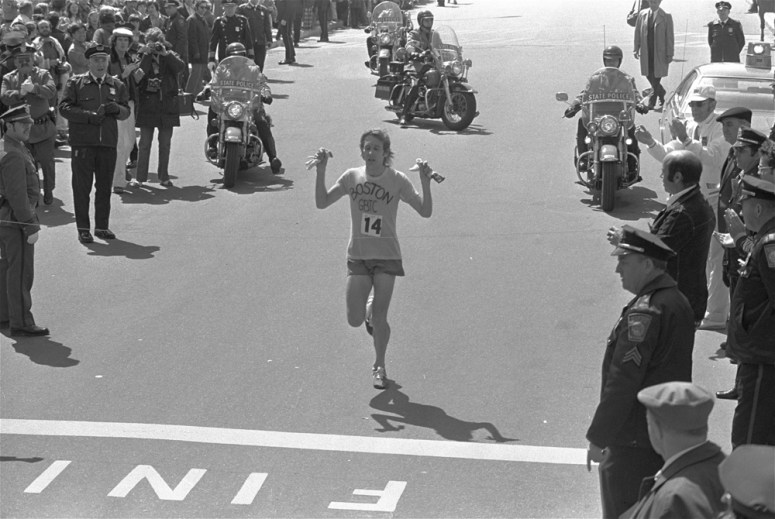
Seeing not just an American, but a local kid, crossing in first place again after so many foreign champions, roused the crowd into a state of tumult. That Bill was setting a course and American record in the process made the moment even more grand.
*
If Frank Shorter‘s gold medal victory in the 1972 Munich Olympic Marathon launched the Running Boom, then Rodgers’ win in the 79th Boston Marathon ignited the second-stage booster rocket. With that victory, while breaking Shorter’s 2:10:30 American record, Bill announced himself as a legitimate rival to running’s reigning king. The next three years would see their rivalry spark an even greater fervor in the expansion of distance running across the nation.
Watching My Own Future Come into View
Boston 1975 was the first marathon I had ever seen live. What an impression it made. All I could think at the time was, “Boy, there’s nothing like this back in St. Louis!” Which is where I had moved from the year before to make Boston my home.
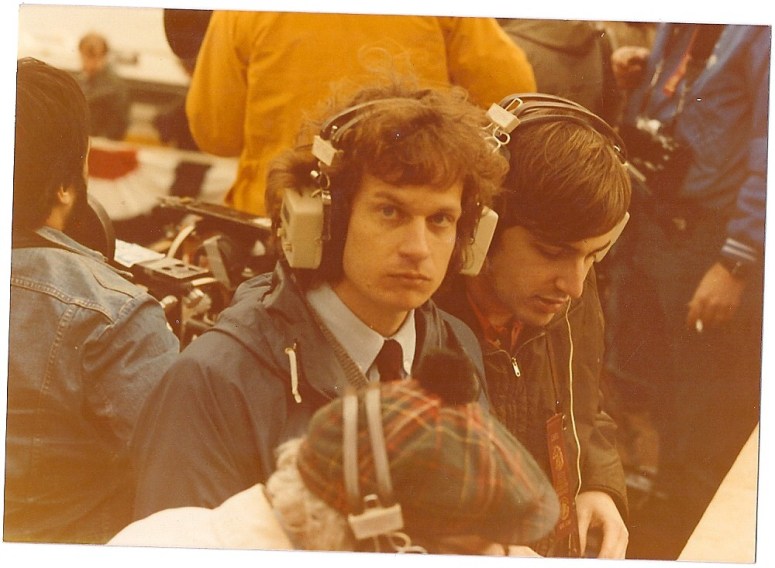
So great was the impression that not two years later, I covered the first of what turned out to be 45 straight Boston Marathons as a reporter and broadcaster.
In that 1977 Patriots’ Day race, Bill dropped out on Heartbreak Hill, falling victim to the heat of the day and the pace of Canadian champion Jerome Drayton, the man he had out-dueled two years earlier.
*
Today, that Boston finish line on Ring Road, once a distant dream, is now a hallowed memory. In 1986, with John Hancock Financial Services as the new event sponsor, the BAA moved the finish line off Prudential property, and onto Boylston Street, between Exeter and Dartmouth Street, next to the 1972 Brutalist-designed addition to the Boston Public Library (PBL).
The World Spins On
I’m old enough to remember 1975 as the future. So, it’s hard not to feel a sense of nostalgia, or even for a lump to form in one’s throat. It always lands tenderly, right at the emotional soft spot, imagining all that time having passed and all the life that’s been lived. Oh, how our world has changed since then. Some, for the better, but much that is not.
On February 11th, 1975, Margaret Thatcher defeated Edward Heath for leadership of the opposition Conservative Party in the UK. At age 49, Thatcher became the first female leader of any British political party. Four years later, on 4 May 1979—just two weeks after Bill Rodgers set his second course record in Boston at 2:09:27—Thatcher took office as the first woman Prime Minister.
Two weeks prior to the 1975 Marathon, Bill Gates and Paul Allen founded Microsoft in Albuquerque, New Mexico. Then, three days before the marathon, the Khmer Rouge, under orders from its leader, Pol Pot, began a forcible mass evacuation of Phnom Penh, beginning the Cambodian genocide that killed three million people over the next several years.
It’s hard to reconcile those three tangential occurrences with the Boston Marathon, which, in its way, feels timeless. But even as thousands churn through Hopkinton’s start line each April, the world beyond continues spinning, always running its own uncertain race.
Advice From A Master – Old Kel Remembers
Looking back from today, 50 years seems like ages ago. Yet it doesn’t differ from John A. ‘The Elder’ Kelley, no relation to the other Johnny Kelley, looking back from 1978 to his first Boston Marathon attempt in 1928.

Kelley wins in 1935
It’s strange, imagining a septuagenarian reflecting on 50 years of his own past, then waking up and being the septuagenarian looking back 50 years to his own youth.
A Learning Experience
Among the world’s great marathons, Boston is recognized as among the trickiest to get right, especially for debutants. Just as 1957 Boston champion, John J. ‘The Younger’ Kelley, in 1949, and four-time champion Bill Rodgers, in 1973, Old Kel didn’t finish his first attempt in Boston 1928, either.
As I stood with my cassette recorder in hand, interviewing Johnny Kelley before the 1978 Marathon for my Runners’ Digest radio show, he wove stories of tactics, hopes, fears, and competitors into a tapestry threaded with both triumph and loss. To this day, Johnny Kelley’s memories hold sage advice for today’s runners.
“To me, it’s a strange fascination,” said Johnny. “It’s a labor of love. 1928 was my first year at Boston. I dropped out at 21 miles and then I let four years go by and didn’t run again until 1932.
“As you stand at the starting line you think about: did I do enough long, long distance training? Will my shoes hold up? How about that injury that healed up a month ago? Will that come back on me? Did I eat too much for breakfast? Will it be too warm? Will I get enough water on the course? I wonder how I will feel the last 5 miles. But when they fire the gun, all those anxious moments disappear. You either do or you don’t.
Knowing The Route
“On the Boston Marathon course, the first 5 miles and the last 5 miles are all downhill. As marathon courses go, it’s not as tough as some of the others.
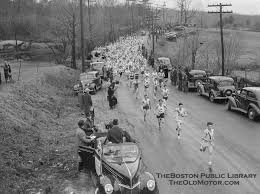
“The effort is so great, and the reward is so small, anything can happen in this 26-mile race. The distance is so great, you’ve got to run a pace from the very beginning that you know you can maintain to the very end. But a big factor is the weather. If it’s unreasonably warm, it’ll knock you out! You can pass a lot of men in the last 5 miles if you hold your patience.
Tactics
“I would stay within striking distance of the leaders, say 100 yards, until I got to Natick Square at 10 miles. Then I’d begin to force the issue. And I’d think to myself, I hope the good Lord lets me finish it again.
“During the course of the race, you feel pretty weary. But then sometimes that tired feeling goes away. But when thousands and thousands of people are cheering for you and you’ve trained faithfully for 12 months. And you’ve done your long work every two weeks, you feel you can do 20 miles, anyway.
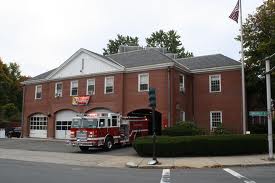
“When I get to the 17-mile mark and start to go up over those hills in Auburndale, that’s when it gets pretty rough. I’m always glad to get over those hills and see Lake Street.
“But there’s one part of the course, from Lake Street to Cleveland Circle (21-22 mi.), that I called the Haunted Mile. There’s something about that particular section that I dread. I always have.
“Once I hit Cleveland Circle, it is four miles to the finish and I’m awfully glad to see Cleveland Circle.
“Coming along through Coolidge Corner at 24 miles, the motorists are still sitting in their cars waiting for me and they blow their horns and make a terrific din. The crowd pulls you through the final three or four miles. I’m associated with the Boston Marathon for so many years that it’s a tradition to watch for Old Kel.
First win in 1935
“I ran the race in 1932 for the second time. And I was with the leaders at Wellesley when I dropped out with blistered feet. The following year I was ill with the flu and finished in 37th place in 3:03:56. But at least I finished. The next year, I was a surprise second to Dave Komonen of Canada in 2:36:50.
“And the next year, I was getting ripe like an apple on a tree, and I won 2:32:07. I was 27 years of age, and at my physical peak. But it took me 10 years to win again!
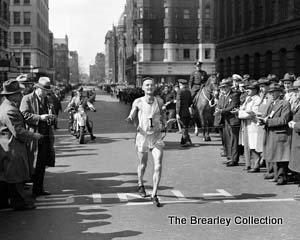
“My best memory, I would say, would be my second victory that came 10 years later. Seven times in second place through that period of time. I wanted that victory so bad. I finally got it in 1945 after waiting 10 years to get it.”
2025 Grand Marshals
This year, the BAA celebrates the 50th anniversary of Bill Rodgers’ first of four Boston wins. And also the debut of wheelchair racing when Bob Hall managed to push his slightly modified Everest & Jennings everyday wheelchair over the distance in 2:58. By doing so, he won the wager he made with Race Director Will Cloney that if he could push the course in under three hours, he would receive a finisher’s certificate. Thus was a new division created, hard on the heels of an official women’s division in 1972. Bob and Bill will serve as grand marshals for this year‘s race. Couldn’t think of two better candidates.
It will be with the tinge of sadness that I watch the proceedings on April 21st from out in California. But my heart will be in Boston wishing all those running or watching their first Boston Marathon the best good fortune. Just imagine what your world will look like in 2075. Hope we haven’t screwed it up for you too much. It will be in your care from here on.
END
 tonireavis.com
Hey Toni! I returned to the mayhem that is Marathon Monday this year. I was working a photo booth inside the Westin so a bit removed from the chaos:) Were you there? I will have to seek you out someday! So many memories:)
remember my dad taking us into the marathon every spring, as teenagers took the T into town and tried to get as close to the finish line as possible. Hearing Toni’s voice as Rodger’s come down ring road was special for my generation. Boston is not just a race it is a celebration of tradition and everything good about running. I now live in Arizona but still look forward to marathon weekend.
Toni, we will miss your voice and knowledge and overall wonderful coverage of Boston today. Mike
Thanks, Mike. Just brutal coverage. From all the evidence on the screen, it’s no longer seen as a sporting event. It’s more of a civic/charity fundraising extravaganza. Almost glad I wouldn’t have to sit there and bite my tongue for 3 hours. Best ahead
Toni
Why aren’t you here, Toni? Will it really be Boston without you?
I was also at that finish line in 1975. I was working at Polaroid Corp. across the river in Cambridge when a coworker asked me to join him to watch the finish…he a runner and I not.
After seeing that finish by Bill I decided to start running the next day. I ran my first of 9 Boston’s in 1980. I still run to this day at age 73 thanks to seeing Bill Rodgers run down that road.
That’s a great story. Heroes make a difference. Onward!
Toni
Thanks again Toni. On this, the eve of yet another Boston, I was trying to get further psyched up for what lay ahead in almost exactly 12 hours and this missive did exactly that.