
HONOLULU, HI—As thousands of runners came across the finish line at Kapiolani Park at the 53rd JAL Honolulu Marathon, I sat with Dr. Jim Barahal, longtime President of the Honolulu Marathon Association, to speak about his event, the sport, and what’s ahead for this iconic race.
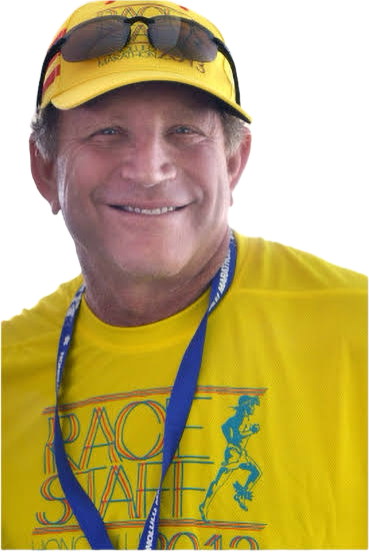
Toni: Talk about the weekend numbers. There are entrants, starters, and finishers. But that’s just in the main event.
These days there are more than the one event through the weekend, and you’re saying the way to really judge an event is not by its signature event anymore?
Jim Barahal: It depends, you know, what you’re judging it on. So when we look at the old the statistics, there’s the number of marathon finishers. But that was from the other running boom.
These were the really competitive guys in the marathon. You know, that world is over.
That world is long gone. Honestly, this is a new world.
And, you know, the world marathon majors are getting 50 to 60,000 runners. But even they have other events on the weekend. So if you’re judging it on—lots of good things happen when you turn over a city to runners, the economic benefit being the biggest.
“But there are a lot of problems too: Roads are closed, people are inconvenienced, lots of ambulances, lots of city personnel tied up.
So, you know, it’s a cost benefit. And the benefit, besides the fact that it’s a healthy event—and maybe people started having better lifestyles—economically it’s a huge thing.
“So if someone comes out to Honolulu or wherever, and does a 5K or 10K, or even in our case a mile, the economic impact’s the same as in the marathon.
They’re on an airplane, they’re renting a hotel room, they’re eating meals, maybe renting a car. It’s exactly the same no matter which event they compete in. So really, when we look at that, we think we’ve moved into the top 3 or 4 events in the country with nearly 43,000 entrants through our three events. I mean, we’re happy to be judged on our marathon finishers, but that’s not really the whole story here.”
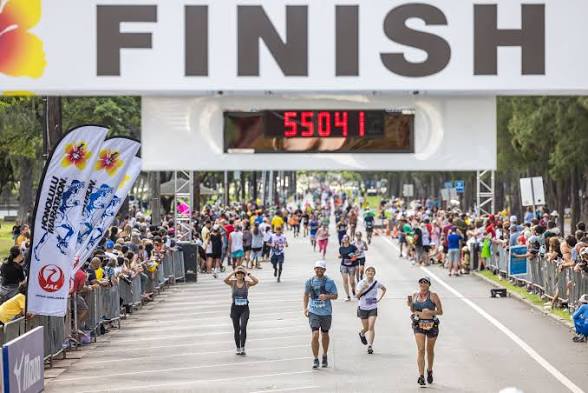
Toni: Now talk about how you have to be careful about staging three events. Because, like we said earlier, in the old world, only Cleveland put on a top-class marathon and top-class 10K on the same day. But over time, the 10K started cannibalizing the marathon until the 10K became the larger event. So you have a mile on Saturday, then you have a 10K on Sunday along with your marathon.
How do you protect your marathon from people choosing the easier distance?
Jim: Well, we talked about this a few years ago, Toni. When we started the Hapalua Half Marathon people asked why we made it a standalone half marathon in the spring as opposed to putting the half inside the marathon in December. Other events do that to increase the number of people on marathon weekend.
We decided to take the plunge and put the Hapalua on as a standalone event in April because we knew at least in those days, when the marathoning wasn’t like it is today, that we’d cannibalize our own marathon if we tied it into the longer race. And we didn’t want to do that.
“One of the reasons a lot of races do fold in a second event is because the incremental costs are very minimal. Your biggest costs are blocking the roads, barricading, police, medical. Many of your costs are fixed. So if you drop a half marathon inside the marathon, you know, you can get a lot of extra revenue without having to spend a whole lot of extra money.
So when we started the Hapalua 14 years ago, that cost us a lot of money to launch. Now it’s a standalone huge event. But we knew that that a half would cannibalize our marathon. So when we looked at adding an event for the marathon, we realized that our starting line and our finish line were literally 10 K apart. So we decided to drop a 10K inside the marathon, but to make it non-competitive.
We would time it and give you a medal and a tee shirt because we want it to be something on its own. But there’s no age group, there’s no awards, and it’s not a wheel-measured course. We’re doing everything we can to keep it fun so that it does not cannibalize the marathon. In fact, it adds to the marathon, and a number of those people will go on to run a marathon, but that’s not the purpose either. We’re not trying to start you out on like marijuana thinking you’re going to move up, you know, taking more serious drugs. We think a 10 K is its own thing, and it’s fun and it’s healthy and it stands on its own.
Toni: And the road mile on Saturday?

Jim: The Kalakaua Merrie Mile allows us to have an event with greater prestige than our marathon can achieve because of the course, the weather, and the time of year. We can’t be a World Marathon Major, but our mile can be one of the greatest road miles in the world.
“Another thing we did with the mile, but also the 10K, is we know that people travel from other places (66% of Honolulu’s entrants come from outside the state). They bring people with them. And, you know, in the last number of years, people are interested in an active tourism. It’s become a much bigger thing. People don’t necessarily just want to sit on a beach. It’s not a sedentary thing anymore. People want to engage in activities. And so the objective on that was that the people came with somebody running the marathon, particularly from Japan, that we would give them an opportunity, whether this was a spouse, a child, a grandmother, somebody who’s coming to cheer the marathoner and give them a chance to do something active, to get out on the road and really feel like they’re part of the thing and not be a spectator. We’re not trying to create a spectator sport here. We’re trying to create an active lifestyle participant sport, which we know is a good thing and will connect people to the event and to the experience. It’s better to have your own experience and then relate to your partner who’s maybe doing the marathon. So that’s what this is about.
Again, our mile and 10K are not gateway drugs. We’re not trying to say, you know, you’re going to start with a mile and then do a marathon.
No, you’re going to do the mile because it’s really fun and you’re going to be part of an amazing event and you’re going to have a memory for life.
Toni: Well, you know how it was when we all began. You didn’t want to be embarrassed by finishing last.
So there’s a certain ethic. You have to encourage people to come, and the way you present them allows them to go in there and not feel that potential embarrassment of being looking like,”Oh, I’m too slow.”
Jim: Right. And again, with the mile, it’s a serious race. Sinclaire Johnson just broke the American record in our mile.
I don’t know much more serious you can get. But again, we time everybody and we give everybody a medal and a shirt, but we don’t have age-group awards.
And so it’s exactly what you said, Toni. How do you straddle that line between serious competition and fun run? How do you invite people to come run, but not have them feel embarrassed or inadequate or feel that they failed in some way?
Yet at the same time, legitimize it enough as an accomplishment? And I think that’s how we do it. Just like the marathon, you know where you stand against the best, literally, an American record.
“So if you took 43 minutes to do the mile, instead of saying, ‘I can’t believe
I took that much time’, you’re saying, ‘it took me 43 minutes and this woman just ran 4 minutes 21 seconds. That is unbelievable.’
“So, yeah, it’s our way of saying, “this is just for fun. There’s a clock at the finish, but we don’t officially time the people’s race. We don’t make it serious in that way.
“So, it’s almost inverted. I mean, we load this thing up as an experience, but then we don’t put performance pressure on the majority of the entrants. We’re giving out 3,200 bottles of fresh pineapple juice. We give about 3,200 very healthy ice cream bars. I mean, we’re paying for this, and for the marathon, we’re cooking 40,000 malasadas. So we’re doing a lot of things that makes people know this is a big event. This is not the kind of event you’re ever going to experience anywhere else. Certainly not in Hawaii. Yet we’re calling it for fun.
“It’s serious for people who want to take it seriously, but at least in terms of the experience, you’re going to have a wonderful time no matter your speed. So this is going to be an experience that you’re never going to forget. But there’s no failure.
We want people to go home and say, “That was great. You gotta go do that.”
Toni: You develop a word-of-mouth marketing. But if you got 36,000 total last year, now near 43,000 this year, is there any reason not to think it’s going to go up from there?
Jim: No, I think as long as the trend we’re seeing, which is with the young people coming into the sport. I mean, sure, there can be fads, but our new running boom seems real. Our baby boomer running boom lasted, I don’t know, 15 years? Yeah, I mean, essentially, 1975 through 1990, maybe?
Toni: Yeah, yeah. as a generational spin.
Until we started falling apart.
Jim: You know, we were probably too serious. I mean, even like really, really good local level runners, we trained too much, tried to run too fast. I think it’s healthier now, and we know that it’s really not performance driven.
But I do think that everybody’s performing to the best of their ability on that day. I’ve never heard someone say, “You know, I’m just going to go out there and dog it.”
You know, once you go anaerobic, everybody’s in the same boat.
Toni: I found my last semester’s tuition slip from Washington University in St. Louis from 1973. $1,250 bucks. That same semester is now $30 -$35,000. When I moved to Boston in ‘74, the four of us had a two-bedroom apartment, and we paid $160, $40 each. You go to Zillow, the same apartment is $2,200. So kids come out of college enormously burdened with debt from school, and then it costs a fortune to live in major cities. They’re competing at such a high level on a day-to-day basis just to live. They don’t have the inclination to go train 70 or 80 miles a week to see how fast they can run 10K or a marathon. So it’s a different environment.
Running for them is a decompression chamber, not a competitive arena.
And also, they can meet people. GenZ grew up in a digital world. So they are looking for face-to-face connections.
Jim: But interestingly, it’s more performance driven than I would have thought.
I think one thing that I see that is very different is, the whole Lydiard system and the whole mega-mileage trend. That was not a good idea. The reality is there’s much more sophisticated training programs out there now, there’s much better cross training. The shoes are so much better.
The, uh, you know, the cross training, the massage, the yoga.
So the reality is people are starting to go fast again, but they’re not doing it like we did.
You know, the gospel back in the 70s was the more the better. Now it’s the smarter, the better.
Toni: It’s no longer eyeballs out, right?
Jim: And the nutrition is amazing, too.
Toni: Yeah, like the malasadas here. All right. Another great year in Honolulu. Thanks. And congratulations.
END
 tonireavis.com
Good interview guys, but i have long questioned the need to bring in invited runners. Very few people are aware of them and do not buy tickets to see them. I see no reason why anyone in the field would stay home if a local runner win the race with a time of 2;25; to 2;30. It would encourage local runner to get out there and trains harder and more often, returning it to sport status for them. They are not movitated to do optimum training now as they know professional runners are invited and they know they can’t win against these professionals. Thus, they don’t even make an attempt. I realize that the lack of newspaper coverage may be a factor While i covered races for the Advertiser between 1979, i’m pretty getting newspaper coverage3 elevated the race to a sport and runners with the ability trained harder. if the race was won my local runnin in 2;25, i DON’T THINK IT WOULD DETRACT FROM THE STATUS OF THE RACE OR AFFECT PARTIICIPATION IF OTHER RUNNERS KNEW THAT A SUB 2:30 WAS MORE LIKLEY TO WIN THE RACE THAN A 2:15. lOCAL RUNNERS HAVE FAMILIIES AND JOB TO CONFLICT WITH TRAINING AND KNOW THEY CAN’T COMPETE WITH GUYS WHO DO NOTHING ELSE BUT RUN.