
America’s Ilia Malinin stepped onto Olympic ice in Milan carrying not just a five-point lead after his win in the short program, but a sense of inevitability. At just 21, the Virginia native and two-time world champion had redefined the technical ceiling of men’s figure skating—stacking quadruple jumps like Vegas chips, seven landed clean in one free skate earlier in the season, point totals that made bookmakers fearless.
So when his chief rival, Japan’s Yuma Kagiyama, skated an uncharacteristically poor performance just before him, Malinin stood poised to join Scott Hamilton, Brian Boitano, and Nathan Chen as iconic American Olympic men’s figure skating champions. Then the weight of expectation joined him at center ice.
His first quad opened into a double. No worries…Refocus. Next, the highly anticipated quad axel “popped” into a single, and suddenly the mental dam that is an athlete’s protection began to disintegrate.
A fall followed in a discipline where rotations are counted in fractions and under-rotation is punished with forensic precision. Figure skating’s scoring system compounds error.
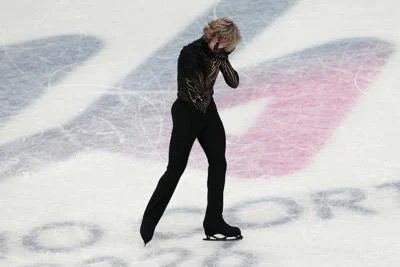
(Toronto Star)
By the end of the free skate, the crowd sat in hushed silence. Ilia’s gloved hands covered his face as much in shock as the audience. He had free-fallen from inevitability to an inexplicable eighth-place finish, scoring the worst free skate in his remarkable career.
Malinin’s burden was, in some ways, made greater by the poor performances skated before him. Except for Mikhail Shaidorov of Kazakhstan, the eventual gold medalist, none of the medal favorites put pressure on Malinin.
He didn’t need to be the “Quad God” to win gold. But without the pressure of immediate need, the overall Olympic pressure became even greater. With his guard down, the gremlins took over.
It was, more precisely, the cost of living up to the hype.
Living With the Monster
Malinin’s meltdown reminded me of something my father observed about pressure on young people. In 2009, a year before he passed at age 98, my father considered his own time as a young man growing up in middle America in the 1920s and ’30s and compared it to the lives of youngsters he saw in the 2000s.
His conclusion: 21st-century Millennials at age 12 were already more worldly than his 20th-century Greatest Generation was at age 25.
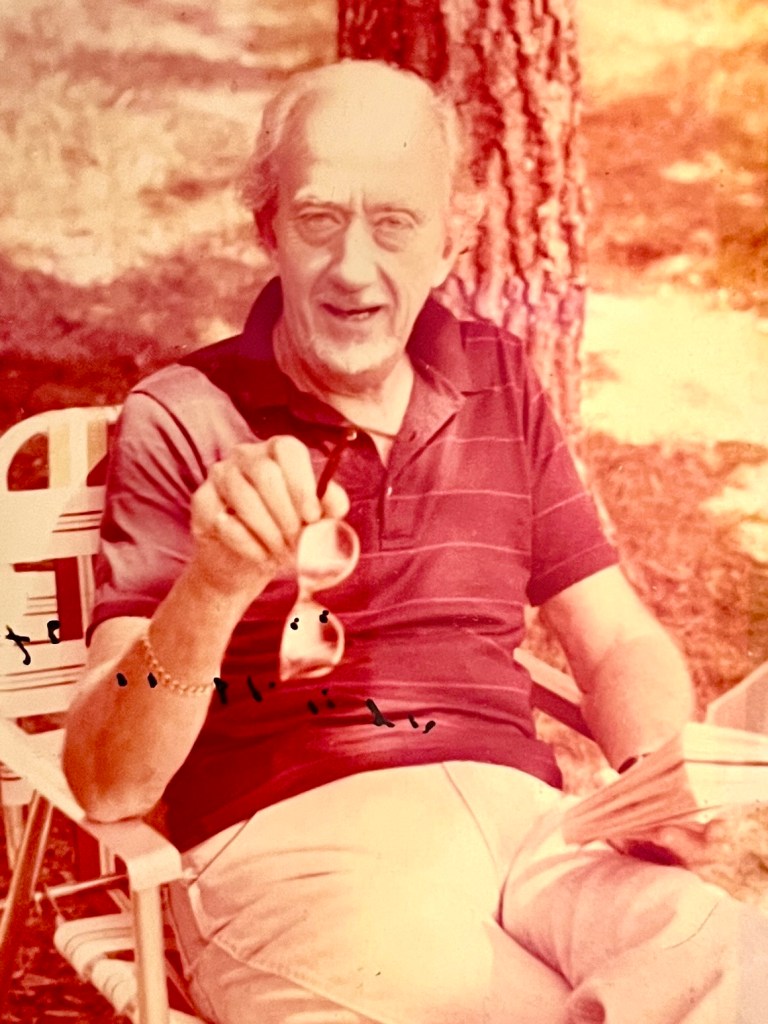
“We didn’t live in cities,” he told me. “We lived in neighborhoods.”
Even in my day, people identified houses on our block in south St. Louis by the name of the families who had lived in them for decades. The man at the local hardware store already knew how wide your window sashes were when you needed new shades.
When the neighborhood is replaced by the global stage, the safety net of being ‘known’ by a hardware store clerk is replaced by the clinical observation of millions of strangers. Kids now grow up in virtual communities even faster than they did a decade ago.
Bombarded by so much, so early, by so many, how could it come without cost?
In this age, the burdens of life require more than physical strength to carry. Ask any of the young athletes we’ve seen come apart under the pressure of expectations.
Three Athletes, Three Burdens
Gymnast Simone Biles’ experience at the 2021 Tokyo Olympics turned a spotlight on the issue of an athlete’s mental health.
Gymnastics is not merely judged difficulty; it is spatial orientation at blinding speed. When Biles withdrew, she cited the “twisties,” a dangerous loss of air awareness —proprioception: often called your “sixth sense”— the body’s ability to sense its own position and movement.
Losing that sense can turn a vault into catastrophe. The pressure on Biles was not only competitive. She carried the mantle of being the greatest ever in her sport, the weight of institutional failure exposed in the wake of abuse scandals, and the expectation that she would validate American dominance.
Her crisis was not a missed routine; it was a neurological dissonance in a sport where miscalculation risks paralysis. Her choice reframed the conversation from “can she win?” to “can she land safely?”
In Beijing 2022, Mikaela Shiffrin arrived as the face of her Games, a generational alpine skier whose résumé invited historic projections. But alpine skiing is governed by the law of gravity and the nature of ice. One edge set a fraction late, and years of training dissolve in milliseconds. Ask Lindsey Vonn.
Shiffrin’s early DNFs shocked us because they contradicted her reputation for precision—the same contradiction Malinin embodied. But unlike figure skating, there is no program to salvage after a major error in skiing. The gate is missed, and the Olympic opportunity is finished.
Malinin, Biles, and Shiffrin all carried the burden of expectations under the pressure of Olympic history.
Now overlay all three with the modern sporting apparatus: endorsement portfolios, sponsor deliverables, mandatory media, and the silent roar of social platforms. Elite athletes today are not only competitors; they are branded enterprises. Visibility monetizes excellence, but it also magnifies failure. A missed quad, a balked vault, a straddled gate—each is dissected in real time by millions who risk nothing themselves.
The Sorting Mechanism
High performance has always contained the possibility of unraveling. What has changed is amplification. The Olympic flame once illuminated the arena; now it beams out across a global theater.
It’s worth separating normal competitive anxiety from clinical disorder. Every elite environment carries a psychological load: exams, auditions, public speeches. The question sport asks—ruthlessly—is who can metabolize the natural anxiety on demand and like an alchemist transform it into performance. Sometimes the answer is not you, not today.
For those facing genuine mental health challenges, that distinction matters and deserves clinical attention and support.
But it’s also true that when expectations are inflated to inevitability—when bookmakers price gold at near certainty, when sponsors build campaigns around a coronation, and cameras are never more than five feet distant—the athlete competes not only against rivals but against a storyline that isn’t theirs to edit.
Ilia Malinin admitted afterward that his collapse was more mental rather than mechanical. We call it tragic, gut-wrenching, shocking. In truth, it is the exposure of risk we pretended didn’t matter.
Their Due
Ilia Malinin is the most technically ambitious skater of his generation. Simone Biles redefined her sport and insisted on safety in the process. Mikaela Shiffrin’s body of work remains historically secure despite an unfortunate fortnight in Beijing.
Their experiences are not identical. Their pressures are not interchangeable. But together they illustrate the central tension of modern elite sport: the pursuit of unprecedented difficulty under unprecedented scrutiny.
Pressure has always been part of greatness. What is new is how publicly we price it—and how loudly we react when the margin proves thinner than we imagined.
At just age 21, Ilia should take heart. Both Simone and Mikaela came back to find their full glory after their Olympic disappointment. Just remember, Ilia, like success, failure isn’t inevitable either.
END
 tonireavis.com
Excellent column, Toni.
Although not your main topic, your comment “…each is dissected in real time by millions who risk nothing themselves.” immediately reminded me of one of my all-time favorite speeches, Citizenship in a Republic, by Theodore Roosevelt. I think we would all do well to remember these wise words.
“It is not the critic who counts; not the man who points out how the strong man stumbles, or where the doer of deeds could have done them better. The credit belongs to the man who is actually in the arena, whose face is marred by dust and sweat and blood; who strives valiantly; who errs, who comes short again and again, because there is no effort without error and shortcoming; but who does actually strive to do the deeds; who knows great enthusiasms, the great devotions; who spends himself in a worthy cause; who at the best knows in the end the triumph of high achievement, and who at the worst, if he fails, at least fails while daring greatly, so that his place shall never be with those cold and timid souls who neither know victory nor defeat.”
One of your best columns in a long time. Thanks, Toni.