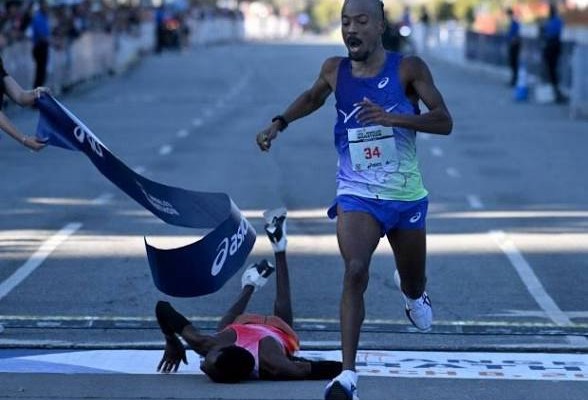
The 41st Asics Los Angeles Marathon delivered the kind of finish that reminds us why the marathon remains the most unpredictable event in sport. Anything can happen over 42.2 kilometers. On Sunday, just about everything did.
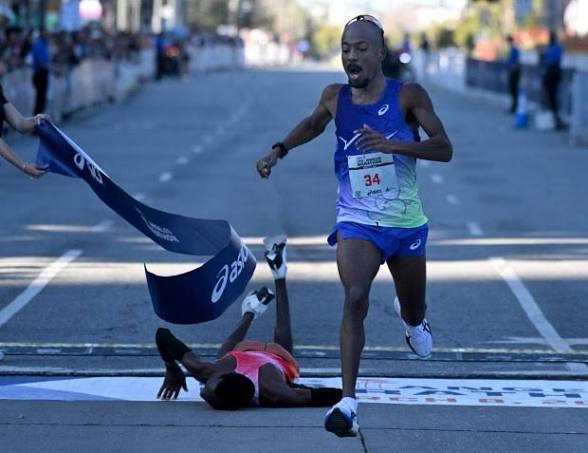
With the finish line in sight, and the lead-vehicle escort system beginning to peel away, long-time men’s leader, 34-year-old Kenyan Michael Kamau, entered a disorienting strobe of fatigue, mixed signals, and one tragic error that climaxed in the most dramatic turnaround in LA Marathon history.
On a day when the pro women began 15:45 before the men in the marathon’s signature Gender Chase race-within-the-race, Kamau had been running alone from miles 12 to 26, looking every bit the day’s leading man — brave, disciplined, and in full command of a difficult race run under challenging Santa Ana conditions. And then, in the space of 300 meters, his Hollywood dream came crashing down.
While we were tracking the Gender Chase on NBC4 — a $10,000 winner-take-all bonus pitting the leading man against the leading woman — Michigan’s Nathan Martin was surging from behind in second, gaining confidence with every stride. Ahead, in his first marathon in America, Kamau was coming apart in public view.
Michael Kamau’s run had been admirable from the start. A 2:08:19 man at his best (Shenzhen, China 2023), he took control with a three-mile surge of 4:47, 4:50, 4:53 from miles 11 to 13. He extended his margin with a mix of confidence and aggression, posting a 4:33 mile 15 as the chase pack fell more than a minute behind.
By mile 20, he had carved out a 1:43 advantage, thanks in part to a bold 4:34 twentieth mile that suggested he was not merely racing to win the men’s race but still pushing to catch women’s race leader Priscah Cherono for the Gender Chase bonus.
The 45-year-old mother of three who retired in 2020 after a career that reached World Championship podiums in cross country and on the track — came back last December to run the best marathon of her life by three minutes, taking her PR to 2:25:17 at The Marathon Project in Chandler, Arizona.
With three months extra training, the Colorado Springs resident attacked LA as if it were a sequel to Chandler. Pulling free of Americans Kellyn Taylor and Makenna Myler in mile one, she lit out at 2:19 pace through 25K on a course that had never yielded a sub-2:24. She was holding form, even as you suspected the back half of the course would exact its toll.
That’s because the marathon is a truth-telling distance, and on Sunday both Kamau and Cherono had taken bigger bites than they could swallow. Both had misjudged the difficulty of the course and conditions. LA’s route drops early then rolls upward late, while Southern California’s notorious Santa Anas blow in from the desert with spiking temperatures and plummeting humidity, demanding respectful pacing, diligent hydration, and electrolyte replacement. Cherono might have been vulnerable, too, but the women’s field never dredged up a challenger to ask her the difficult questions the men’s field did of Kamau.
After adding another ten seconds to his lead by 35K — now up to 1:53 — Kamau began glancing back as his time splits told the story before his body did. The mid-race 4:40s and 4:50s gave way to later-stage 5:18, 5:14, 5:12. His shoulders tightened. His right arm began swinging like a buggy whip as he vainly tried to stimulate his stride. And most tellingly, he kept turning around — again and again, seemingly dozens of times — searching for the runner he feared was coming. Each backward glance cost him rhythm and ground as he veered sideways for several strides. You could see it: he was unraveling. Each backward glance affirmed his feeling that his moment was slipping away.
Even so, though he had lost nearly a minute from his margin at 35K, he still held a 56-second lead over Nathan Martin at 40K. In most marathons, on most days, that would have been more than enough with just 2.2K remaining. On this day, it was not.
At the 40K elite aid table, he fumbled his bottle to the pavement as he lunged for it. It was more than a mistake. It was a symptom. His coordination and motor skills were gone, as fatigue and the hilly final 10 kilometers of the LA course exposed every deficit.
Into his descent came a cascade of small, human moments that produced the most heartbreaking yet thrilling finish in LA’s 41 years.
As Kamau entered the finishing straight beside the Westfield Mall on Santa Monica Boulevard, the scene shifted from athletic struggle to something closer to street theater. The grandstands were packed. Excited fans lined the fencing along the curb farther up. But before the fencing began at mile 26, people edged out onto the street to catch a glimpse at the presumptive champion like spectators on the mountain stages of the Tour de France.
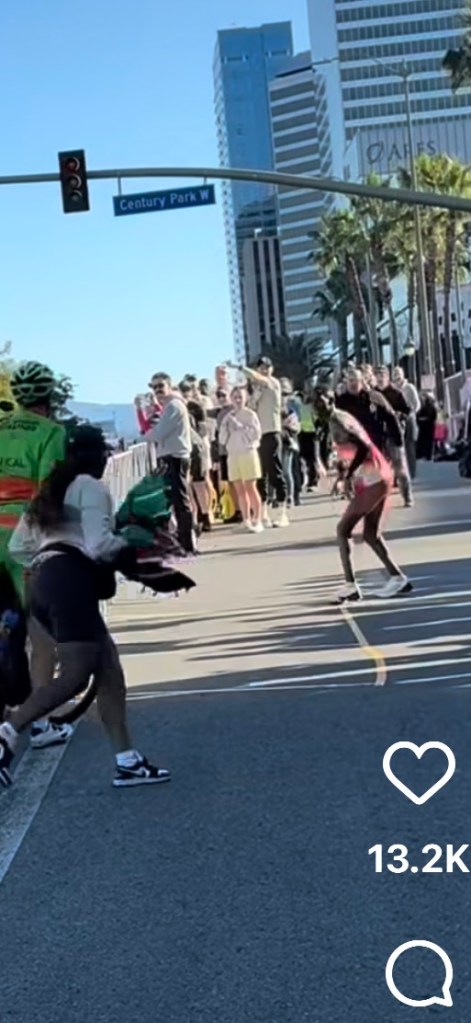
And from that charged atmosphere, as the two police motorcycle escorts passed at 2:09:42, a woman carrying a Kenyan flag ran out on the street to celebrate her countryman’s expected victory. Another woman in red filmed the moment. A police officer stepped out to wave them off. Volunteers holding signs for the eventuality of bandit runners stood nearby. The white lead vehicle pulled off to the side, as per instructions.
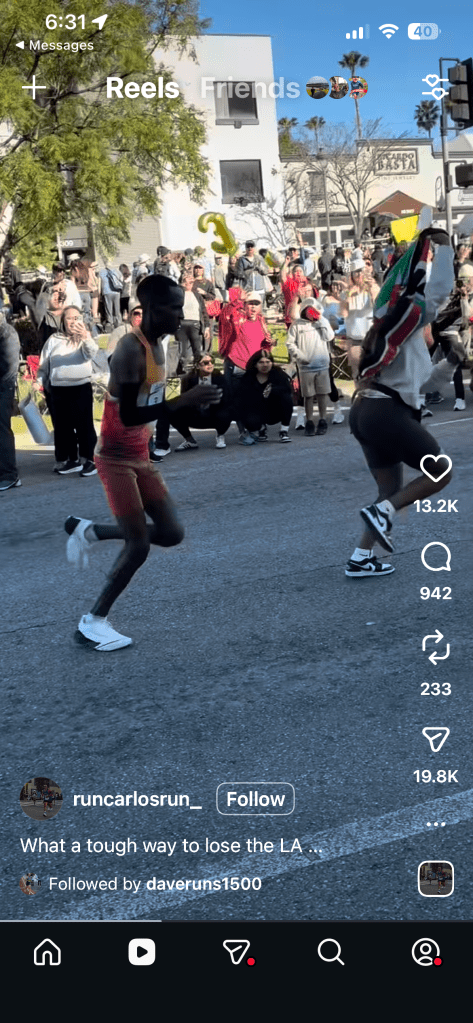
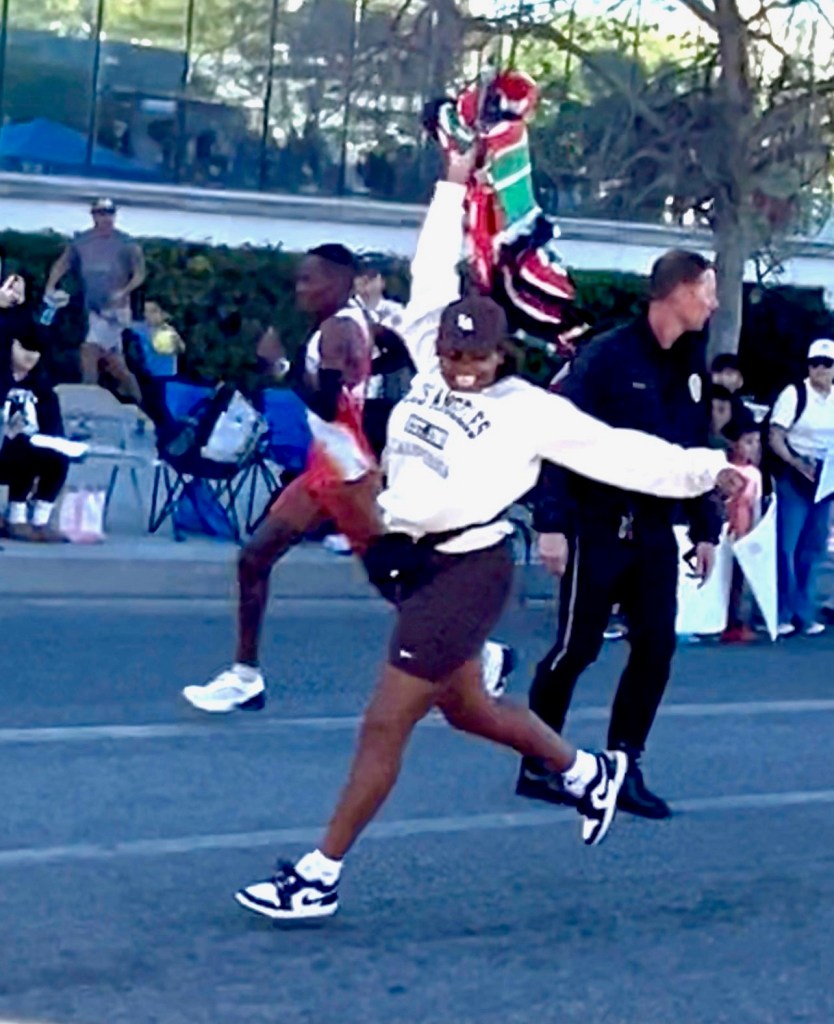
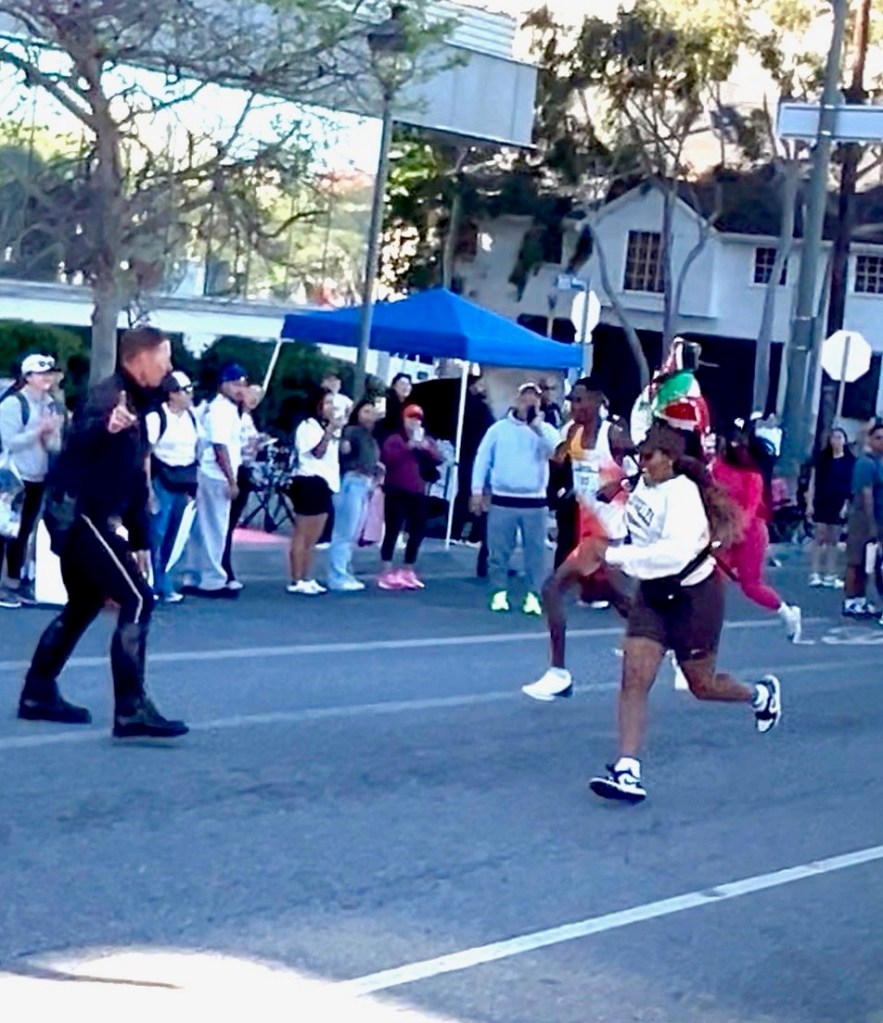
None of these actions were malicious. Lead vehicles followed assigned protocols—including the lead camera moto continuing straight toward the finish. Nothing by itself was enough to influence the race. But together they created a swirl of motion that would have challenged even a fresh athlete. Kamau was anything but fresh. The din of the crowd along with banging drums and tooting horns only deepened the confusion.
Instinctively, Kamau veered right, following one of the police motos as it pulled to the right of the first barrier, a road to nowhere. People instantly started pointing and shouting for him to turn around. A look of panic played out across his face as he stopped before doubling back to reenter the course. He was already desperately afraid someone was charging from behind. Now he had lost all his momentum — the only currency he had left. The detour cost him five, six, maybe as much as eight seconds, time he no longer had to spare.
Behind him, Jackson, Michigan cross-country coach and substitute teacher Nathan Martin was coming hard, sensing the opportunity. Head up, arms in rhythm, each stride he took shrank the gap Kamau could no longer defend. Seventh in the Orlando Olympic Trials in 2024, Martin had been sick before last December’s California International Marathon in Sacramento yet finished strong in 12th place in 2:12:55.
“My goal is a PR,” he told me before the race. “I want to fight and battle. I’ve raced a lot of marathons, and it comes down to who’s mentally toughest. I want to know I’ve given all I have.”
He followed that script to the letter. Where Kamau was coming apart, Martin was turning the screw. His agent, Hawi Keflezighi, had told me that Nathan was a conservative starter but a powerhouse closer. Where Kamau was glancing back, Martin was locked forward. He had paced himself with clarity, hydrated well, and kept his emotions in check. And when the opportunity appeared — unexpected, unscripted, and almost unbelievable — he had the strength and presence of mind to seize it.
Down by 56 seconds at 40K, he closed the gap relentlessly, his legs gobbling pavement as Kamau seized with fatigue. In real time, one athlete was disintegrating, the other rising to the moment.
Martin’s final strides took him past Kamau in the blink of an eye as the finishing tape stretched across the road. His last stride was the lone step he took as race leader — likely, the most glorious step of his athletic career.
He pipped Kamau by .018 of a second, over a race of 2:11:18. With his mouth agape, as much in surprise as to draw in oxygen, Martin continued through the finish, still in wonder of his miraculous win.
After his final desperate step, Michael Kamau crashed to the ground and lay motionless for a heartbreaking period. Officials rushed to his side and after ensuring his safety, eventually helped him away. The good news is that he recovered and was alright after being attended to in the medical area.
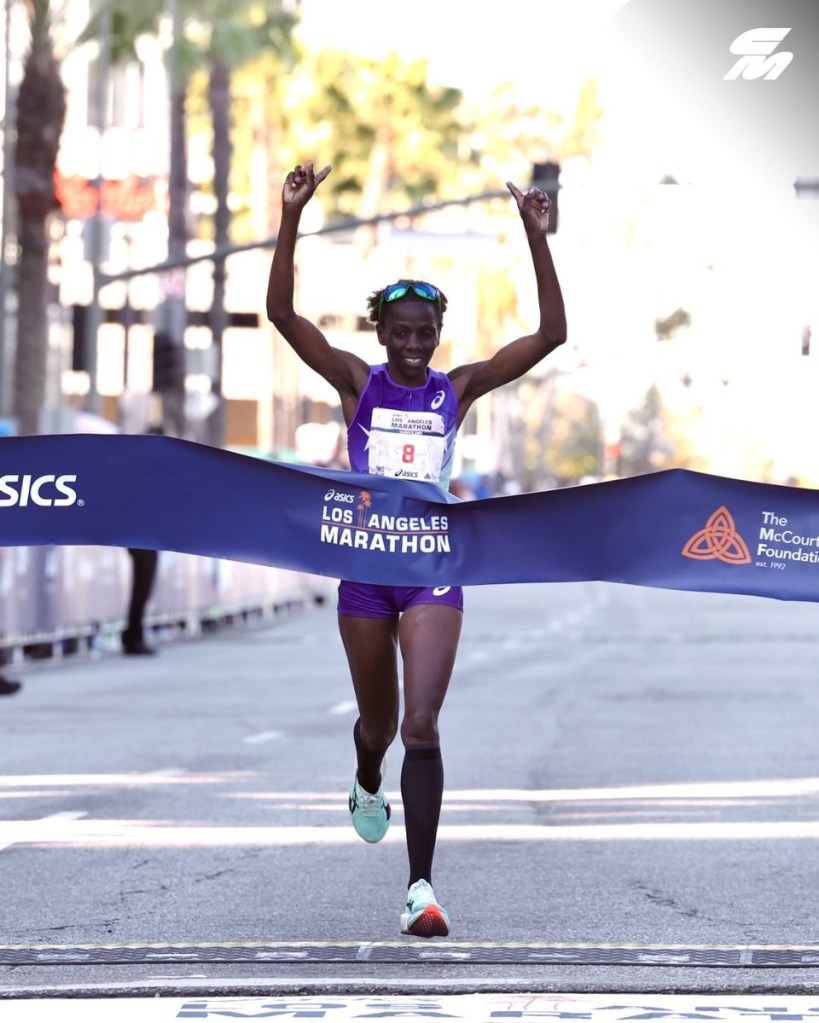
Meanwhile, just over a minute before the climactic men’s finish, Priscah Cherono had captured the women’s title and the Gender Chase with its $10,000 bonus. She had to battle her own deterioration over the final 10 kilometers (37:30 – 6:03/mile), splitting the second half five minutes slower than the 1:10 first 13.1 miles. She posted a time of 2:25:20, three seconds shy of her PR from Arizona in December, but 2:17 ahead of runner-up, American Kellyn Taylor.
Both she and Kamau bravely pushed to the edge of what the day would allow. The difference was that Cherono survived it without challenge.
By rule, athletes are responsible for knowing the course. But rules do not capture the lived reality of a challenging marathon’s final mile. Dehydration clouds the brain. Crowd noise distorts perception. One well-meaning supporter can distract marshals and confuse a runner whose reserves are spent. Kamau reached that moment on Sunday with nothing left to summon.
Any one of several small changes — a steadier pace, cleaner hydration, a calmer finishing stretch — might have preserved his victory. But the marathon does not deal in hypotheticals. It deals in actions and consequences.
What we witnessed was not merely a dramatic finish. It was a reminder of the vortex of energy contained in a modern urban marathon, especially on a challenging day on a difficult course in a non-paced marathon. Sunday in Los Angeles was a test that revealed character under duress, that punished imprecision, rewarded resilience, and turned on the smallest pivot.
Michael Kamau ran bravely. Nathan Martin raced brilliantly. Priscah Cherono ran with the quiet ferocity of someone who waited six years to show her children it’s never too late to dream big.
And the race, as it always does, told the truth.
END
PostScript: Michael Kamau recovered well from his day’s travails, and informed LA’s elite athlete coordinator, Liam Fayle, that he would like to come back in 2027. What a redemption story that would be.
 tonireavis.com
wonderfully written Toni…and a finish that will not soon be forgotten.
SO well written, as always.