
The Marathon and half-marathon are the only two foot races designated by name rather than time (one-hour run, 24-hour-run, etc.) or distance (100 meters, 5000 meters, etc.). Since its introduction at the inaugural Olympic Games of the modern era in Athens 1896 at 40 kilometers, the Marathon has changed in distance several times over the years.
Based on the apocryphal journey of the messenger Pheidippides, who was sent on a mission from the Plains of Marathon 40 kilometers to the city of Athens to announce the Greek victory over an invading Persian force in 492 BC – whereupon he died after making his declaration of victory – the Marathon has represented a test of human endurance rather than one of outright speed.
It only officially arrived at 26 miles, 385 yards, or 42.195 km, following the 1908 London Olympic Marathon. It was there, purely at the whim of the British royal family, who wanted to watch the start at Windsor Castle, then its finish in front of the Royal Box at White Stadium, that officials stretched the Marathon distance to fit the royals’ request. Before that, the marathon ran roughly been 40 km or 24.5 miles, the distance between Marathon and Athens.
As such, there is nothing sacrosanct about the specific distance itself. Instead, the Marathon has always denoted a challenge to human endurance, representing the outside limit of human capacity.
In the early years of the 20th Century, people would watch a Marathon because, just as at car race, the chance to see something severe happen to one of the competitors was more likely than not. The Marathon, therefore, was actually seen as a death-defying act of athletic brinkmanship.
Today, more than a century and a quarter after its founding, the Marathon no longer falls into the category representing the outer edge of human capacity, not with the training, nutrition, therapies, hydration, PEDs, pacesetters, and the new super shoes. Based on these new metrics, the Marathon is still a long race, true, but it is no longer challenging in the same way that it once was. Few things are.
Throughout the 20th century, the great challenges of the past were surmounted one after another: the poles were conquered, the four-minute mile eclipsed, and summiting Mount Everest became something of a banality. Most people even believe man reached the moon and returned safely in the summer of 1969.
For decades now, the world around us has continued to shrink as our technologies have grown, bringing humankind into ever closer communion with itself. In some respects, this reduction in time and distance has improved the human condition immeasurably, as in the flow of goods and services. But in other respects, it has created new, more daunting challenges, i.e. the coronavirus pandemic of 2020.
As times change, therefore, so must we. Accordingly, might we have reached that time whereby a new distance is required to return the Marathon to its once vaulted position as the supreme test of human endurance?
All I know is with the kind of times being run today, i.e. the 2:11:53 in Berlin 2023 by Tigst Assefa of Ethiopia, a women’s world record by 2:11, the marathon may still be a long race, but it’s no longer a great test of endurance to modern athletes. Ms. Assefa could be seen skipping around the finish line in the shadow of the Brandenburg Gate after her run like a schoolgirl on lunch break, hardly a Pheidippidian response.

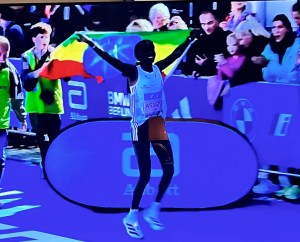
As such, to maintain its credibility (hell, it’s dignity!) might it be necessary that the Marathon undergo another change in distance commensurate to the reduction that the new technology has wrought in its times and difficulty? I mean, what’s the difference between a marathon and a 10K these days, other than the time it takes?
Question is, what would that new distance be, 50 km? More? As always, just wondering.
Remember, the horizon can never be met without relinquishing its name.
END
 tonireavis.com
I think the hype surrounding the 2 hour barrier is the best thing about the marathon right now. Once that dies down, maybe the athletics world will move on from its obsession with 42.195km. I like to think that the 50km distance will be more prestigious in the not too distant future. These days, even the 100km is run fairly quickly. The 6 hour barrier at that distance intrigues me as much as the 2 hour barrier for 42.195km.
You lost me on this one. Today’s new world record for the women certainly highlights that there’s plenty of room for growth all levels of competitors. And if you’re going to apply this logic that there’s no difference between a 10k and a marathon in terms of effort, then you can safely eliminate either the 100 or 200, the 400, the 800 or the 1500, and consolidate down to one distance over 5k because they’re all the same race (which they’re not). Personally I think today’s 2:11:53 was amazing, and I was stoked that 12 women were on world record pace at rhw 15k. Go them.
Charly Haversat
After all the years of you following the sport, is there no performance that would induce incredulity? 12 women on world record pace through 15km is what, a banality? And if we’re talking about truly professionalizing the sport, yes, there needs to be a consolidation of events into sprinting, middle distance and distance not 16 variations on the same theme. However that’s another topic for another day. Other than that, hope you’re well.
TR
You bring up some good points, Toni. Unfortunately those technological advances include PEDs. As we’re all aware, far too many elite Kenyan runners, who dazzled and amazed us with their incredible performances, were using drugs. Several years ago I wrote an article for Road Race Management about the “B” and “C” team Kenyan runners, who competed around the country in shorter distance races that still offered nice paydays for winners, and said winners were never drug-tested. Racing every weekend in a small local or regional event and picking up $500 to $1000 for a win was a cottage industry for these athletes. And of course high-profile “A” team runners have turned out to be dirty. Assefa’s performance, again unfortunately, must be questioned. Sadly, like so many other sports, baseball and football come to mind, PEDs have a much bigger impact on performance than all the razzle/dazzle equipment and hard training will ever and can ever achieve.
Agree.