
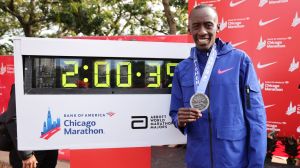
Kenya’s 23-year-old Kelvin Kiptum announced his arrival as the new king of the marathon today with his 2:00:35 world record at the 45th BofA Chicago Marathon. The king is dead, long live the king.
Kiptum’s time broke Eliud Kipchoge’s 2:01:09 record from Berlin 2022 by 0.60%. His 30k – 40k split, 27:54 (13:51 & 14:03), suggests there’s more time to come given similar conditions.
What we saw in Chicago today continues the shredding of the marathon record book, as Kiptum followed Ethiopia’s Tigst Assefa’s stunning women’s world record in Berlin from just two weeks ago. Young Mr. Kiptum’s effortless run on a perfect marathon day showed him delivering on the promise he first evidenced in Valencia in December 2022 (2:01:53) and then in his sophomore ride in London this April (2:01:25).
Kiptum’s record was the first for Chicago on the men’s side since Khalid Khannouchi‘s 2:05:42 in 1999. And Khalid was on hand to see Kiptum’s performance, as was Chicago’s first men’s world record setter, Steve Jones of Wales, who ran 2:08:05 in Chi-town in 1984.
But men’s world record notwithstanding, the more intriguing competition going in was the women’s race considering last month’s otherworldly 2:11:53 world record in Berlin by Ethiopia’s Tigst Assefa, which lowered Brigid Kosgei’s 2:14:04 Chicago 2019 world record by 1.66%. Big difference.
Both pro races boiled down to the essentials pretty quickly. At that pace, how could they not? Still, the men’s dual between training mates Kiptum and debutant Daniel Mateiko lasted till 30k, about 5k longer than the women’s shootout.
With a few differences, today’s women’s race was like a replay of 2022. In both years, the leader(s) lit out on record pace before producing the second fastest time in history at the finish.
2023 London Marathon champion Sifan Hassan’s new Chicago course record, 2:13:34, bettered Brigid Kosgei’s 2019 mark by 30 seconds. But even in comparison to Tigst Assefa’s 2:11:53 world record from Berlin last month, the pacing in Chicago was far more aggressive, though not as aggressive as Chicago 2022. Looking back, that might have been the telling detail to explain why Hassan slipped so far off the Assefa record. Even super shoes can’t make up for everything.
Last year in Chicago, defending champion Ruth Chepngetich went flying out like she was Rob de Castella in Fukuoka 1981 (minus the mustache and back hair):
5K- 15:11 (2:08:19 pace)
10K – 30:40 (15:29, 2:09:34 pace) (More like Bill Rodgers)
Halfway – 65:44. She ran the second half in 68:34 second half to register her 2:14:18 near record.
Today, Sifan Hassan and Ruth C. both went out only slightly more rationally before gettin’ jiggy:
5K – 15:42 (:31 slower vs. 2022) (2:12:36 pace)
10K – 31:05 (:25 slower vs. 2022) (2:11:06 pace) and,
Halfway – 65:42 (:02 faster than 2022)
Finish – 2:13:34 (:44 faster vs. 2022). Her second half took 67:56.
Perhaps most tellingly, Hassan actually looked like she’d run a grueling marathon at the finish. Her 30k – 40k split lasted 32:06 (15:47 & 16:19), still fast, but 61 seconds slower than her opening 10k. Who knows what she might have done if she hadn’t competed in three track finals – 1500m, 5000m, 10,000m – at the Budapest World Athletics Championships six weeks ago, taking home medals in the two shorter events? Talk about unprecedented! It’s like the old laws of motion no longer apply.

(Courtesy EuroSport)
All things considered, she held on fairly well in Chicago, but really struggled in the final few kilometers into Grant Park. And Ruth Chepngetich suffered mightily to a 2:15:37 in second place.
So how does Chicago contextualize Tigst Assefa’s 2:11:53 world record from Berlin where she showed no signs of fatigue?
Following her race, Hassan told NBC Chicago she found conditions a little cold for her liking. Plus, she remains very inefficient in grabbing her aid station bottles, dropping off pace until she finished drinking, before regaining contact.
On the other hand, in Berlin, Assefa gradually built up her pacing, running her slowest 5k in the first split at 15:59 (2:15-flat marathon pace). She then strung together gradually faster 5k splits of 15:46; 15:42; before dropping to 15:26 from 15k – 20k.
In Chicago, Sifan and Ruth split 15:42 for their opening 5k (:15 faster than Assefa in Berlin); then 15:23 (:38 ahead) and 15:31 (:49 ahead). But from there, Hassan slowed each subsequent 5k split till the finish. Yet she was still ahead of world record pace at 30k by 12 seconds.
Assefa negative split her 2:11:53 (66:20 & 65:33). Sifan positive split her 2:13:34 (65:42 – 67:56).
It’s hard to parse the cost of the aggressive early pacing and the fact that Hassan ran three world championship finals six weeks ago in Budapest. Also, Berlin is a marginally faster course than Chicago. It’s all pretty remarkable, no matter how you look at it.
But today’s race in Chicago makes Assefa’s Berlin Marathon seem marginally more legitimate, all things considered, though skeptics remain firm in their disbelief. She ran a more disciplined effort, pace wise. She didn’t have three World Championship level competitions in her legs six weeks before, and she did not have competition to worry about.
The times are still a little hard to wrap your head around if you’ve been in the sport for a long while. But it is what it is. And if you don’t believe one, then you can’t believe them all. And where does that leave you?
In order to bring rationality back into the equation, we need to identify and show internal physiological metrics in real time – like respiration and heart rate, and wattage power – like they do in cycling to really express the difference in what athletes are doing, as opposed to what difference the shoes are making. The technology is there. It’s just not being used to give us that data.
In the same sense, the television coverage, which hardline followers of the sport will always find wanting, is the same as it’s been for decades, locally, not internationally oriented.
The local station is not there to cover a world-class sporting event, per se. They’re there to cover a major civic event that has a world-class running component affixed to it. And with limited resources, they have to cover two elite running races and two elite wheelchair races with moving cameras. Which means they don’t have the resources to put a moto camera on the second or third lead running packs, even when there are Olympic qualifying standards on the line for the top Americans.
This is not Formula One. This is not Tour de France. There is no organization willing or able to underwrite coverage of these events as world marathon major competitions on par with other pro sports. These are local stations covering civic events.
They do that very well, but they frustrate the bejesus out of running fans. And without a home team up in front competing for the win, local stations are never going to show two hours of non-Americans running by themselves. They just won’t. Remember, most people find running BORING, even at world record pace!
Plus, when race organizers set races up with pacers to produce the record times, they simultaneously remove the drama of pure competition. And casual TV viewers will never lock into that, either. Chicago tried that a few years ago. All it produced was slower winning times and no increase in TV ratings. So, you might as well go for the records. What the hell?
You might think with all the money the Abbott World Marathon Majors are saving not paying their series champions $500,000 anymore, they might slide that money toward proper sporting coverage of their races, but evidently, it’s not a priority. The Six-Star medalists are the new focus.
But nitpicking aside (and that’s all it is), this was a fine day all around. And with the race tracker and all the running websites firing away, it’s easy to follow the races as closely as you like. So congratulations to all Chicago finishers and the hard-working local organizers, sponsors, and volunteers. Now it’s on to New York.
END
 tonireavis.com
It was quite the race!
Toni, since you brought it up, they DON’T need to cover the f’in wheelchair races. Every race they do this, and no one cares. It’s a waste of airtime and takes away from real race coverage.
I’m sorry, but if you’re able to win and race again at NYC in four weeks, the quality of your win isn’t what it is for marathon runners.
Oh, I agree. A wheelchair marathon is more like a running 20 or 25K, but it’s not the same effort as running a Marathon. That said, elite wheelers are excellent athletes, and have been part of the sport since mid-1970s.
And it’s not that they shouldn’t be covered or paid. It’s just it should not be a zero sum game where the runners lose coverage in the process. But no one wants to pony up the resources to actually cover the races as they should be. So elite runners lose out. Thanks for contributing.
Thanks for this analysis. Would love to have been on the sidelines.
Thanks for a great recap, Toni.
“The times are still a little hard to wrap your head around if you’ve been in the sport for a long while.”
Guilty as charged.