
We are all born onto this spinning orb, traveling at 1000 mph at the equator, with the pack of previously born moving through on the inside already up to speed. There are no head starts, my friends; we’re all coming from behind, in one fashion or another. So the only thing to do is to pick yourself up, slime yourself off, and get on with the chase.
Perhaps nobody got on with the chase after picking themselves up any more dominantly in my lifetime than Henry Rono, the great Kenyan runner who established a legacy for the ages in just 81 days in 1978. Henry passed away in Nairobi, Kenya, on 15 February 2024, following a short illness, just three days after his 72nd birthday.
During that magical stretch from 8 April to 27 June, 1978, the Kalenjin tribesman from Kiptaragon, Kenya, in the Nandi Hills, destroyed four world records on the track from 3000 meters, to the steeplechase, the 5000 and 10,000 meters.
His record spree represented a pointed example of punctuated equilibrium in the sport’s evolution – the idea that evolution occurs in spurts instead of following the slow but steady path suggested by Darwin.
Henry didn’t just break the records; in an unparalleled display of distance running excellence, he obliterated the previous marks, putting them all on a new level that only he inhabited for years after.
His 3000m (7:32.1) and steeplechase (8:05.4) records both lasted 11 years, 2 months. His 10,000m (27:22.47) was eight seconds faster than the previous record, and stood for six years, the 5000m (13:08.4) for three.
It was as if Henry was wearing Super Shoes while everyone else was still competing in training flats. And except for his third mark, the 10,000 meters in Vienna, which had the help of a top-notch pacer in Dutch Olympian Jos Hermens, his other three records were solo runs in low-key meets in front of scant crowds under challenging conditions.
But it seemed like all of Rono‘s years were marked by challenges. First, a bicycle accident left him unable to walk until age 6. During that same period, his father died in a tragic farm accident. Then, without the necessary funds, Henry was unable to attend school for many years as his mother struggled to generate the funds.
He didn’t even get into running till age 19 when he was still only in seventh grade, inspired by Kenya‘s first, and most famous, legend, Kipchoge Keino, who lived in a nearby village.
Looking back, perhaps nobody had a heart as big as Henry’s. If they ever did an autopsy, I wonder if in opening that great barrel chest they might find a heart on par with the majestic racehorse Secretariat, an organ simply that much larger than the average man’s, one that could pump significantly more oxygen to his churning muscles than any of his rivals.
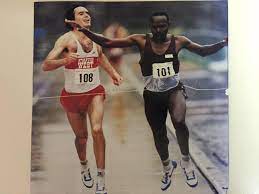
Though his greatest glory came in 1978, Henry still showed flashes of his former brilliance for the next several years before his alcohol addiction diminished his powers.
In 1981, he lowered his own 5000m record to 13:06.2. A year later, at an invitational 10,000m in Eugene, Oregon in the second week of April, carrying a virtual spare tire around his middle, Henry out-kicked collegiate rival Alberto Salazar 27:29.9 to 27:30 on a rainy Hayward Field, just eight days before Alberto out-kicked Minnesota’s Dick Beardsley in the famous Duel in The Sun Boston Marathon. I still have a copy of KPNW radio’s live call of that 10,000m invitational somewhere.
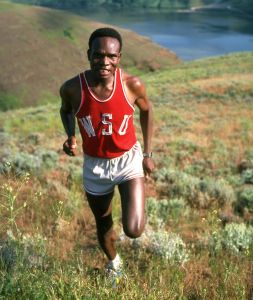
Henry was among the first generation of Kenyan runners who came to the United States on athletic scholarship during the glory years of the 1970s and 80s. He joined Coach John Chaplin‘s crew at Washington State University in Pullman, along with countrymen Joel Cheruiyot, Samson Kimombwa, and Richard Tuwei as they took on Ted Banks‘ talented teams from Texas, El Paso (UTEP) led by Kenya’s Michael Musyoki, and Tanzanian Suleiman Nyambui.
But Rono was also one of the unfortunates whose timing of birth coincided with later Olympic boycotts in Montreal 1976 and Moscow 1980, keeping Kenya off the world stage where Henry might have stood as an Olympic champion.
Even so, the 1978 Track and Field News Athlete of the Year managed double gold at July’s All-Africa Games in Algiers (10,000m & steeplechase), then two more gold in Edmonton, Canada at August’s Commonwealth Games (5000m & steeplechase). Moscow 1980 will always remain a huge What If for Henry. Imagine him trying to burn off the kick of Miruts “The Shifter” Yifter of Ethiopia.
Of course, Henry experienced many problems both during and after his career, stemming from his impoverished upbringing, then difficulty adjusting to worldwide fame.
The late 1980s found an out of shape Henry moving like an itinerant, from Albuquerque to Utica, to Alfred, New York, to NYC, to Hackensack, N.J., to Boston.
Wherever he went, he could always find kind-hearted runners willing to lend a helping hand to one of the sport’s all-time greats. People like Tracy Sundlun, Tom Sturak, Don Paul, Gary Moore (Alfred State coach), Brian Fullem, Bernie Allen, and attorney Merrill Rubin all did their utmost to put Henry on the right path. But despite their best efforts, often at considerable personal expense, and despite stints in rehab, Henry could never outrun his less ennobling habits. For a time, he even went homeless.
Despite his enormous physical gifts, Henry was never the natural ambassador to the sport, like Kipchoge Keino. Nor did he exhibit the boy-next-door charm of Kenya’s first marathon star, and friend, Ibrahim Hussein, nor the natural elegance of Paul Tergat, or cerebral philosophizing of Douglas Wakiihuri and Eliud Kipchoge.
And now, even in passing, his star remains somewhat eclipsed by the tragic death of current marathon world record holder Kelvin Kiptum, who perished last Sunday night, 11 February, in a one-car accident returning to his training camp from Eldoret City with his coach and a female passenger.
After years of existing from one menial job to the next, Henry finally managed to overcome his troubles later in life in his adopted city of Albuquerque, New Mexico. There, he returned to community college, became fluent in English (his self-declared greatest accomplishment), earned his teaching certificate, and began coaching.
He returned home to Kenya in 2019, where he sought a coaching position befitting his stature. But though often seemingly close, an opportunity never emerged before his passing on 15 February 2024.
All sports renew themselves from the wellspring of rising generations striving for excellence. All have heroes they admire. But new generations of Kenyan distance runners, and running fans around the world, will search a long while before coming upon another comet the likes of Henry Rono, who blazed a short, but dazzling, light across the athletic sky. Rest in peace, Henry. You sure deserve it.
END
 tonireavis.com
https://www.onlinetis.com/es/asistencia-remota/windows
cool! HAKKEN
Thank you, Toni! He was one of my running heroes, not only for his incredible 1978 exploits, but for the race against Alberto Salazar and his willingness to continue running and living even as he battled his inner demons. I never met him, but those 81 days in ’78 are at the pinnacle of out-of-this-world athletic achievement.
brilliant piece, Ato Boldon featured this on his feed
Thank you Toni. Brilliant as usual. Very few folks know that Henry showed up at Falmouth one year in his early 50s and humbly asked if he could jog our race. We were thrilled to have greatness in our midst and welcome him to our little town. He struggled in the race, but we still treated him like royalty, and acknowledged him at the finish line. he was more than a world-class runner. He was a gentleman
In spite of his celebrity and hardships, Henry was still a kind, thoughtful, gentle man. I often spoke with him at the Albuquerque airport, where he worked as a Sky cap in the late 90s and early 2000s. On a trip I stumbled upon some old Track and Field News’. Upon returning, people were surprised to see a Sky Cap autographing that ‘78 edition while my wife and I fan-boy’ed him.
I had the thrill of running with him in a 25k race in the late ‘80s. I zipped past him on a downhill, but since it was a training run, I circled back to run with him. When we split a little over an hour at 10 miles, he said, “that’s pretty good.” Heartbreaking to me, but he was happy to be getting back into some sort of shape. All along the course the fans were cheering him on, and he had a smile and wave for them all. A special thrill for me, and a treasured in-race photo. He of course claimed to remember me 15 or so years later, which I doubt, but he always wanted others to feel good, and I did. A fine man as well as a legendary runner.
Rico
Insightful as always Toni!