
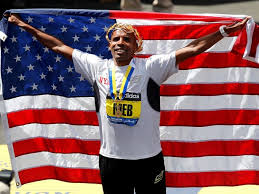
 (The following is based on my contemporaneous reporting of the 2014 Boston Marathon.)
Ah, the mysteries of racing. Which is why pure, non-paced competition is almost always more compelling than time-trialing. The only question in a paced race is whether the pace and finishing time can be attained, not how it is attained, as that has been predetermined. If ever there was a case for competition over pacing, Boston 2014 was it.
Today, on the eve of the 10th anniversary of that historic race, let’s look back to the 2014 Boston Marathon, and explore how the tactics and personalities of each race contributed to the outcome that brought Meb Keflezighi to the finish as the first American male champion in Boston in 31 years and redeemed the race and its host city one year after the tragic bombing of 2013.
With excellent conditions on race day – low 40F temps and a light SSW tailwind at the start – the pro women took full advantage, whipping out of Hopkinton like the men did in their record year.
Under even more salubrious conditions, Ryan Hall pranced to the front in 2011, kick-starting the field onto record pace: 4:38 for the first mile, 4:36 for the second, 4:39 for the third. Once rolling, the pace never slackened on the way to Geoffrey Mutai’s spectacular 2:03:02 finish. Hall took fourth in 2:04:58.
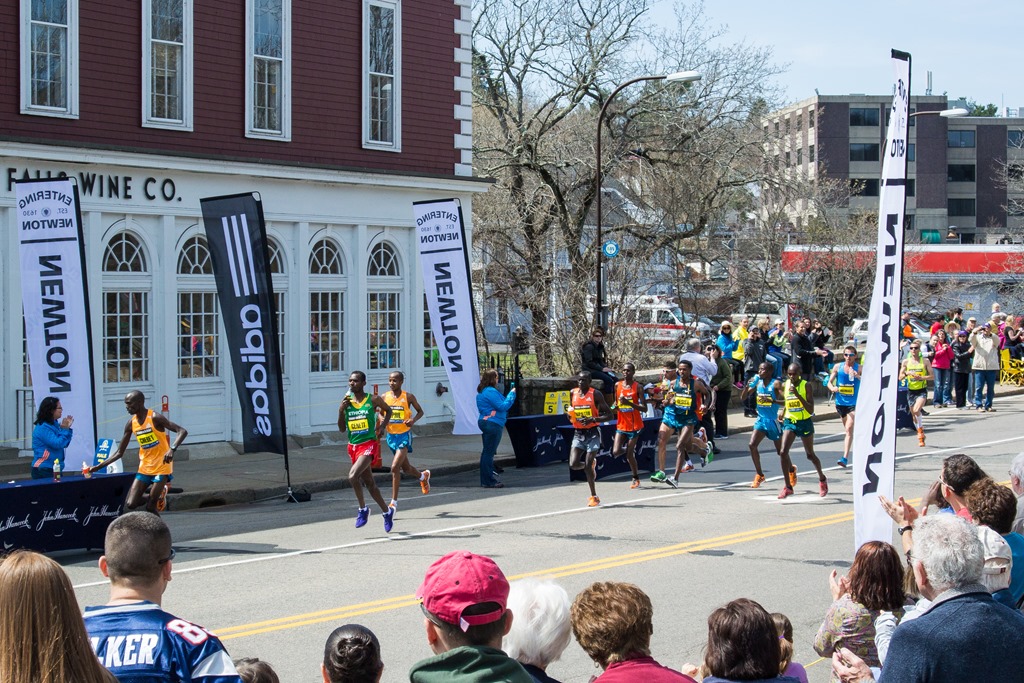
In the 2014 men’s race, there was no discernible leader or plan whatsoever. Meb and Ryan went to the front early, but posted unremarkable splits in the early downhill miles as the big guns eyeballed each other warily. That is the potential anytime you put together a field of parity and strength. If one man of note would have gone, like Ryan Hall did in 2011, then all would have gone. But hesitancy breeds hesitancy, and so did the miles slide by in moderation, all the while building tension in the pack.

Finally, when Meb and late entrant Josephat Boit opened a gap by passing up the elite aid station at 15K, two things happened that conspired to keep the chase pack in idle according to coaches and managers I spoke with afterwards.
“Some guys didn’t realize Meb was up ahead,” said Claudio Berardelli, coach of Paul Lonyangata and Joel Kimurer (also Rita Jeptoo and Jemima Sumgong).
Though hard to believe, in reflection, it shows the intricate complexity of life within a World Marathon Major’s lead pack. Back-row guys may not have their heads up, or they could be watching someone nearby, sipping water or throwing away their bottles, and just not be keeping a sharp eye on the point of attack. As long as they account for all the guys they think are the dangers, all is well.
Recall that Catherine Ndereba didn’t realize that Constantina Dita was way out in front at the 2008 women’s Olympic Marathon in Beijing until the final kilometer when she saw Constantina on the other side of the road coming back into the Olympic stadium. Well, Catherine hadn’t joined the lead pack until after Dita had gone free early on, and no one ever mentioned the fact that somebody was up the road throughout the race. By that time Catherine saw Dita, there was nothing she could do but graciously accept her silver medal. It happens.
But that was only one element that let Meb go free in Boston.
*

*
“(Joel) Kimurer (6th place, 2:11:03) told me two Ethiopians started to push and he went with them,” recalled Claudio Berardelli, Kimurer’s coach. “But after two kilometers they slowed and returned to the pack. Wilson Chebet (2nd, 2:08:48) did the same thing. He pushed for 600 meters, then said, ‘why push by myself?’. Boston is complicated. There is a fear to go unless all go.”
That, perhaps, is another long-term consequence of guys learning their craft in paced marathons, via group training and group racing. There’s no thinking required in a paced race. It’s either can you do this pace or can’t you? You don’t start seriously looking around till 35 km. That’s generally when the modern paced marathon begins its competitive phase.
There is also the seniority thing to consider; there is a hierarchy in running. People know who the alphas are, and are loath to upset that order. It’s not that anyone can’t win, it’s just that the pecking order of movement is sometimes overly constraining, especially in the paternalistic societies like those of East Africa, where seniority is highly respected.
“I’m not going to go ahead of X, X is The Man, or X is my training camp leader.” This waiting for the alpha to move can’t be discounted as a contributing factor.
We’ve seen this happen before. In 2007 James Kwambai seemed to let training mate Robert Cheruiyot go without a fight as the two headed into Kenmore Square in the final mile. We saw it again in Berlin 2011 when debuting Dennis Kimetto deferred to his training camp leader Geoffrey Mutai in the final 200 meters. But Kimetto, who was in Berlin because of Mutai, wasn’t about to topple the senior man. In both cases the World Marathon Majors bonus of $500,000 was on the line for the top gun, as well. So the protege wasn’t about to upset that apple cart. Seniority still means something in other parts of the world. In that sense, the lack of a timely counter-attack at Boston 2014 can, to a degree, be viewed through this cultural prism.
*

*
On the other hand, America was founded on the concept of individual freedom, and we tend to act from that understanding. Ryan Hall and Meb Keflezighi were veterans who trained mostly by themselves. The loneliness of the long distance runner wasn’t new to them, they were used to having open road in front and behind them.
While they may have missed out on the very tangible benefits that big-group training does provide — particularly forming one’s blade then sharpening one’s edge on a larger stone — there is at least one plus to solo training, a sensory comfort to being out there on your own, riding the wave unperturbed by the wake that’s forming behind.
Ryan Hall might not have had the day he was hoping for in 2014 (20th, 2:17:50), but at least he finished his first marathon in two years and, according to reporting by LetsRun.com, helped discourage any increase in tempo that might have come from the American contingent. Even if that had little to do with the eventual outcome, it was a characteristically generous gesture by Hall.
But there is a third, and possibly most likely, reason the pack didn’t give chase till too late.
“They all waited for Desisa,” said Gerard Van der Veen, manager of Dennis Kimetto (2:03:45 Chicago champion, DNF Boston) and Frankline Chepkwony (3rd, 2:08:50). “By the time they realized the defending champion didn’t have it (30 km), it was too late. Dennis moved after Wilson Chebet did, but he pushed too hard, and his hamstring (which he pulled at the City Pier City Half Marathon in The Hague in March) went again.”
“Desisa was saying to the other Ethiopians, ‘let’s go, let’s go’,” confirmed his manager, Hussein Makke of Elite Sports Management International. “But Tilahun Regassa said, ‘no, no, no. He will come back. We can catch him later. He is not dangerous to us. We have 4 or 5 minutes better PRs than him’. Then, too, Tilahun got pushed from behind by Micah Kogo at the 15 km aid station and went down flat on his face, and bruised his knee badly. He DNF’d at 19 or 20K.
To show how the fates have a hand in any such endeavor, according to Makke, defending champion Lelisa Desisa twisted an ankle at the 25Km elite aid station, which caused him to compensate his stride, and eventually caused him to drop out before 40K. Stuff happens when it’s not your day.
*
*
“Both Desisa and Regassa had bad luck,” Makke concluded, “but five days later, and I am still confused how the men’s race unfolded. It was one of the most disastrous races I have ever seen. They didn’t give respect to a champion like Meb, but eight or nine guys just didn’t show up. I blame Kimetto and Desisa. They were the heavyweights in the field. If either one of them would have gone after Meb, everyone would have gone.”
But, but, but…if, if, if.
That’s racing. You don’t get a mulligan. Of course, three-time Amsterdam Marathon champion Wilson Chebet finally did mount a late-race charge. But though he ran Boston in the hot year of 2012, taking fifth, the rest of his marathon career has been spent on the flat, paced tracks in Amsterdam and Rotterdam. The 1:21 lead Meb had built up by 30 km now required serious closing speed, and maybe some fading by Meb.
Forgetting about who else might come, Chebet threw in a 14:29 5K split from 35 – 40K down Beacon Street into Kenmore Square. Problem was, those downgrade miles after all the early-mile downhills zapped his quads and drained his tank even as Meb kept a solid, even-paced tempo up ahead. When Chebet finally got into the killing zone — 6.3 seconds back with a mile to go! — all he had left was a pocket full of air. He was shot, now trying to fend off Frankline Chepkwony, coming on hard from third.
Just ahead, Meb concentrated on maintaining form, fought nausea, and rode the crowd in, even-paced to the end. His was a victory for resolve, reliability, and resolution.
***
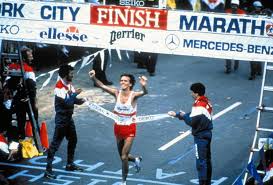
There was history to apply, as well. In New York City 1986, the alpha male in the field was Boston champion and course record setter Rob De Castella of Australia. That year in New York City, everyone kept eye-balling Deek waiting for him to go. Somewhere along the way Italy’s Gianni Poli opened a gap that nobody covered. By the time they realized Deek wasn’t the same guy he had been Deek in Boston, race over! Big smile Poli! Deek in second 37-seconds back.
Twenty years later it happened again. The Man in New York 2006 was Paul Tergat of Kenya, the world record holder and defending champion. 2004 Olympic champion Stefano Baldini of Italy was also there along with 2005 Boston champion Hailu Negussie of Ethiopia. But the pacers never got close to the 64:00 first half they had been contracted to run. They crossed the Pulaski Bridge in 65:30. Nobody wanted to venture out as there were too many major champions in the field to account for.
Nine men joined the hunt up First Avenue with Americans Meb Keflezighi, Dathan Ritzenhein and Alan Culpepper either unable or unwilling to respond. (Meb had twinged his hammy in his tuneup half marathon in San Jose that year).

During mile 18, Brazilian Marilson Gomes Dos Santos went to the front looking to thin the herd a little. Not among the major players in the pre-race build up — though he had set national records at 5000 & 10,000 meters that summer in Europe, and I was told to keep me eye on him by his manager Luis Posso — he opened a gap with a 4:48 19th and 4:53 20th mile. Nothing flashy there, but because he wasn’t considered a threat, none of the guys went with him. Oops! He opened a 38-second lead by 23 miles. And though Tergat and Stephen Kiogora eventually whittled Dos Santos lead to 10-seconds, they ran out of real estate, and Dos Santos hoisted the first of his two NYC trophies.
*
These are the games athletes play. These are the decisions athletes make and the consequences which define championships and champions. The fact is, like Poli in New York 1986 and Dos Santos in 2006, Meb in Boston in 2014 wasn’t taken seriously by the Kenyans and Ethiopians, and it cost them the race. Meb ran completely up to his potential, posting a PR 2:08:37, which is all any athlete can do. The others didn’t and were left to wonder “What if?”.
With his own intelligence, experience on the course, and the overwhelming emotional support from the throngs lining the roads, Meb was lifted to an historic win.
The alpha-males: Lelisa Desisa (DNF) and Dennis Kimetto (DNF), and the secondary threats, Wilson Chebet (2nd, 2:08:48), and Micah Kogo (17th, 2:17:12), all ran with an implied arrogance that dismissed an aging, but still dangerous opponent. This was not a first. Meb made a habit of feasting at the expense of faster runners, but lesser racers.
So, let us not just recall and celebrate Meb for his historic victory, the first by an American in Boston since Greg Meyer in 1983, but also a redemption of the race and the city after the previous year’s finish line bombings.
Let’s also acknowledge the BAA for never going to a paced race format. Instead, they make the athletes figure it out for themselves, which is part of the game.
It is quite evident that had Boston been a paced race, Meb Keflezighi would not likely have won the 2014 Boston Marathon, and the sport would be the lesser for it.
its been ten years since that historic run. Meb has since retired, though he will run again in mid-pack in tomorrow’s 128th edition. Once again, racing will take centerstage, and I, like so many millions around the world, will be riveted.
END
 tonireavis.com
Great analysis and review of so many great races, Toni, and means we/I cannot wait for the Paris Olympic marathons. Does make me wonder if there will be any team tactics, so to speak, but also how the races develop on a course that is not pancake flat.