
The crosscurrents of history and technology met up at the Boston Marathon in its 128th year. The notoriously downhill, quad-busting early miles of the Boston Marathon course have brought many a competitor to a damaged standstill, especially those intrepid souls who choose to dash out of Hopkinton like they were riding the Space Mountain rollercoaster at Disney Land. And yet the new super shoes, with their 40 mm mid-sole foam cushioning and carbon-plate that simultaneously allows lightweight speed and yet ample protection that the old shoes could never offer, makes it difficult to determine how much damage those early downhill can still inflict and how much the shoes now absorb?
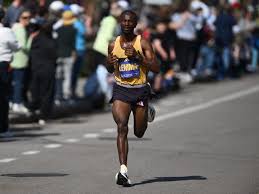
2024 Boston men’s champion Sisay Lemma of Ethiopia joined a spirited group that lit out of Hopkinton at a relatively quick pace yesterday – 4:32 for mile 1, 9:19 at 2 (4:48). But Lemma didn’t really spin up his turbo-charger until he got past Ashland heading into Framingham. His 14:07 from 5K-10K, producing a 28:28 10K split led to a fastest ever 60:19 half marathon time, 99 seconds faster than Geoffrey Mutai ran in his 2:03:02 course record of 2011. By halfway, Lemma had opened a 109 second advantage over the five-man chase pack. You knew right then Lemma was going to pay a price somewhere down the line. How much of a price was the question for watchers and competitors alike?
Though we hadn’t had success in Boston in his previous three visits, including two DNFs and a 30th place finish last year, that’s still a lot of experience on the old course for the fourth fastest marathoner in history (2:01:48, Valencia 2023). He knew the road ahead, treacherous though it may be.
Of course, we’ve seen front runners at Boston pull free before, as recently as American CJ Albertson in 2021. But historically, early front runners almost always get swallowed up, as CJ did on the Boston Hills (though he still finished 11th in 2021, and took seventh yesterday in a PR 2:09:53).
The last time we saw somebody take a big lead in the first half and finish first was Meb Keflezighi back in 2014. But the difference between Meb 2014 and Lemma 2024 wasn’t just a decade’s time, but regard amongst his competitors.
The top challengers of 2014 didn’t take Meb seriously after he and Kenyan Josephat Boit pulled free by skipping the elite aid station at 15K. At nearly 39 years of age, with a personal best of only 2:09, Meb didn’t register as a threat to men like defending champion Lelisa Desisa, and the recent world record holder Dennis Kimetto, 2:02:45 in Chicago the fall before.
By the time the pack figured out that Meb was upfront all by his lonesome, it was too late to do anything about it. Remember, he had a 60-second lead at the top of Heartbreak Hill with only five miles remaining. Yet he only won by 11 seconds as Kenya’s Wilson Chebet came roaring up from behind, only to run out of fuel before he could run down the American Olympic medalist and 2009 New York City Marathon champion.

In 1978, American record holder Bill Rodgers passed his eponymous running store in Cleveland Circle at near 23 miles with a 60-advantage over Jeff Wells of Dallas, Texas. At the Ring Road finish, Wells was only two desperate seconds behind, haunting Rodger’s dreams.
So, you can make up a lot of room in the final stages of the marathon, but the lead guy has to help by dying off a bit, too. And while Lemma paid for his early speed, giving back 1:33 over the final 7.2K, it wasn’t nearly a steep enough price to cost him the win. Crossing the Boylston Street finish line, he still had 41 seconds in hand over countryman Mohamed Esa. Though he probably grew a few extra gray hairs and lost some of the ones that weren’t gray along the way.
The last time we saw someone run solo from the front all the way to the finish was in 1985, when England’s Geoff Smith won his second straight Boston title. But that was a much warmer Patriot’s Day, and Smith was immoderately hellbent on running the world record.
Of course, the fields were historically thin back in the pre-Hancock days of 1984 & 1985 as the B.A.A. was still clinging to an amateur past whose time had passed, while the top stars of the day were finding other cities to race through for newly allowed prize purses and old time appearance fees.
Smith plowed through 5K in 14:15 in ‘85, six seconds faster than yesterday’s split. He hit 29:05 for 10K, versus 28:28 for Lemma, and 62:51 vs. 60:19 at halfway.
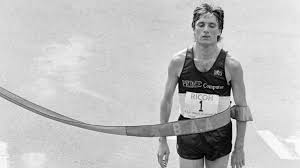 With the warming temps, Smith came to a stiff-legged stop on Heartbreak Hill as he tried to massage a damaged hamstring. He even walked across the finish line, dejected at 2:14:05, but still a full five minutes ahead of Californian Gary Tuttle in second place.
Yesterday, we saw Lemma make it all the way to the finish without a serious challenge. His near 66 minute second half is today’s version of hitting the wall, equivalent to stopping to walk.
But I wonder if we will ever see a Boston Marathon leader actually come to a dead stop somewhere along the course due to going out too fast, now that they have the technology, training, and nutrition that seems to have offset the damage done by hard pacing on the early downhills?
Remember, the marathon wall was born at a time when running wasn’t professional, people didn’t fully understand proper fueling, and people still considered the event the ne plus ultra of endurance. Since that time, coaching and nutrition have dramatically improved. Once the top dogs laced up the new tech shoes, endurance be damned!
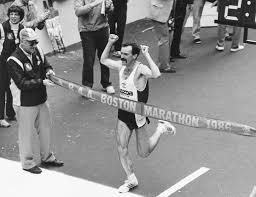
 Historically, there are two types of athletes who do well in Boston. First, like Sisay Lemma, we have the stockier built, bomber quads type who can absorb the pounding of the downhills through the first 25K, and still have the pliability to climb the hills and run down Beacon Street into the Back Bay finish without it feeling like every step someone is jabbing an ice-pick into your quads. In that, Lemma reminds me of Rob de Castella, the great 1986 Australian champion and then course record holder, and 1981 & 1987 champion and fellow course record setter Toshihiko Seko of Japan.
Of course, the other type that do so well in Boston are the light-weight flitters like 4x champion Bill Rodgers, who, like water bugs, dance lightly atop the road and never produce the pounding that can damage those quads.
It’s not that new shoes have made the old course toothless; Lemma did slow dramatically in the last miles. But super shoes have reduced its bite. We’ll see how many people walk backwards down stairs today, always the telltale sign of a Boston Marathon finisher the day after the big race. Hope everyone recovers well.
END
 tonireavis.com
The Great Boston Mystery: Friday’s cold rain stopped, Sunday’s blustery wind dropped, and when I went for a morning run before the VIP breakfast, it was overcast and mid-fifties with a light breeze likely to be tailwind for most of the distance. Near perfect.
So what went wrong? Runners at all levels complained of its being too warm, of a feeling of stuffy over-heating, listlessness, and after halfway, legs cramping. I have never known such consensus. Elite times were slow and I have met no one from the mass field who felt they had a good day. Even the wisest and canniest (eg Sisay Lemma, Sally Gibbs, Amby Burfoot) went out too fast. Why did the whole field experience the same bad symptoms on what seemed a good day?
Once as a birthday surprise for my wife, I took her for a ride in the basket of a hot-air balloon. (It’s hard to find anything exciting that Kathrine hasn’t done.) One unique thing about the ballooning experience is that as you drift along, there is absolutely no air movement – because the balloon moves exactly with the air/the wind. It’s different even from walking, a strange kind of static nullity.
My theory to explain this year’s Great Boston Mystery is that the light tailwind was moving at running speed, so there was no cooling air movement. None. I know Sisay Lemma ran faster than mid-packers, but the effect of more or less nil air movement would be the same. Add the microclimate of the crowded field (except for Lemma) and for a runner, it was effectively a lot hotter than the thermometer showed.
It’s only a theory, but after 70 years in running, I have never heard it before, and it seems to fit.
Roger
[cid:e90e5552-0e15-438e-a891-0c98f6ba6b5a] ________________________________
Excellent point, Roger. I call it running in a vacuum where there is no moving air to evaporate the sweat, so the body just keeps sweating because that’s all it knows in terms of trying to cool itself down.
They keep saying the point-to-point, downhill, potential tailwind conditions make Boston ineligible for record purposes. But as we saw again on Monday, those conditions can be quite tricky to overcome.
Thanks for the input. Hi to your wife😎👊
Toni
Everyone on my tracker was 15 to 30 minutes slower than predicted except for one individual. Pat Moulton, a very gifted masters runner, ran five minutes slower than hoped, but may have been modest in his prediction. 40 runners suffered heat stroke. Fortunately, none resulting in critical illness.
PM
As always, Toni, great insights about Boston; you know its course and history well.