
I am a numbers’ guy. I’ve always been a numbers’ guy. I always want to see what the numbers tell me before I opine from an emotional standpoint.
Accordingly, I did a deep dive into the last five women to hold the marathon world record going back to Kenyan Catherine “The Great” Ndereba, in 2001. What I found was a changing world order.

Catherine Ndereba was the last of the old school road racers who then progressed to the marathon. Catherine came to compete on the U.S. road tour beginning in 1995, but really began winning convincingly in 1996 at age 24, winning four times in New York City; Spokane, Washington; Utica, NY; Flint, Michigan; and Philadelphia, Pa.
In 1999, she made her marathon debut in Boston, running to eighth place in 2:28:26. Later that fall, she finished second in New York City in 2:27:34. But she also had eight wins on the road circuit when you could still make money there and the marathon wasn’t yet as lucrative as it is today.
The following year, 2000, Catherine won her first Boston and Chicago Marathons, with another eight wins on the road circuit. She won Boston again in 2001 in 2:22:53, then set her world record in Chicago in the fall in her sixth career marathon, running 2:18:47, with another eight wins on the roads. Catherine was 29 when she ran her record and set her personal best by 2:46 seconds.
In all, she ran 23 marathons, finished 23, won 8.
Great Britain’s Paul Radcliffe broke Catherine‘s world record one year later in Chicago 2002 (2:17:18) then smashed her own record one year later in London (2:15:25), a record that would last 16 years, by far the longest standing women’s marathon world record in history. Before that, Paula had run her debut in the spring of 2002 in London, at age 28, winnng in 2:18:56, a debut record.
In all, Paula started 13 marathons, finished 12, won 8. She, like Catherine, was age 29 when she set her final record at 2:15:25.

But Paula had a long, distinguished career in cross country and track going all the way back to 1992 when won the IAAF World Cross Country U20 championship in snowy Boston before finishing fourth in the World Junior Championships in the 3000m, a circumstance that would repeat itself over the years until she moved up in distance.
Paula ran fifth at the 1996 Olympic 5000m final in Atlanta. Then fourth in the 1997 World Championships 5000 in Athens; second in the WC 10,000m in Seville; and fourth again in the 2000 Olympic 10,000 in Sydney. She just couldn’t finish the last 200-300m with the East Africans like Derartu Tulu and Gete Wami to nab gold.
She entered her first marathon in London 2002 after showing her ability at the half marathon, winning at the Great North Run and the World Half Marathon Championships in Vera Cruz in 2000, and again in Bristol in 2001 – though she still ran on the track at 3k, 5k and 10k. From there, it was clear sailing, as the world came to expect Paula’s 2:15:25 to last for a long, long time.

It wasn’t until Brigid Kosgei came along in Chicago 2019, running 2:14:04, that Paula’s mighty record fell. But that was a bit of a stunner, as people didn’t see it coming. That gave even more gravity to the super-shoe era, because Brigid was 25 years old running the ninth of her 17 career marathons when she set her record. It was a personal best by 4:16, very similar to what we saw with Ruth Chepngetich last Sunday in Chicago. Both were deep into their marathon careers before producing their other worldly record performances.
Between Brigid and Ruth came Ethiopia’s Tigst Assefa. She ran her world record of 2:11:53 at age 26 in Berlin in the third of only five career marathons. And that WR was a personal best by 3:44.
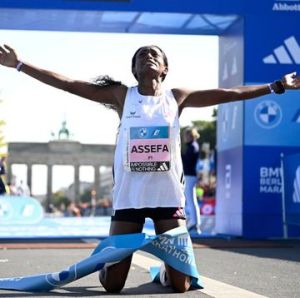
Looking back at Assefa’s career, we see she began back in 2011 as a 57-second 400m runner, who got her one-lap PB down to 54.05 the next year before turning to the 800m. She eventually ran 1:59.24 for 800, but took fourth at the 2016 Rio Olympic 800m final at age 19. She moved up to 10,000m in 2018, then to the marathon in 2022 after showing no results at all in 2020 and 2021 after suffering a serious injury in Valencia in 2019.
In March 2022 in Riyadh, Saudi Ariabia, still overweight and not race-fit, she ran her debut marathon in 2:34:01. Not much to learn from that. But she followed that up with two half-marathons and three 10ks in Europe (all victories, including two PBs) before heading to Berlin, where she rattled the windows with her 2:15:37 victory.
Like Paula, it was only her second marathon, and yet it produced a near 19 minute PB and the No. 3 marathon of all-time! One year later, she defended her Berlin title in her only race of the year, the 2:11:53 world record. It represented a PB of 3:44 at age 26.
And now, of course, we have Ruth Chepngetich, whose 2:09:56 in Chicago last Sunday has had heads spinning faster than Linda Blair in the Exorcist.

Ruth has run 15 marathons, finished 13, won 9, while running her world record in her 15th marathon, seven years into her career, setting a PB by 4:22. That last stat is the one people have trouble getting their heads around. You don’t improve that much so late in your career; they say.
But Brigid Kosgei ran her world record in the ninth of 17 career marathons with a personal best by 4:16. So what Ruth did was not unprecedented, though taken from a tiny sample.
The ages when they produced their world records:
Catherine, age 29; Paula, age 28 and 29;Brigid, age 25; Tigst, age 26; Ruth, age 30.
The world is constantly spinning, changing. Catherine Ndereba and Paula Radcliffe came from an old world, not just pre-super shoes, but pre-only focusing on marathons and half marathons.
And with the super shoes and super nutrition and super coaching and super God knows what else, there has been a great stir in the running community. Some refuse to even consider the possibility of these record times. Others say “wait and see if any positive testing follows down the line”, as we have seen many times before. And very few say, “everything‘s on the up and up. There’s nothing here to see other than a great performance.”
That doesn’t leave the sport in a very good place. But guess what? We are kidding ourselves if we think 2:09:56 is going to last very long. Look at Chicago’s women’s splits: 15:00 at 5K = 2:06:46 pace; 45:32 at 15k = 2:08:16 pace; and 64:16 at halfway = 2:08:32 pace. You even out that effort just a little, and you’re looking at sub-2:09! It’s coming. You can count on it. Plus, once one-person shows what’s possible, it inspires many more to try.
Remember, we are still in the first two generations of world-class women’s distance running. We have no idea what their limits may be, notwithstanding all nefariousness that attends the sport these days.
And so the debate continues, even as the sport searches for leadership, which seems to be missing in action. It’s one hell of a Wild West show, isn’t it?
END
 tonireavis.com
Really helpful, thank you! Veronica Dantas
I love how you approached this topic—well done! Veronica Dantas
I love how you approached this topic—well done! Veronica Dantas
Toni: Thanks again for keeping after this. I’m not sure you reach a clear conclusion here, except that the marathon world is rapidly changing. Agreed. But women are only half of that world.
I think you need to do a similar analysis of men’s performances. I believe that will show smaller jumps in world record times, at least if you chart the last 10 years, which are the most important. If so, you have to ask: Why are women making so much larger performance improvements than men?
Saying that advances in shoes, nutrition, and coaching is terribly naive considering that:
Ruth’s 2:09:56 is not a theoretical time run by a theoretical woman with theoretical shoes / nutrition / training. It’s a real time run by a self-coached woman who has already had super shoes for the past 7 years, and who has shown zero indicators that she could run this time based on past performances (again, in said shoes and with no coach).
Where there’s smoke, there’s fire. And there’s a fire here. Let’s just wake up already.
Toni wrote, “We are kidding ourselves if we think 2:09:56 is going to last very long.”
My first thought watching Ruth Chepngetich finish the Chicago Marathon in 2:09 was, “Is this a Roger Bannister moment?” Or was it “Beamonesque”, not to be bettered for decades? I agree with Toni – this record won’t last long, but that shouldn’t diminish it’s historic significance. I recall the legendary (and I believe, factual) story of Roger Bannister crossing the finish line in 1954 after becoming the first human to run the mile under four minutes. As he collapsed into the arms of an official he quoted Louis XV of France, “Apres moi, le deluge”. Probably the classiest running quote ever.
Soon after the finish, but before the 2nd place runner appeared, I caught a great shot on TV of Joan Benoit Samuelson congratulating Ruth Chepngetich with a hug. It was wonderful to see the connection between the generations of world class marathoners.
Only this: You are making the argument that this WR progression is no head scratcher because it is similar to other leaps in the WR (in terms of minutes). However, WR progression tends to diminish as times get faster, not stay the same.
Sub: 2:20 is not yet commonplace. But it’s no longer the outlier that it was 20 or even 10 years ago. That is s testament not only athletic progression, but most definitely to shoe technology, advancements in nutrition, coaching, and the avoidance of drug detection.
That last factor is sad to say, but it cannot be denied. We have to believe the vast majority of these performances were done clean. But only a credulous person would suggest all were done without help.
Such is the world in which we live. Such is the skepticism attending any great performance these days. That’s the consequence of human nature.
Women’s SUB-2:20s
2001 – 2
2002 – 3
2003 – 3
2094 – 1
2005 – 2
2006 – 2
2007 – 0
2008 – 1
2009 – 0
2010 – 0
2011 – 2
2012 – 6
2013 – 1
2014 – 0
2015 – 2
2016 – 1
2017 – 4
2018 – 11
2019 – 13
2020 – 9 (Covid-19)
2021 – 8 (Covid-19)
2022 – 37
2023 – 31
2024 – 28 (as of 13 October)
Jumps in the women’s world record can be made because we are still in the first stages of the new era.
Thanks for contributing,
Toni
TYPO
Its really up to majors marathon directors.