
 One of the major track-based stories of 2024 was the Athlos’ 2024 Women Run New York meet at Icahn Stadium on Roosevelt Island on September 26th. Funded by Reddit co-founder Alexis Ohanian, the meet had high intentions before the first starting pistol was ever fired.
“We’re setting a standard in women’s sports,” said Ohanian standing trackside just moments before the first race.
That a wealthy man funded an all-women’s track meet holds its own irony. But it was the NBA that created and underwrote the WNBA for a quarter century before Caitlin Clark created the buzz that finally hooked the American sporting public in 2024.
The Athlos Women Run New York meet piggybacked nicely on the WNBA moment this year. Beyond that, the meet finally presented track like one might expect of a major sport, with music, lights, and celebrities, transforming Icahn Stadium (as best they could) into a performance center.
And like the Super Bowl halftime show, the Athlos meet presented Megan Thee Stallion in concert afterward as an added attraction.
But that kind of production costs money and track never had pockets this deep before, funded, as it is, by world and national governing bodies whose portfolios extend well beyond staging elite competitions.
Perhaps it’s not surprising that a new single-gender track presentation was funded by a tech hundred-plus millionaire. There was always a sense that you needed that one right person with deep enough pockets to produce something that rose to the next level.
***
Among the challenges for athletics in the 21st century is the breath of its presentation: Soup to nuts, sprints and hurdles, middle and long distance, all the field events, all at once, all going on simultaneously. The staging of an athletic’s meeting still reflects its 19th-century pastoral beginnings when there were very few sporting opportunities available.
Yet, more than 100 years later, when other sports are so specific and so targeted, to maintain a one-venue-fits-all program that takes hours to complete, is more likely to fail than not. And yet it continues to present itself in this fashion.
Michael Johnson’s new project, Grand Slam Track, which will stage four meets in its inaugural 2025 season in Kingston, Jamaica; Miami, Philadelphia, and Los Angeles, seems to understand this point.
Yesterday, on Pardon The Interruption, one of ESPN’s daily talkshows, co-host Michael Wilbon said kids who play high school and college basketball these days don’t actually watch full basketball games on TV anymore. They watch highlight clips of basketball games. And they don’t watch sports talkshows anymore, either. They watch clips from sports talkshows.
Back in the day, when TV was in its infancy, we were starved for any sports on TV, because so little of it was ever shown. First, there were only three major networks, and a few independent local stations. And technology was so bulky and rudimentary, easily staged studio programs were favored over expensive, outdoor programming.
Yet in that limited television universe, track and field more than held its own. The four-minute mile, having first been conquered in 1954 by Roger Bannister, remained a marquee event. And unlike its pro sports brethren, track was viewed through the prism of America’s Cold War with the Soviet Union.
As one of the few sports both nations practiced equally, T&F became a staple on the weekend sports anthology shows like ABC’s Wide World of Sports and the CBS Sports Spectacular before reaching into the larger public sphere during the quadrennial Olympic Games and annual U.S. vs. Soviet Union dual meets.
***
The Athlos production targeted women-only in a limited, six race program, with very polished feature pieces that brought the audience into the lives of the athletes from where they actually lived and trained. It met the moment perfectly.
One reason there’s so much skepticism about the times coming out of Kenya these days, is not only the rampant number of positive drug tests, but the lack of seeing what actually goes on there. Most interviews we get before track meets come in hotel rooms or press conferences one or two days before the meet.
That means Athlos had to send a production crew over to Kenya to talk to Faith Kipyegon or, to Austin, Texas, to showcase the friendship between hurdler Keni Harrison and sprinter Jenna Prandini. The results were telling. You got to know these athletes much like the 24/7 shows previewing and promoting pay-per-view boxing matches.
They also made the distinction between the anchor desk and the play-by-play and color commentating booth. Whether it was in the call room, the VIP section close up to the track (where alcohol was being served), the pre-race introductions, the lighting, it all had a shiny professional lacquer to it.
Prize money was also way beyond what normally attends track meets, though still a pittance by professional standards. $60,000 and a Tiffany tiara went to the winner of each event, six times the Diamond League cash payoff for a victory. Yet, there were only six races, none beyond 1500 meters.
200-meter Olympic champion Gabby Thomas said, “we’re having our moment in women’s track and field.”
There has never been a distinction made between Olympic style track meets with their strict protocols, and a professional track meet whose sole goal is to sell tickets. The Olympic format is cumbersome and time consuming. It’s all about precision and inclusion, because opening the sport to as many of the 200-plus federations as possible is important, and the record book is always open and ready for revision. That’s why it takes so long in staging each event. Then, finishing times, distances, and heights are the focus of attention, rather than the competition between athletes.
A professional presentation has to be sensitive to the audience because viewing audiences are where the funding is coming from.
NBA commissioner Adam Silver made pointed comments this week at the mid-season Emirates NBA Cup final in Las Vegas about how the three-point shot has become so predominant, it is turning audiences away from the game. NBA TV ratings are down a concerning 48% since 2012.
All professional sports are sensitive to their audience reception. If something isn’t working, they tend to change it. Not all changes work, as the three-point shot is proving. But don’t be surprised if revisions aren’t made in the coming seasons.
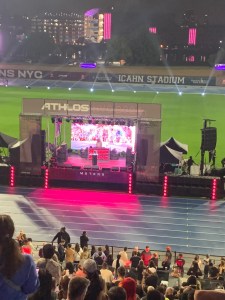 From the trackside bar in the VIP section, to the waitresses carrying drink trays to their customers (like every other sport), the Athlos meet looked like what fun looks like, a fan-first presentation that brought track athletes close to the people.
The big problem that remains is the absence of track and field theaters in the United States beyond Hayward Field in Eugene, Oregon. Professional, performance-grade venues that are track-specific in major cities, like they have in Europe, don’t exist in the U.S.
Everything in the U.S. is an add-on to a football stadium. It’s not intimate. And one of the messages coming out of the VIP section at the Athlos meet was seeing track up close and feeling the power of elite running.
From a fan standpoint, outdoor track is too detached to feel the visceral athleticism that you do at a basketball, football, baseball, or hockey match. Outdoor track struggles to fill the psychic space.
You can’t be that far away from the long jump on the far side of a 400 meter track and expect to be drawn to it. It’s like going to a Taylor Swift concert. You may be in attendance, but unless you bought the really expensive tickets, you’re mostly watching the big screen, even knowing the little dot down there on stage is Taylor.
You have to get close to track and field to feel and appreciate its effort. The energy of indoor track is of a different order.
One wonders why Michael Johnson didn’t get together with Alex Ohanian and combine their efforts. Michael Johnson has the expertise in track and Ohanian has the contacts in the tech world.
In any case, Mr. Ohanian did a fine job with his initial attempt in 2024. Let’s hope there is more ahead like it in 2025.
Merry Christmas.
END
 tonireavis.com
Indoor track is so much more fan friendly than outdoor track. Easy to pack stands, it never rains, intimate atmosphere, you’re never far from every event, it’s louder, and the runners simply look much faster on an indoor track than on an outdoor track, even when running slower. There is an energy to indoor track that is lost when competing outdoors on a large track.
I wonder if indoor track would be the more popular season if it were included in the winter olympics… if the biggest stars had competed in it historically… if people considered the best 60m runner to be the fastest person on the planet.
I’m a huge track fan, but I couldn’t honestly tell a non-track fan that they’d enjoy attending an outdoor track meet. Even the gimmicky events like street vaults, I couldn’t.
I would tell people they’d have fun at an indoor meet though, even if its just a high school meet.
I totally agree. I think they should take a 200m banked track outside and put stands up around it. Outdoor track at 200m might engage people because of the nearness that we both speak about that’s missing an outdoor track. Thanks for contributing.
Toni