
It was a day for flying if you had the itch. 24-year-old Montana State University grad Matt Richtman got on board early. The women missed the flight.
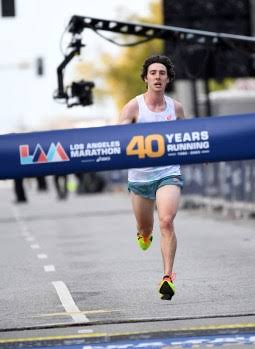
In only his second marathon, Elburn, Illinois native Matt Richtman emphatically pushed his name into the 2028 U.S. Olympic Marathon Trials sweepstakes with a dominating—yes, he dominated!—2:07:56 win at the 2025 LA Marathon presented by ASICS. Under ideal conditions—46-degrees Fahrenheit, a light easterly breeze, and overcast skies—The 2024 Montana State University grad blew away his challengers, dropping a 14:37 5K split between 25 and 30K to open his winning margin.
Minutes later, he dashed past the women’s lead pack of four led by Bakersfield, CA native Savannah Berry (3rd place, 2:30:31) to secure the extra $10,000 awarded to the LA Marathon Chase winner. The gender v. gender format, now in its 15th running, pits the pro men against the pro women in a Chase format where the 2025 women were given a 16:05 head start.
While the men gave chase with solid splits—15:27 for the 5K, 31:02 for the first 10K—the women began hesitantly, and stayed that way until the final mile. We can attribute some of that to the lack of critical mass in the women’s field. The men’s field wasn’t stacked, either, but at least they had seven running together.
Richtman’s win marked the first for an American in LA in 31 years, since Paul Pilkington and Olga Appell brought home both victories in 1994. Interestingly, in 2014 in Boston, it was UCLA grad Meb Keflezighi who became the first American male to win in Boston in 31 years.
Saw the Opening & Took It
I spoke with Matt today (Tuesday, March 18). He’s back in Bozeman, Montana after what he called “a whirlwind last two days”.
“I didn’t plan on making a move,” he said about his breakaway 4:38 16th mile. “But I looked around about an hour into the race, and there were still quite a few guys in the group (7, in fact).
“The idea was to move a little to split the group up a bit. I didn’t want to have that number still around going into the final three or 4 miles.”
Just Like NYC 2006
Instantly, my memory flew back to the 2006 New York City Marathon. I called that race from the lead men’s camera motorcycle for NBC-TV.
From journal #135 (of 277 to date, I found the following:
– Pacers Joseph Kariuki and Julius Kibet fronted the early miles stuck at five-minutes per mile pace up Brooklyn’s raucous Fourth Avenue. Their charge had been to run a 64-flat first half, which is 4:53 per mile.
But the entire men’s field strung out in twos and threes with some of the big name favorites like Olympic silver medalist Meb Keflezighi and 2004 New York champ Hendrick Ramaala staying close on the pacers’ heels, while others like defending champion Paul Tergat and Olympic champion Stefano Baldini of Italy hiding in the back out of sight. The pace never reached the 4:53 per mile average the organizers designated.
Alphas Afraid to Attack
The pack split the race in half on the Pulaski Bridge at 65:30 with the entire field still intact. But there were so many major champions in the field to account for. Like alpha dogs, they all just sniffed at one another. Nobody as much as snarled, much less bit. Finally, like always, things broke free on First Avenue between 17 and 20 miles.
Up Thunder Alley
2:08 Moroccan Youssef Galmin was the first to go, opening a 10-meter gap on the field as they curled off the Queensborough Bridge before heading up First Ave. But as the enormous crowd released its voice, the charge ignited the pack.
After the hushed crossing over the East River, South Africa’s Hendrick Ramaala, the 2004 champion and 2005 close runner-up to Tergat, gave wing to his emotions. Galmin‘s lead evaporated within two blocks as Ramaala ripped up the road and the rest of the pack wondered how long his burn would last.
Dark-horse contender Marílson Gomes dos Santos of Brazil assumed the lead, opening a small gap with a 4:48 19th mile followed by a 4:53 20th. Nothing major. In fact, he said he was only looking to thin the herd from nine to maybe three or four with that surge. But when nobody responded, he just kept going, thank you very much.
And you could tell that the others—all East African except for South African Ramaala—never took him seriously as a threat.
Before the event, his agent, Luis Posso, said to watch out for this guy. He just set Brazilian records at 5K (13:19) and 10K (27:48) in Europe. He believes he can run with anybody. And he beat Robert Cheruiyot at the Sao Sylvestre Midnight run to start the year.
Dos Santos never faltered. His lead grew to 38 seconds entering Central Park at 90th St. and Fifth Avenue.
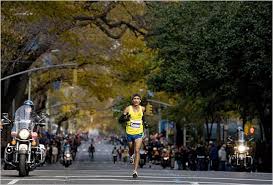
Well-earned arrogance
Kenyans Paul Tergat and Stephen Kiogora eventually whittled the pack away and narrowed dos Santos’s lead to 12 seconds with one mile remaining. But they ran out of real estate. It was the first of two wins for the Brazilian.
***
The reason I’m giving such a detailed account of New York 2006 is because essentially East Africans not taking non-East Africans seriously happened again in Los Angeles.
Fourth place finisher—for the second year in a row—Sammy Rotich, told Liam Fayle, the elite athlete coordinator, “I was really ready. I just didn’t expect Matt to make a move like that. I didn’t see a 2:07 coming.”
Not Taken Seriously
Most of the East African athletes I have engaged with over the years are exactly how you want your children to grow up to be: humble and courteous.
It may not come out in words, but as athletes, these same modest people carry a well-developed, long-earned athletic arrogance. If you’re not one of them, they don’t look as you as a threat. Sometimes, it is to their own detriment. We saw that on vivid display in Boston 2014, when the field let Meb Keflezighi get away and build up a minute lead at the top of Heartbreak Hill. By the time they realized what they had let happen—oops!—they never saw him again.
Monitoring The Lead
Matt Richtman pulled away in LA between 25 and 30K with a 14:37 split (4:43/mile), real running. It might not have been intentional to gap the field, but the gap opened nonetheless.
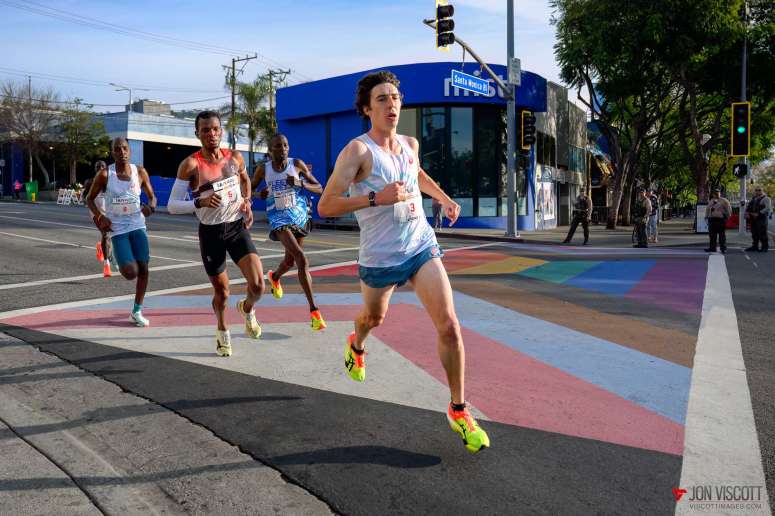
“I realized they weren’t anxious to go with me,” said Matt. “So I thought I might as well try a little and see who would respond. Someone on the sideline told me I was 100 yards ahead. So I had to keep pushing.
“Until the turn around at 22 miles, I had no clue where they were. I knew they weren’t right behind me, because I couldn’t hear the crowd cheering for them after I passed.
“With eight miles to go, I did look back once, but it was hard to see anything. And I didn’t want to start turning around because that becomes a habit and you’ll end up turning around all the time. So I just felt I was better off pushing the pace. And I could see by my watch I was still running quickly.”
Nothing New on Race Day
The final 5K on the Stadium to Stars course (first run in 2021) is an upgrade with a pretty steep hill in the final mile. Yet Matt put that 5K down in 15:10. He put three full minutes on second place, Athanas Kioko, over the final 10 miles. He didn’t just win; he kicked their ass.
Talking to elite coordinator Liam Fayle afterwards, he said the three Ethiopians in the field, Gizealew Ayana (2023 Paris champion, 2:07:15), Asefa Bekele, and wife,Tejinish Gebisa, the women’s champion in 2:30:16) went to a Chinese restaurant the night before the race where they had chicken and rice.
The two men woke up with what they called food poisoning. Ayana vomited after Richtman made his original move, though Gebisa wasn’t affected by the food.
What’s the first thing anyone tells you about running marathons? No new shoes, no new drinks, no new anything!
Back in the 1980s in Boston, the great Toshiko Seko used to bring in his own food from Japan, but also his own pots and pans. He was taking absolutely no chances. He ended up being a two-time Boston champion.
Sky’s The Limit
Matt’s win in LA marks a turning point in his career. It might not be Boston, but as the new Los Angeles Marathon champion, he’s set to capture attention in major races ahead. Don’t be surprised if Matt’s near-hometown major, Chicago, doesn’t come calling. With a steady, easy-going demeanor linked up to mature inner drive, and savvy racing intelligence, there’s no telling where he can go.
With a little more mileage and physical maturity, as his speed gradually improves—much less if he gets on a flat course with pacesetters—he’s got a lot of time he can still scrub from his new personal best. He’s now the eighth American sub-2:08.
“It’s been quite a whirlwind these last few days,” said Matt. “I’m meeting a lot of new people, talking to everybody.”
After Greg Meyer won the 1983 Boston Marathon, he went back home to Grand Rapids, Michigan. He said even his old friends started treating him a little differently. They weren’t just looking at their friend. They were looking at the Boston Marathon champion.
Matt Richtman is now the Los Angeles Marathon champion. It might not be Boston, but you can bet that offers will come his way for the major fall races. Let’s hope he keeps his head screwed on tight.
Having seen him throughout the week in Los Angeles, I have no doubt that he will. He has all the qualities you’re looking for in a champion. So good luck to him.
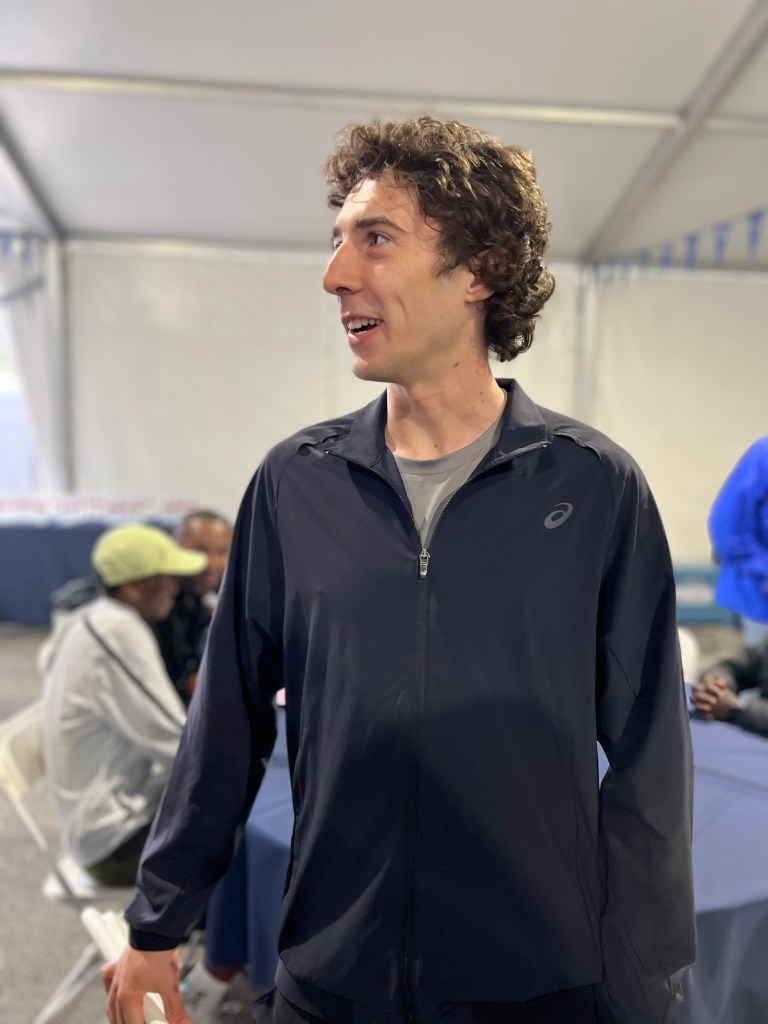
Quite a race. Quite a future. The sky’s the limit.
Onward!
 tonireavis.com