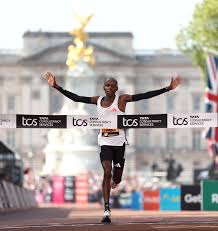
It’s been an electrifying week in the sport of marathon running. First, the 129th Boston Marathon was on Monday, then the 45th TCS London Marathon six days later. Each event featured tens of thousands of starters and world class fields upfront. One record fell, as London women’s champion, Tigst Assefa from Ethiopia, broke the women’s-only world record in London with her 2:15:50 win.


Both events witnessed single-move breakaway wins on the men’s side. First, in Boston, John Korir of Kenya sensed weakness in his six opponents on the hills of Newton on the way to his 2:04:45 win. He accelerated in mile 20 (4:41) as the course reached the base of infamous Heartbreak Hill. Then he blew over HH in 4:39 followed by a 4:24 22nd mile, splitting 35K in 1:43:05 (14:26 5K). His 35-40K down Beacon Street (slight downgrade) took just 14:19 as he opened a near one-minute lead.
In London, fellow Kenyan Sabastian Sawe won in 2:02:27, also breaking free in the 20th mile, which he consumed in a stunning 4:18 as the 8-man pack all ducked over to the aid station table for their bottles and Sabastian just kept hammering. He split 35K at 1:41:43 (13:56!). He followed with a 14:20 from 35-40K, winning by 1:10 over debutant marathoner Jakob Kiplimo from Uganda, the world record holder in the half-marathon.
John Korir beat Alphonce Felix Simbu of Tanzania by 19 seconds, who finished with a time of 2:05:04. Simbu edged out Kenyan Cybrian Kotut by a fraction of a second, who also finished with 2:05:04.
Though Korir’s winning margin was quite slim by comparison to Sawe’s, he eased in after 40K, taking 8:21 for the final 2.2K, as the fight for second reduced the winning margin considerably.
Wouldn’t it have been nice/interesting to see Korir going up against Sawe? Which do you believe would have prevailed? I think they would’ve gone 1-2 in whichever order you believe in either Boston or London.
*
Korir v. Sawe would be a fascinating head-to-head matchup between two on-form marathon champions who both can lay claim to world #1 after winning their last two marathons in fast times! Let’s consider some factors and the potential outcome.
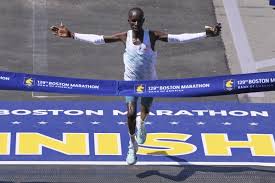
John Korir (2025 Boston Marathon Champion – 2:04:45; 2024 Chicago Marathon Champion – 2:02:44)
- Strengths: A veteran of 12 marathons at age 28, and a proven winner on challenging courses in Los Angeles (2021 & 2022) and now Boston, where he demonstrated strong tactical racing and a decisive late-race surge. His Chicago Marathon win in 2:02:44 shows he also has significant speed. He overcame a fall at the start of Boston, indicating resilience and mental toughness.
- Considerations: Boston is a unique course with significant elevation changes, which might not directly translate to performance on a flatter course like London, or vice versa. But in today’s marathon world, anyone knowing they’re going to Boston trains for hills. While those racing flat courses like London train accordingly, as well.

Sabastian Sawe (2025 London Marathon Champion – 2:02:27; 2024 Valencia Marathon Champion – 2:02:05)
- Strengths: In only his second marathon, 29-year-old Sawe recorded a dominant victory against a strong London field (stronger than Boston’s), making a decisive breakaway while the lead pack still numbered eight. His winning time of 2:02:27 suggests consistent form as touted pre-race by his veteran coach, Claudio Berardelli. He also won the Valencia Marathon in his debut in 2:02:05, highlighting his natural talent for the distance as he glides over the road, thin-limbed and efficient as hell.
- Considerations: London in 2025 saw Sabastian make his winning move when others went for their aid bottles past 30K, suggesting confidence, a willingness to take risks, and an ability to read race dynamics.
Head-to-Head Assessment:
- Slight Edge to Sawe: Based on his slightly faster winning time in London—2:02:27 vs. 2:04:45—and his slightly faster marathon PB—2:02:05 debut in Valencia to 2:02:44 in Chicago—Sawe might have a very slight edge. But Korir saw no real challenge in Chicago or Boston, so there may well have been more left in the tank.
- But Sawe also holds faster PBs in the Half-marathon—58:05 to 58:50—and the road 10K—26:49 to 27:47.
- Course Matters: The specific course where they meet would be a factor. If it’s a flatter, faster course, Sawe’s times suggest he could excel. If there are more tactical elements or significant undulations, Korir’s Boston and LA experiences might be more relevant, though there’s no reason to believe Sawe’s efficiency wouldn’t work well in Boston.
- Tactical Race: Both runners have shown they can make strategic moves at critical times to win. It took Korir several late race falters to learn, while Sawe has come to the sport relatively late and gone two for two in the marathon, with no fade in sight. The race could come down to who executes their plan better on the day and reacts most effectively to their opponent.
- Current Form: Both are clearly in excellent form, having just won major marathons. Their physical conditioning leading up to a potential head-to-head would be crucial.
- Korir takes coaching from former University of Louisville coach Ron Mann, a savvy instructor who also helmed Korir’s older brother, Wesley, to a Boston title and Chicago runner up.
- Sawe’s coach is Claudio Berardelli. The Italian has trained many a great runner, including two-time Boston champion Evans Chebet, and former London champ, Martin Lel.
Likely Outcome:
A head-to-head race between John Korir and Sabastian Sawe would likely be a close and exciting affair. Slightly favoring Sabastian Sawe because of his faster winning times across multiple distances. But John Korir’s proven ability to win major marathons, even on a challenging course like Boston, and his greater experience, would make him a very formidable competitor. It wouldn’t be surprising to see either of them emerge victorious depending on the specific race conditions and tactical decisions made.
It’s a shame we can’t match these two up while they’re in their prime. It’s unlikely that either will still be at the top of their game come Los Angeles 2028. Except for the still marvelous Eliud Kipchoge, 6th today in 2:05:25, the cycle for greatness out of Kenya spins like a centrifuge.
*
Do you realize that we’ve never actually had the best against the best in this sport? It can be argued winning a World Marathon Major is more difficult than winning the Olympic Games, as the Olympics limit participation to three runners per country. That reduces the number of East Africans coming from Kenya, Ethiopia and Uganda significantly.
The dilution of talent across many marathons within the same time frame is one reason the general population doesn’t look at the sport as being compelling or exciting.
Not only are Boston and London in direct competition with one another just one week apart in April, just two weeks ago, 13 April, the Paris and Rotterdam Marathons, two other long-standing major marathons with world- class fields and significant purses, ran on the same day.
Many years ago, I suggested that to boost interest in the game, the World Marathon Majors should separate their men’s and women’s fields in order to create a greater critical mass of racers in each venue.
Critical mass leads to close finishes, as the marathon is a numbers game, with the key number being three. One-third of the field will have a good day; one third an average day; and one-third a poor day. Since we don’t know who will make up which third, you invite three times the number you want racing down the course.
Imagine if Boston’s top two women, Sharon Lokedi and Hellen Obiri, were running today in London? That’s two more A-level women to put into the mix to fight against Assefa and Joyciline Jepkosgei.
So why don’t all the top men in those two fields go to one race and all the top women go to the other? Then, the next year, swap. That way you increase the chances of having John Korir racing against Sebastian Sawe to see who’s the best of the best.
The same with the women. Rather than dilute the talent base, which leads to winning margins of two to three minutes, you’ve got competition all the way to the line.
ALWAYS DONE IT THIS WAY
But the events are so well established as they’re currently formatted, with everyone having an elite men’s wheelchair race, and an elite women’s wheelchair race, and an elite men’s foot race and elite women’s foot race, it remains business as usual. The chances of a close, compelling competition significantly lowers.
But I wonder if there is any interest in improving our professional product from a fan-based standpoint?
Years ago when a change in formats was suggested, I was told by one race director, “why would we ever do that? We’ve always done it this way.”
Yes, I replied. And Henry Ford used to make a real nifty Model T. Times change. Yet running doesn’t. Still, outstanding performances in an overall wonderful week in running. Onward!
END
 tonireavis.com
Would love to see all if not most of the best come face each other, head to head on one course but it would take race directors across many borders coming together as well as some very deep pockets (think LIV golf). Hard to imagine Chicago, London, Berlin, Dubai, Rotterdam, New York……giving up a piece of their field.
Nice!Sent from my iPhone