
The Valencia and Cal International Marathons on December 7 marked the completion of the speed events for the 2025 marathon year. The Honolulu Marathon is up next weekend, where several sub-2:10s are possible, but the traditional burner courses have laid down their markers for another year.
Berlin, Chicago, Valencia, London, Tokyo, Amsterdam, Hamburg, Rotterdam, Barcelona, and Dubai fill the top 32 spots on the world list in 2025. Sebastian Sawe’s 2:02:16 win at Berlin was top dog. He also won London with 2:02:27, fourth best of the year.
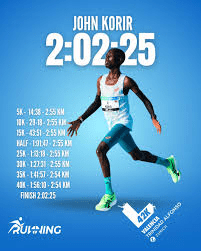
Boston winner John Korir capped his year with an impressive 20-second PB win in Valencia, 2:02:24, #3 best for 2025. The victory, after Chicago’s disappointing DNF eight weeks ago, came with a relative ease. The light-footed Kenyan broke away from a pack of Gemechu Dida (debut), Justus Kangogo, and Hillary Kipkoech with an elegant 13:35 split from 25 to 30 K. He won by a comfortable 1:39 seconds over new German record holder Amanal Petros (2:04:03). Valencia bore 5 sub-2:05s, 25 sub-2:09s, and 32 sub-2:10s.
Two national records fell, Amanal Petros for Germany (out of Eritrea) and Suguru Osako of Japan took 4th, 2:04:55.
As the 2025 marathon season slides away, I did a deep dive into the numbers as I’ve done for the last several years.
I begin with 2016 because that was the year that the super shoe era officially began, though the new technology was only available to a handful of Nike athletes at the US Olympic Trials and all three men’s medalists at the Rio Olympic Marathon.
It took several years for the other shoe companies to catch up. But by 2019, the year before the Covid pandemic closed the entire sporting world, we saw the rapid improvement in performance show up on the results pages.
As always, the Kenyans led the way in sub-2:10 performances in 2025 at 133. But their gap over perennial runner-up Ethiopia continued to erode. And now the Ethiopians are just eight behind at 125 sub-2:10s, with Japan holding its traditional third-place position at 63.
Only Kenya saw a reduction in top performances in 2025 compared to ‘24, with seven fewer < 2:10s. You can attribute that to whatever you want. Perhaps better supervision? Finally, a deterrent from high-profile doping busts?
Whatever, here are the numbers in the marathon and then the numbers for the track events in 2025 compared to 2016 for context.
Marathons
Year Sub-2:10s Nations
2016 150 Ken 98; Eth 39
2017 186 Ken 113; Eth 41
2018 215 Ken 97; Eth 67
2019 293 Ken 123; Eth 98
2020* 164 Eth 53, JPN 35, Ken 27
2021* 245 Ken. 89, Eth 55
2022 395 Ken. 136, Eth 99
2023 434 Ken. 142, Eth 97
2024 469 Ken. 140, Eth 106
2025 468 Ken. 133, Eth 125
*Covid reduced
The 471 sub-2:10s in 2025 is only up to December 7, so that could still increase by a handful before the end of the year. Still, Kenya fell off by seven performances compared to 2024, Ethiopia picked up 19, Japan ran 63, 20 more than a 2024, and runners from the USA ran 16 times under 2:10, six more than a 2024, including three yesterday at Cal International.
The 150th-best men’s performance in the marathon in 2025 was 2:07:15. To contextualize, in 2016, the year super shoes were first introduced (but only to a handful of Nike athletes) there were 150 sub-2:10 marathons run worldwide.
Taking away the two Covid-years of 2020 and 2021, we can see the increase in sub-2:10 performances year on year. The biggest jump came from 2019, when they were 293 sub–2:10s, to 2022, the first full year back from Covid, which had over 100 more.
But now we are seeing performance leveling off, as the total in 2025 was nearly the same as in 2024 after steady increases in the years before.
The original Super Shoe, Vaporfly 4%, took its name from the difference shoe designers thought the new technology would make in performance. But over time, the actual percentage difference between a 2:07:15 (150th-best in 2025) and a 2:09:59 (150th-best in 2016) is just 1.47%. And that also doesn’t consider the advances in nutrition that have accompanied improvements in shoe design. So the new shoes helped, but they’re not quite the rocket fuel some suggested they’d be.
What they seem to do better is allow more performances in shorter time frames. Peres Jepchirchir won the World Championships Marathon in Tokyo eight weeks ago, and maintained until 40 K at sub-2:14 pace with Joyciline Jepkosgei, before the former world record holder pulled away for the win.
Before super shoes, one wouldn’t have thought that Jepchirchir would start another marathon after the world championships. But she hung on for second place in 2:14:44, 44 seconds back of her countrywoman.
Here are the percentage differences for each pair of track times: 2025 vs 2016.
Event 2025 vs 2016 Difference
– 100m: 9.75 vs 9.80 – +0.51%
– 200m: 19.51 vs 19.74 – +1.18%
– 400m: 43.53 vs 43.03 (WR*) – -1.16%
– 800m 1:41:44 vs 1:42:15 – +0.51%’
– 1500m: 3:27.49 vs 3:29.33 – +0.89%
– 5000: 12:44.08 vs 12:58.29 -+1.85%
– 10,000: 26:43.82 vs 26:51.11 – +0.45%
– Half Mara: 56:42 vs 59:07 – +4.27%
– Mara: 2:02:16 vs 2:03:03 – +0.63%
Now it’s off to Hawaii for the 53rd Honolulu Marathon. You can watch live coverage next Sunday, December 14, on Hawaii News Now beginning at 5 a.m. island time, 7 a.m. Pacific, 9 a.m. Central, 10 a.m. Eastern standard time. Mahalo.
END
 tonireavis.com