
Patriots Day 1978, the Boston Marathon, back when the fields were still growing, but small enough where, as our friend Norma Friedman once said, “We knew the top hundred finishers by their first names.”
I was helping call the race on WBZ radio, watching Bill Rodgers striding toward a second Boston title. But in the final mile, Texan Jeff Wells was closing like a freight train and Rodgers was desperately trying to hang on.
Jeff had been behind by 59 seconds passing Bill’s running store in Cleveland Circle at the 23-mile mark. But crossing Boylston and turning left onto Ring Road—the short service road beneath the Prudential Tower where the marathon finished between 1965 and 1985—Wells was within spitting distance with 200 meters to go!
At the time, Rodgers was the closest thing distance running had to a rock star. American record holder, winner of both the New York City and Fukuoka Marathons in late ‘77, going for a second Boston, skinny, blond, and faster than seemed fair.

The crowd, five and six deep, pressed in along both sides of the narrow road craning for a clearer view of a potentially heart-stopping finish. Helicopters hovered overhead. The Boston police motorcycle escort led—probably closer than necessary.
As the finish line beckoned, Bill glanced back, fear etched across his face. It wasn’t just the race that was in jeopardy; it was Billy’s crown as King of the Roads.
In the closest contest to date in Boston’s long history, Bill Rodgers held on to win by two seconds, 2:10:13 to 2:10:15, falling into the arms of two policemen just beyond the finish line.
The moment lingered; the crowd still buzzing as we awaited Atlanta’s Gayle Barron, the women’s winner, who upset 1976 champion and pre-race favorite, Kim Merritt of Wisconsin, who finished fourth.
Following the hectic post-race interviews and festivities in the bowels of the Prudential parking garage, I shared a ride back to Cleveland Circle with Bill and his lifelong friend, Jason Kehoe—my apartment was just two blocks from Bill’s store. As we exited the vehicle and headed to the store, the crowd still massed for the thousands of BQ runners remaining on the course saw Bill. Near pandemonium ensued.
As we waded through the throng, Jason turned to me.
“Toni,” he said. “These are the good old days.”
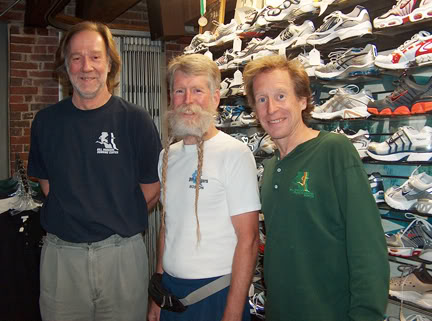
Friends for Life
We knew it as we lived it, the running boom in its full thunder. Running was the gospel in those days. You saw it; you believed it; you signed up. No charity needed, no apps, no $200-$300 entry fee. Just a pair of $19.95 New Balance 320s and the wild idea that ordinary people could cover 26.2 miles if they were stubborn enough.
What we didn’t fully grasp was how those miles intersected with another, very different historic moment. While running boomed, the U.S. still grappled with the aftershocks of the Arab oil embargo—rising inflation, stagnant wages, and the middle class feeling the post‑war promise of upward mobility slipping out of reach.
Yet out on the roads, the old bargain still held: if you showed up, did the work, and suffered honestly, the distance and your goals would return in kind. OPEC couldn’t embargo your miles. The Fed couldn’t deflate your PR. The boom wasn’t just happening during economic uncertainty; it was, in its own quiet way, a grassroots reply to it—a place where the American promise still seemed to function, stride by stride.
Maybe that’s one reason athletic heroes like Bill Rodgers were so revered. With his steady string of victories, Bill felt like a sure thing, offsetting the shadows cast by the economic dislocation.
Yes, those were our good old days—and there were more to come. Yet here, in the final days of 2025, amid continued national uncertainties, we are experiencing a second running boom, fueled by a new generation searching for the same connection and promise we chased nearly a half-century ago. There may no longer be a “sure thing” coming down Boylston Street anymore, but we do have contenders again—which carries its own kind of hope.
Happy 78th birthday, Will-ha. Here’s wishing you many more good old days ahead (and for us all).
END
 tonireavis.com
It’s all or nothing today. There is the elite and the participants. I walked on at Penn State and kept getting a little bit better. Never thought I wouldn’t continue after college because I wasn’t elite. I just wanted to get better. For 2 years in The 1970’s I taught school full-time, went to law school 5 nights a week and ran 110 miles. That was the best time in my life. Racing was so competitive. I would run 10 milers in Central Park ND there would be 20 guys around 50 minutes for a weekend race. Check out results today for races outside the big events and the results are pitiful. There are no more foot soldiers and that is sad. Where did all the 25 minute 5 milers go? I was blessed to have run in the 1970’s.
it’s A different time, and a different place, a different environment. Today, runners are stressed by life a lot more than we were in the 1970s. Because of that, I think they’re looking for a decompression chamber rather than another competitive outlet. In either case, running fulfills every need perfectly. I’m just glad the Sport is thriving and that we had a chance to experience it when we did. Merry Christmas and happy new year. Thanks for contributing. Stay well
toni
Hey Toni…Just wondering how Charlie is doing these days (if you care to comment)? We used to have interesting political discussions whenever I popped into BRRC…
Rick
Rick,
Charlie is doing great the last time we communicated. He’s involved in running the store’s website along with his son. I see him each year at the BIX 7 road race in Davenport, Iowa. Merry Christmas and Happy New Year.
toni
Thank you Toni; we have all had a fun ride in this sport of Athletics! Bill
>
happy new year
hi Toni, we were lucky and trying to be aware of the Sadness of the Vietnam War ;along came an American who defeated the World in the Olympic Marathon. Many in the World of Distance running didn’t think that could be done;;always watch out for them; they are a Good and Strong People; and you area hell of a Writer!
Your long time Friend, Bill
Very nice look-back, Toni. It’s always a great pleasure chatting with you, Boston Billy, Coach Squires, and everyone from back in the day because all of you are still relevant, contributing, and advocating for the sport.
HBD fellow December birthday boy, Bill!
Paul Clerici
Very nice evocation, Toni, especially the near-religious spirit of running in that time. I’m less convinced by your economic analysis. The growth of running wasn’t only in America, nor only in the marathon. While America was certainly leading by 1978, running was booming and innovating worldwide. At that exact date in New Zealand, for instance, April 1978, I was running in the Lion Beer TV Cross-Country Series in New Zealand, a totally new concept, with sponsorship, paid travel, invited runners (some 21-year-old Aussie called Rob de Castella was the overall winner), deep popular fields, regional qualifiers and national final, made-for-TV scenic lap courses, etc. That kind of innovation was everywhere. Three years ahead (1981) two new nations entered the World Cross-Country, Ethiopia and Kenya.
Season’s greetings! Keep wandering. Roger
Roger,
Merry Christmas to you and Kathrine, and thanks for responding to my post. Always look forward to your perspective.
Movements arise out of the seed bed of their times. America in the mid-1970s was coming off a decade of civil rights and anti-war protest, and the women’s liberation movement. Running offered a more individually oriented focus to a generation grown cynical (or at least less naive) of their ideals as they exited their protected college sanctuaries.
That’s not to say that running didn’t grow in other parts of the world based on for very different reasons. Once begun, I think it resonated along the same lines with everyone.
But here in America, when the movement found heroes like Shorter and Rodgers, a ground swell of interest quickly catalyzed into the running boom.
Having lived through it, it’s hard to downplay the profound impact the oil embargo had on the US economy and the American sense of its power in the world.
Oil prices quadrupled from $3 to $12 per barrel, causing a significant increase in energy costs for consumers and businesses.
Gas stations ran out of fuel, and rationing was implemented, leading to long lines and frustrated motorists. Driving from St. Louis to Denver, we stopped at every highway exit that had an open gas station, knowing we had to top off before sundown when all the stations would close for the night.
The sudden increase in energy costs pushed inflation up, with consumer prices rising by nearly 7% in 1978, and the US economy slipped into recession, with GDP growth slowing down and unemployment rising.
The advent of the Watergate scandal close on its heels, followed by the Nixon resignation, only added to the sense of American unease.
I think people turned inward and for young people, running gave them the perfect vehicle. At the same time, my brother was studying transcendental meditation in Sweden, which tapped into many of the same uncertainties.
People were searching for something of meaning in the world which was offering less from the old-line channels.
At least in America, the uncertainty of the times was one of the motivations for running’s growth.
I look forward to sitting down with you in 2026 and sharing a glass of something to dig into such matters and more.
Toni
To the good old days. We ran, drank beer and had fun.
Still doing a stripped-down version of the same. Hope you are, too. Best ahead,
Toni
Thanks, Toni!
And, Happy 78th Birthday to Bill Rodgers… one of my heroes and fellow competitors in our sport.
I came along at the same time in the 70’s… moving up from high school to intercollegiate running to the early days of the professional runner. At least on the roads.
You describe the time and circumstances back there pretty well.
Times have changes and many things are different now… but the basic tenants of the sport remain the same and the physical and emotional price that Bill and ALL of us have to pay to be good at this sport…. remains the same. I am happy to see that some of the “fun runners” have gotten more serious now and there is a slight refocus on performance and times. And, the elite runners have certainly gotten faster…. but exactly “how & why” is due to many external factors that were not available to us back in our days. That is food and thought for another day/column.
Happy Birthday to Boston Billy and I wish you both a happy holidays and a happy (and especially healthy) new year!
Craig Virgin
Merry Christmas, Craig. You were, indeed, a major player in those “good old days”. Back then around this time of year, I’d be driving up to your parents’ ranch in Illinois for our annual Christmas run in the cold and dark of those Midwestern winters. I still have a tape from one of those excursions. Hope all is well, and you and yours have a wonderful turn of the year. Best ahead,
Toni
70s were great for running. Put on the Hinsdale Marathon near Chicago for years. $2 entry. You didn’t have to worry about permits or insurance.
Simpler times, for sure. We were lucky to have lived through them. Thanks for contributing. Happy holidays.
Toni
As an enthusiastic music lover, I am always en garde for those that claim the 70s were the best days for music. SO much great music available today. But, have to agree with most, those Were the good ol days for road running.