
Last Sunday in London, Sebastian Sawe ran 1:59:30—the first sub-two-hour marathon ever recorded under record-eligible conditions. He did it wearing the Adidas Adizero Adios Pro Evo 3, a shoe that weighs 97 grams and that Adidas claims 1.6% better economy than its predecessor.
London runner-up Yomif Kejelcha (1:59:41) and women’s champion Tigist Assefa (2:15:41, a women’s-only world record) wore the same shoes. I would call that proof of concept.
But watching the race unfold, I didn’t think first about carbon plates or lighter foam. I thought about Rome.
⸻
1960: The line we draw
September 10, 1960, 5:30 pm. Rome. Ethiopia’s Abebe Bikila runs the final miles of the Olympic Marathon over cobblestones in the dark in bare feet because the shoes he bought in Rome gave him blisters. He wins in 2:15:16.2. World record, first ever sub-2:16.
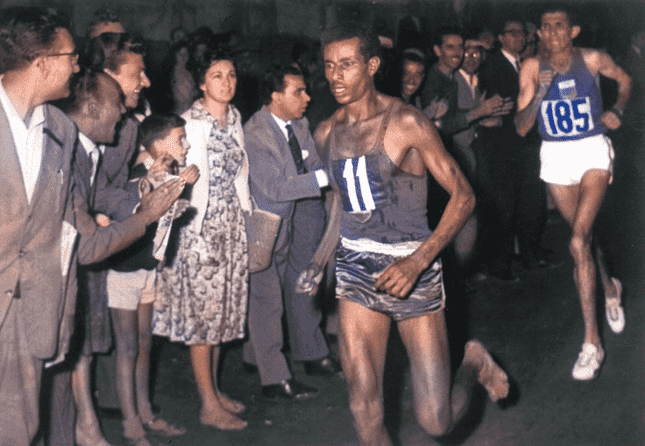
That night is as clean a place as any to say the modern marathon era began. Bikila was the first Ethiopian Olympic gold medalist, and the first sub-Saharan African Olympic champion. Rome 1960 was the moment endurance began to bend toward world-class speed.
Before Bikila, marathoners were shod, and largely Asian, European, or American (North and South). After him, the center of gravity gradually shifted to the highlands along the Great Rift Valley. And once it found its equilibrium there, it has never meaningfully moved back.
⸻
1964: The appendectomy
Four years later in Tokyo, Bikila wins Olympic gold again — 2:12:11.2, another world record, this time in Puma racing flats. What the record books leave out: he did it barely a month after an emergency appendectomy. He’d had surgery in September, was back running within weeks, and on October 21 took 1:44 off the world best.
Equipment, fueling, and competition surfaces have all changed in the interim. But the human body has not. Thirty-five days removed from abdominal surgery, the margin for error is still measured in pain and risk. Bikila absorbed all of it — and still ran faster than anyone ever had.
But what if he had today’s shoes? Today’s fueling? Today’s pacing? Today’s competition? Or today’s surgeons, for that matter?
⸻
The what-if calculator
Start with Tokyo 1964: 2:12:11.2. Put Bikila in the 2017 Nike Vaporfly 4%, which lab testing credited with roughly 4% better running economy:
• A straight 4% conversion yields ~2:06:54
• A more realistic 2.7–3% gain puts him around ~2:08:14 — one second off Alberto Salazar’s winning time at the 1981 New York City Marathon, later found to have been run on a course 149 meters short.
Now give him Sawe’s shoes from London. Adidas claims 1.6% better economy for the Evo 3:
• Straight conversion: ~2:06:11
• A tempered estimate of 1.0–1.1% yields ~2:06:50 — the time Ethiopia’s Belayneh Densimo ran in Rotterdam on April 17, 1988, a world record that stood ten years and five months until Brazil’s Ronaldo da Costa took it to 2:06:05 in Berlin in 1998, becoming the first man to pass 40 km in under two hours (1:59:55).
None of this is science. Call it barstool physics. Economy gains don’t map cleanly from the lab onto the race-day clock. But it places Bikila — training in army boots on dirt roads, fresh off surgery — firmly within the following generation’s lead pack. Add modern fueling, pacers, and a flat course, and his excellence grows further still.
⸻
Why Sawe matters — and why it could have been someone else
Sabastian Sawe is now part of the same historic arc as Abebe Bikila. As one of the world’s best, in peak form, on the right day against the right field, he was the man. Had Kelvin Kiptum lived, we might well have written this in 2024 or ’25. Had Boston Marathon record setter John Korir been on the London start line, perhaps the same story, different name. Who knows?
History needed someone to summit the mountain. It landed on Sawe — an honorable selection.
Which is precisely the point. The sub-two barrier didn’t fall because of one singular athlete. It fell because sixty-five years of accumulated answers to the problem Bikila posed on those Roman cobblestones finally managed to outrun the clock.
• 1960: barefoot over cobblestones — 2:15:16
• 1964: thin flats, post-surgery — 2:12:11
• 2026: 97-gram carbon shoes, calibrated pacing, optimized conditions — 1:59:30
Each step was an incremental improvement, an engineering answer to question: how much can the engine do if you remove friction — from the ground, the shoe, the air, even the body itself?
When I watched Sawe hold up his Evo 3 with “WR SUB2” scrawled on the side in magic marker, I thought about Bikila presenting his bare feet to the photographers in Rome. The modern marathon began with a member of the Ethiopian Imperial Guard who decided shoes were optional — and proved in Tokyo that even a scalpel couldn’t stop him.
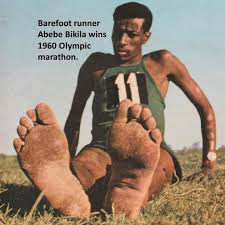
Sixty-five years later in London, Sabastian Sawe, the clock, and new kicks finally sutured one era and opened another. Wonder where the scalpel will fall in 2091?
END


which is faster – the new adidas or bare feet? If you’re looking for lightness and not losing energy into the squish of the sole, I would think bare feet would be.
Thanks for reading and asking. it can sound counterintuitive that something heavier (shoes) can still be more beneficial than something that weighs less (bare feet).
What the shoe does that your foot can’t
Bare feet are marvelous springs — Achilles tendon, arch — but they’re made of living tissue, and tissue damps a lot of energy as heat. A super-shoe adds three engineered helpers:
1. High-return foam as an external tendon
• The new foam midsole compresses and rebounds with 80% efficiency, far above skin, fat pads, or muscle. You don’t “lose energy into the squish”; you store it briefly and get most of it back on toe-off.
2. A stiff lever
• The carbon-infused ENERGYRIM (or a full plate in other models) limits toe dorsiflexion and creates a rocker. That reduces the work your ankle and calf have to do, and studies show that alone improves running economy. It also stabilizes the foam so it compresses evenly.
3. Tall, soft stack to save muscle
• At ∼38 mm heel stack, the Evo 3 sits at the World Athletics midsole limit. That height isn’t for comfort — it lets the foam absorb impact so your quads and calves don’t have to. Over a marathon, that means less muscle damage, which is why the benefit grows with distance, leaving athletes with better running economy and more energy at the latter stages of marathon.
Together, independent labs see about a 4% improvement in running economy today compared to the first Vaporfly generation onward, and newer foams push a bit further. And recall, the original Nike Vaporfly 4% was said to improve running economy by 4% over previous shoes.
A 2025 analysis also found that increasing cushioning and longitudinal bending stiffness both improve economy significantly.
Where barefoot actually stands
This is important because barefoot did beat old heavy trainers:
• A 2024 review pooled six studies: barefoot vs traditional shod running gave a small economy edge (SMD −0.28).
• Minimalist shoes did even better vs old trainers (SMD −0.62).
But those “shod” shoes were mostly 2010-era EVA trainers weighing 250-300 grams with only 50-60% energy return.
When researchers compare super shoes to those same controls, recreational runners used 3.9% less oxygen at marathon pace in super shoes.
In other words: barefoot wins the weight battle, but loses the energy-return and muscle-sparing battle once the foam gets good enough.
Toni