
And so, it is done. From the legend of Pheidippides in 490 B.C. — the myth that inspired the inaugural Olympic Marathon in Athens 1896 — the marathon has stood as mankind’s defining measure of endurance. But on April 26, 2026, Kenya‘s Sabastian Sawe redefined that measure for all time.
By winning his second consecutive TCS London Marathon in 1:59:30, Sawe became the first man to run a sanctioned marathon in less than two hours — a distinction he held for exactly 11 seconds.
Hard on his heels came Ethiopia’s distance Swiss-army knife, Yomif Kejelcha. Shadowing Sawe past 40K, in a staggering debut, the lean former indoor mile world record holder finished second in 1:59:41. Jacob Kiplimo of Uganda held on for third in 2:00:28, also under Kelvin Kiptum’s old world record of 2:00:35.
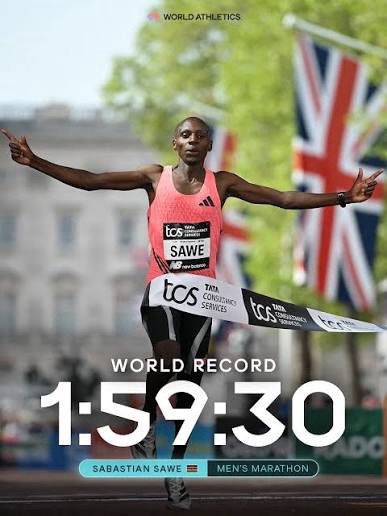
Even Eliud Kipchoge’s exhibition 1:59:40 in Vienna in 2019 — with its choreographed pacers, closed roads, and laser-guided pacing lights — was bettered under open, racing conditions. The Holy Grail the great marathoners of the world had been chasing for more than a generation fell to two men in one race in London.
For added spice, the women’s-only marathon world record fell, too. Defending champion Tigst Assefa of Ethiopia bettered her own record from last year by nine seconds, completing the distance in 2:15:41.
The question that followed the men’s race was no longer whether the clock could be beaten. Rather: what is the clock is worth once its inner sanctum has been breached?
The mile already taught us the lesson
There was a time when no story in sport was bigger than the four-minute mile. When Roger Bannister ran 3:59.4 at Oxford in 1954, it reverberated across the globe like Tenzing Norgay and Edmund Hillary summiting Mount Everest the year before. The cultural weight of the two achievements was comparable: reaching the roof of the world, redefining the limit of human locomotion, both accomplished within thirteen months.
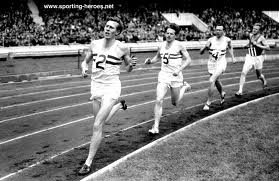
After Bannister, the sub-four chase splintered. First American, Don Bowden, was followed by first indoors, Jim Beatty, then first high schooler, Jim Ryun. Each first mattered less than the last.
We are now so far under four minutes (3:43.13) with over 1800 in the sub-4 club, that the mile survives not because of the time, but in spite of it. It endures because of racing, not record-chasing — and more often now at 1500 meters rather than 1609.
That is the risk for the marathon after London 2026. But the risk is not inevitable, because what happened today was not primarily a time trial.
The interesting thing about London 2026 was the competition.
In the calculus of a marathon world record, you need the right athlete, running the right course, with the right pacing, on the right day, loading the right fuel, wearing the right equipment. But what puts it over the top is someone who will not let you ease off the throttle.
In London, Sabastian Sawe had Yomif Kejelcha as a constant presence. Along with four others and three pacers, they passed halfway in 1:00:29, already inside Kiptum’s Chicago pace by twenty-one seconds. Then came the back half where, just before 30 km, Sawe and Kejelcha separated and the real racing began.
With the defending champion setting the tempo, 30k to 35k fell in 13:54, officially putting the world record and sub-2:00 on notice.
Still feeling Kejelcha looming, and wary of his closing track speed, Sawe turned the screw tighter. 35k to 40k the pace actually increased as the split read 13:42, including an ear-popping 4:12 mile 24.
With the Thames River running off his left shoulder, Sawe closed the final 2.195km in 5:51, which is roughly 13:19 5k pace. But it wasn’t until past 40K that he got away from Kejelcha.
The entire second half only lasted 59:01.
For context: we were still talking about John Korir’s 60:02 second half split at Boston on Monday as otherworldly. Sawe ran a minute faster because another man was there, and that man wanted to win, too.
The race was the thing, the time is what it took.
That said, the equipment does require a sentence or two. The top two men (and Assefa) wore the Adidas Adizero Adios Pro Evo 3, which debuted in London. Adidas claims a 30 percent weight reduction over the previous model 2 and a foam compound 50 percent lighter, translating — they say — to a 1.6 percent improvement in running economy.

Scrub 1.6% from Sawe’s record time and you arrive at 2:01:24.7, rounded to exactly Kelvin Kiptum’s London course record from 2023. When the math from a shoe press release reconstructs the previous course record to the second, the shoe earns its place in the headline.
I am not saying Sawe didn’t run 1:59:30. I am saying we don’t fully know yet how much of it was Sawe and how much the new foam.
So where does the sport go from here?
Any subsequent record will not mean what sub-2:00 meant. If the next barrier is primarily a materials science problem, will the public begin to tune out — not with outrage, but with a slow withdrawal of belief and increasing indifference?
The answer is not complicated. It is just structurally difficult, and the sport has been avoiding the structure for forty years.
Build interest in races, not times. Construct fields where Sawe has to beat Kejelcha and Kiplimo — and add Boston record holder John Korir — not where he has to beat a stopwatch. Put the bonus money on winning London and New York in the same calendar year, or Boston and Chicago. Make the prize for the Tokyo–Berlin double worth more than any time bonus any sponsor has ever offered. Give athletes a reason to choose competition over optimal conditions.
The reason this hasn’t happened is not lack of imagination. It is lack of architecture. Road running has no governing body capable of building and enforcing a unified competitive calendar.
The Abbott World Marathon Majors is the closest thing the sport has, and its members have historically prioritized their own race brands over the collective product.
I have been writing about this since 1994, and it is still true today.
The two-hour barrier fell this morning on the roads of London. That was the easy part — it required one transcendent athlete, one willing and able rival, one fast course on a good day, and thirty years of shoe and fueling technology.
What comes next is harder. Not another number, but a reason to root for someone, not something.
For the marathon to survive as a sporting contest that fans pay attention to not just participate in, it must stop being a laboratory for shoe companies and go back to being an arena for gladiators.
Today, even at 1:59:30, the clock agreed to give equal billing to competition.
The question is whether the sport knows how to build on that — or whether it goes back to chasing the next number, when it won’t carry the same weight as the one just breached.
END


Tony, I think you have hit this conundrum spot on. Kipchoge showed us the 2hr barrier was psychological, not an impenetrable wall. It was just a matter of time before the sub two hour race would feature not just one, but two and almost three competitors. Now, we must once again become more wary of the ‘why’ of these times. The course must be independently re-measured, the extensive PED testing must be improved and the equipment must be looked at. I love a great Race, like Dixon against Smith in NY in the early 80’s. The Olympics will tell us a bit more about what our focus should be. Lets hope we all gather back to the racing, instead of the money/time barrier.
Toni-Excellent artic
Stunningly great reporting by THE Toni Reavis as he put the whole London Marathon in context. Now to see the biological passports of the top 3 men. I trust these guys are clean but I trust the biological passports of even more. LA2028 marathon could shape up to be a real barn burner.
Awesome write up on an unforgettable ‘race’. Not sure LA2028 can live up to some of the competitive scenarios Toni laid out above. Time will tell.