
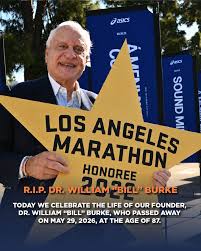
Dr. William “Bill” Burke — who passed away at age 87 on May 29, 2026, surrounded by his family — was many things: among others, entrepreneur, civic leader, and father of the City of Los Angeles Marathon.
“Bill was once famously quoted as saying that ‘the Los Angeles Marathon was for the community not the runners’,” wrote McCourt Foundation COO, Murphy Reinschreiber, the organization that currently conducts the Asics LA Marathon. “He meant that the marathon was for the runners and the community, putting the emphasis on the community. This is exactly the formula that has made major city marathons so successful.”
Bill Burke was an unlikely figure to leave a lasting mark on the sport. He did not come from the marathon world. Instead, he won the bid to stage the race from the L.A. City Council in the wake of the successful 1984 Olympic Games, where he served as Tennis Commissioner. The city was especially enthralled by the inaugural Women’s Olympic Marathon, won by America’s Joan Benoit. As Commissioner of Tennis for those Games, Burke parlayed his charisma, political ties, and long civic résumé into a bid none could match.
The inaugural race in 1986, starting and finishing at the L.A. Coliseum, drew a first‑time record 10,787 runners — even as it ran a $350,000 operating deficit. Burke absorbed the loss and pressed on with business partner Marie Patrick. They approached the marathon as a business rather than a sporting contest, and Bill used his communications background to expand the event’s reach in what had long been a difficult market for marathons to crack.
After growing up in Cleveland and earning his undergraduate degree from Miami University of Ohio, Burke served as an Air Force officer and, by age 25, had become deputy commander of the Armed Forces Korea Network, building studios and producing programs. He later earned an Ed.D. from the University of Massachusetts — a credential that suited his instinct for structure and the human side of organizations.
But the detail that stays with me is this: a man who would stake his professional reputation on a 26.2‑mile foot race had once run a television network in Seoul and mined gold in West Africa before anyone in American running had heard of him. Bill Burke came to the marathon the way he came to most things — sideways, from somewhere unexpected, with his well‑pressed sleeves already rolled up.
Whether in the boardroom or on the stage overlooking the start line, he was always well turned out beneath that corona of bright white hair. He was not the kind to wear running shoes to business meetings.
Peter Ueberroth’s 1984 Games were a revelation — a financial success after years of Olympic turmoil, and a civic spectacle Los Angeles had never quite seen. For those of us who attended, it was L.A. at its best: open roads, blue skies, and a sense of shared purpose. I stayed at the same hotel as Muhammad Ali — a close friend of Burke’s — and sat beside his table each morning at breakfast. Burke later said he wanted to spend the rest of his life recreating the feeling of those magical 17 days. The marathon became his vehicle, and for years he brought Ali to the start line, where he stood beside him waving runners on.
What he built was something the sport’s traditionalists — including me — never fully gave him credit for: one of the grand spectacles in the marathon world. I used to say L.A. was a major event but not a major marathon. Yet in a city without a center, always threatening to fragment, the race found a way each year to wrap its winding course around a vast, divided landscape and create, if only for a morning, a sense of community. That was not nothing. It was, in fact, quite something.
Burke was also capable of genuine creative vision. In the summer of 2003, after the race finished its 18th running, knowing that as a for‑profit race L.A. would never outspend Boston or London for elite talent, he and Marie Patrick invited me to his Century City offices to discuss the race’s future. Kenya’s Mark Yatich had just won in 2:09:52 — a course record — but an occasional fast time wasn’t going to redefine the event.
What emerged from that meeting was my idea for a gender‑challenge as the event’s competitive signature: a single narrative pitting elite men against elite women, giving television a format they could follow and audiences a reason to care regardless of an athlete’s name recognition.
Burke immediately understood its value. Whether or not he knew he was nearing the end of his ownership — he and Patrick would sell the marathon to Devine Racing for $15 million in 2004, while remaining to oversee operations — he committed to the challenge concept and launched it in March 2004.
The proof came quickly. Although the winning times were slower than the year before, the competitive drama of the chase held until the final mile, and television ratings rose dramatically. As our television producer Phil Olsman said afterward, “We gave them a reason to watch.”
In the wake of that success, both Honda USA and KNBC‑TV extended their partnerships, and new sponsorship followed as the format gained traction and the prize rose to $100,000.
Beyond the marathon, Burke served as chair of the South Coast Air Quality Management District for 23 years, as Consul General to the Republic of Mali, as president of California’s Fish and Game Commission, and as chair of the Wildlife Conservation Board. He was married for 53 years to Yvonne Brathwaite Burke — California’s first Black congresswoman and a longtime member of the Los Angeles County Board of Supervisors. They had two daughters, Autumn Burke and Christine Burke Adams, and a granddaughter. Bill died just 16 days after his May 13 birthday; no cause or location was released.
Did the L.A. Marathon ever fully realize its competitive potential? No. Some of that stemmed from Burke not coming from the sport itself. He didn’t follow it as a fan. But he understood the event’s civic value completely and took pride — rightfully — in how it brought Los Angeles together, again and again, after moments when the city had been pulled apart by fire, flood, or civic unrest.
Students Run L.A. (SRLA) became a defining part of the event’s legacy, one of the most successful ancillary programs in the marathon world, touching tens of thousands of young runners in ways no prize purse or race result could measure.
As a for‑profit enterprise, Dr. Bill Burke did very well by the Los Angeles Marathon. But the Los Angeles Marathon — and the city itself — did very well by him, too.
The last time I saw him was in 2022, when the marathon, now under the auspices of the McCourt Foundation, honored Dr. Burke with the inaugural L.A. Marathon Gold Star Award. He stood, as always, wide face beaming, part impresario, part host, still welcoming the city to the race he built.
RIP, Bill. Your race has been run. You will be remembered and missed.
END


Ha! Meant “Chair” in first para 😀
Toni,
I met Bill Burke for the first time when I was serving as hair of Men’s Long Distance Running (TAC and later USATF) in late ’84 or early ’85.
He came to NYC to meet with Fred Lebow, Alvin Chriss and me at the NYAC.
Basically he was seeking advice a tacit permission from Fred to create the LA Marathon. This was the Fred (and Alvin) that most didn’t see or understand. They were classic negotiators and a bit ruthless.
Bill wanted to put LA on in the fall as an “East West” competition. Fred was vehemently opposed. He said that “If you try that. I will crush you!”
I was stunned by the directness.
Fred went on to say “However, do it in the Spring and I will support you!”
It was a very fluid time in our beloved sport and I am grateful I was in the room.
Later, as an agent for Ernest Tjela, I was a guest at the cocktail party Bill hosted prior to the race. I consider the evening very memorable because I was introduced to Muhammad Ali, shook his hand and mumbled something innocuous. After all, he was “The Greatest”. Sadly, I never got a copy of the photo taken (Bill thought of everything including having a photographer present).
Your well-written piece is a succinct treasure.
Creigh
well done Toni. You captured the Bill Burke whom I knew perfectly. Bill certainly made things happen!