
In The Wealth of Nations, Adam Smith argued that when “effectual demand” overwhelms available supply, the market must adjust. That’s what we have here, “effectual demand.” The 21st‑century running boom didn’t knock politely on the door of the London Marathon—it blew the hinges off. With 1.33 million entry requests for 2026—and room for only 60,000 finishers— the market of human ambition completely outstripped traditional capacity. So, London has responded by building an entirely new supply line.
While every major marathon currently conducts a 5K, a 10K, or a half-marathon on race weekend, in 2027, London takes it to an Elon Musk level, breaking the single‑day limit to become the world’s first full‑scale Marathon Weekend. Held Saturday, April 24, and Sunday, April 25, organizers are calling it “The Double.”
This is more than athletic expansion; it’s civic choreography. London Mayor Sadiq Khan and city leadership stood with organizers to greenlight the move, framing London as the “sporting capital of the world” and aligning City Hall behind a 48‑hour logistical experiment of unprecedented scale.
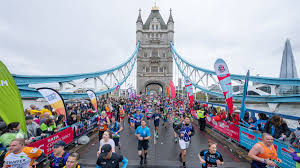
By stretching to a full weekend, field capacity jumps to 100,000 runners. Organizers project £150 million in charity fundraising and £400 million in social and economic benefit — a conservative figure given that New York, Chicago, Boston, and Honolulu each generate more than $500 million.
Walking Before We Run: The Strategic “One‑Off”
A shift this large invites immediate scrutiny. Closing the core of a global metropolis for an entire weekend creates real civic friction. So organizers have framed 2027 as a strict one‑off — a political masterstroke that lets operational reality, not pre‑commitment, determine the future.
History suggests skepticism. Transformations of this scale almost always debut wearing the mask of temporary celebration. The first five‑borough New York City Marathon in 1976 was billed as a one‑time Bicentennial event. But its cultural impact was so explosive that it instantly redefined global road racing and helped inspire the urban marathon boom that led to London’s own debut in 1981.
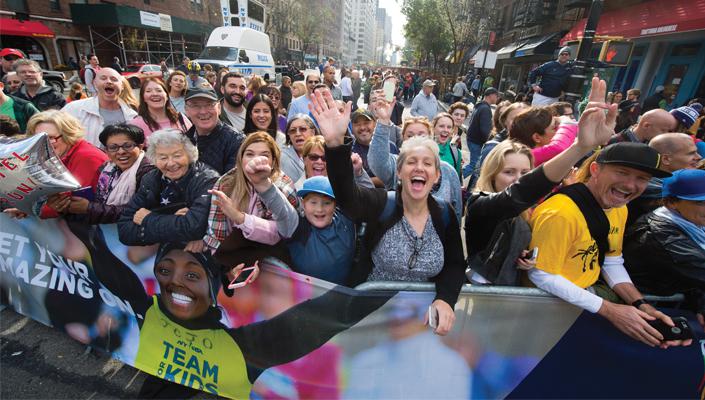
If history runs in cycles, 2027 won’t stay a one‑off. It will become a template — and a precedent — for every other major marathon negotiating with its own city leaders.
Splitting the Spotlight: A Broadcast Breakthrough
The most structurally interesting innovation from my standpoint is the separation of professional fields. Elite women race Saturday; elite men race Sunday, with para‑athletes and “good for age” runners aligned accordingly.
For decades, marathon broadcasts have been forced into frustrating compromises: a decisive move in one race gets cut away to capture the closing miles of another. The drama isn’t lacking — the format is. With so many racing divisions, and only one narrow broadcast window, something had to give.
Giving each field its own day fixes that (hopefully). Broadcasters can deliver uninterrupted, start‑to‑finish tactical coverage, with distinct commercial narratives and sharper fan engagement. The elite races stop serving as warm‑ups for the mass event and become standalone, prime‑time products (hopefully). This is not just a scheduling tweak. It’s a media re‑architecture (hopefully).
I say “hopefully” because I’m still skeptical about what broadcasters will choose to do with the new format. Give them a full, uninterrupted window, and the easy move is still to show watch parties, costume shots, and the churn of the mass field, rather than holding the camera on the tactical battle at the front for the full 26.2 miles, especially when that battle is being run by athletes most audiences have never been taught to recognize or root for. Hopefully, I’ll be proven wrong.
The Cost of Closing a City Twice
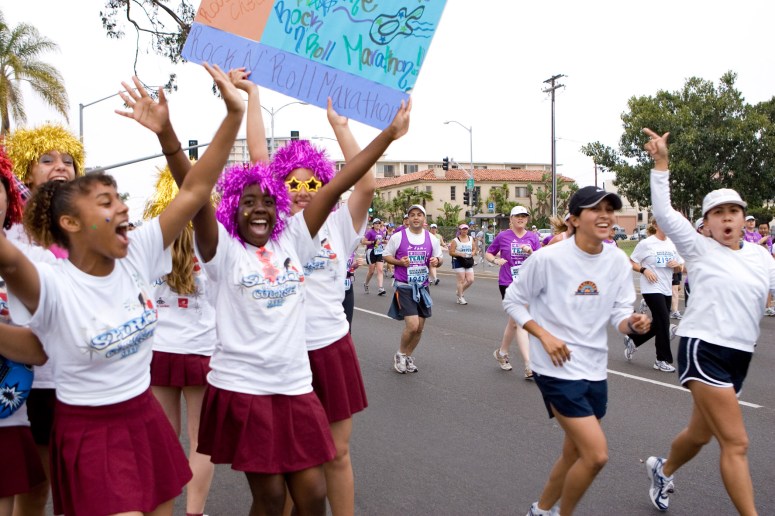
Before we get too giddy, there’s the matter of civic disruption to consider, and it isn’t a footnote— it’s the fulcrum. I’ve seen this tension firsthand. When the Rock ’n’ Roll Marathon debuted in San Diego in 1998, closures around Lindbergh Airport and Mission Bay triggered sustained pushback from residents and businesses who felt blindsided by a route that commandeered their Sunday.
For every runner celebrating at the finish, hundreds of locals were rerouted, delayed, or cut off from customers. That tension never disappears; it gets renegotiated annually.
Now multiply that by two consecutive days in a city the size of London. The Mall, Greenwich, and the arteries connecting them won’t absorb one disrupted Sunday — they’ll absorb an entire disrupted weekend. Emergency services, transit operators, and local businesses will be asked to hold the line twice instead of once. That is not a trivial ask.
Calling 2027 a one‑off is, in part, an acknowledgment of that civic cost — a recognition that goodwill is finite. An experiment becomes permanent only if the city’s verdict, not just the runners’ or broadcasters’, comes back favorable. San Diego learned that the hard way: a race never belongs solely to the people running it.
The Long View
The so-called second running boom shows no sign of easing. The cultural forces driving it — personal transformation, communal engagement, philanthropic purpose — remain powerful drivers. By turning a bottlenecked event into a two‑day festival of endurance, London isn’t just reacting to demand; it’s testing whether a city’s patience can stretch as far as its runners’ ambition.
I have always thought there were four pivotal events in marathon history:
1) The inaugural Olympic Marathon in 1896;
2) The first Boston Marathon in 1897;
3) The inaugural five-borough New York City Marathon in 1976, introducing the urban marathon; and
4) The Rock ‘n’ Roll Marathon in San Diego in 1998, introducing entertainment along the course, drawing the first majority female field ever.
I think London 2027 might add a fifth entry to that list.
Already the largest and fastest marathon in the world—site of the first official sub-2-hour marathon in history—the real verdict on London’s proposed “Double” won’t come from finish‑line totals, broadcast ratings, or even economic impact studies. It will come from whether Londoners who never laced up a super shoe still feel the weekend was worth it. That’s the number nobody is tracking — and the one that will decide whether 2027 becomes a one‑time spectacle or the new shape of the sport.
END


Great essay!
Great insights, as always.