
I have always drawn a distinction between runners and racers.
Runners produce fast times in controlled environments—behind pacemakers, within a defined rhythm, insulated from disruption. They are like actors executing a script.
Racers win competitions, especially major ones where split‑second decisions and risk can create reward or devastation. The difference is not primarily physical. It lies in how an athlete responds when fatigue impairs judgment and uncertainty crowds out clarity. Racers are like improv comics, reading the room, sensing opportunity before it’s visible.
To step into a race where place matters more than pace—where the target is not a clock but another athlete who refuses to yield—requires a different orientation. Some athletes sharpen under that pressure. Others flatten. That is where champions emerge.
That distinction is why winning should remain the primary currency of the sport, as it is at the Olympic Games. The race is what it is. The time is just what it took.
Case Study:
Valencia & New York, 2024
On December 1, 2024, Sabastian Sawe won the Valencia Marathon in his debut in 2:02:05, then the fifth‑fastest marathon in history. Ten men broke 2:05 that day, including Switzerland’s Tadesse Abraham, fifth in 2:04:40.
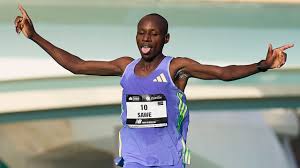
(Getty Pictures)
Five weeks earlier, Abdi Nageeye won the New York City Marathon by six seconds in 2:07:39, out‑kicking 2022 champion Evans Chebet as they re‑entered Central Park after 26 miles of bridges, wind, and surges. It echoed Alberto Salazar’s 2:09:29–2:09:33 win over Rodolfo Gomez in 1982, the famous “cloud of dust” finish.
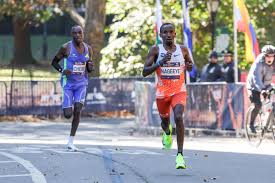
(Kevin Morris photo)
Both Valencia and New York are World Athletics Platinum Label marathons. Both award the same placing points. In 2024, first place at a Platinum Label Marathon garnered 170 points, which would be added to the performance (time) score. Second earned 130, third 115, fourth 100, and fifth 85.
By that measure of time and place, Valencia’s third-placer, Daniel Mateiko of Kenya, running 2:04:24, earned 1,349 points (1,234 for performance, 115 for place). Abdi Nageeye’s New York City victory earned 1,343 points (1,173 for performance, 170 for place).
The winner of the non‑paced, hilly, loaded‑field New York City Marathon earned six fewer points than the third‑place finisher of the paced, flat, optimized Valencia Marathon. Does that sound right to you?
2024 PLATINUM LABEL COMPARISON
VALENCIA — DEC 1, 2024
Fastest marathon of 2024 — Major titles in the field: 0
- Sabastian Sawe (KEN)2:02:05 — 0 majors
- Deresa Geleta (ETH)2:02:38 — 0 majors
- Daniel Mateiko (KEN)2:04:24 — 0 majors
- Alphonce Simbu (TAN)2:04:38 — 0 majors
- Tadesse Abraham (SUI)2:04:40 — 0 majors
NEW YORK — NOV 3, 2024 •
Tactical — Major titles in the field: 8 (+ Olympic Gold & silver)
- Abdi Nageeye (NED)2:07:39 — Olympic silver 2021; 1st major
- Evans Chebet (KEN)2:07:45 — 3 majors: Boston 2022, NYC 2022, Boston 2023
- Albert Korir (KEN)2:08:00 — 1 major: NYC 2021
- Tamirat Tola (ETH)2:08:12 — 2 majors + Olympic: World 2022, NYC 2023, Paris Gold 2024
- Geoffrey Kamworor (KEN)2:08:50 — 2 majors: NYC 2017 & 2019
Both = 170 placing points for first
Third in Valencia > Win in New York
Major = World Marathon Major win or Olympic/World Championship marathon
┌──────────────────────────────────┐
│ TIME BEATS PLACE │
│ Using the revised 2026 WA Placing Table │
│ VALENCIA 2024 (Platinum) │
│ 1st – 2:02:05 – 1,278 +120 = 1,398 │
│ 2nd – 2:02:38 – 1,267 + 90 = 1,357 │
│ 3rd – 2:04:24 – 1,234 + 80 = 1,314 │
│ 4th – 2:04:38 – 1,229 + 70 = 1,299 ← beats NYC 1st │
│ 5th – 2:04:40 – 1,229 + 60 = 1,289 │
│ │
│ NEW YORK CITY 2024 (Platinum) │
│ 1st – 2:07:39 – 1,173 +120 = 1,293 │
│ 2nd – 2:07:45 – 1,171 + 90 = 1,261 │
│ 3rd – 2:08:00 – 1,167 + 80 = 1,247 │
│ 4th – 2:08:12 – 1,163 + 70 = 1,233 │
│ 5th – 2:08:50 – 1,151 + 60 = 1,211 │
│ │
│ Using the revised Place points table of 2026,
Valencia 4th outscores NYC 1st by 6 points. │
│ Same label tier. Different clock. │
└──────────────────────────────────┘
It isn’t an anomaly. It is policy.
The Ranking Problem
World Athletics calculates every performance as Result Score plus Placing Score. Result Scores come from performance tables. Placing Scores come from a meet’s label category: Platinum, Gold, Elite, Label (base).
Beginning January 1, 2026, World Athletics reduced placing scores by roughly 30 percent across the board. A Platinum Level Marathon victory dropped from 170 placing points to 120; fifth place from 85 to 60 points. As a result, time now carries even more weight than before.
Athletes and agents have responded logically, seeking courses that minimize volatility—flat, cool, heavily paced, with minimal turns—because a fast time on an optimized course may return more ranking value than victory on a demanding one. Race directors have responded just as logically. Courses are refined. Pacemaking extends deeper. Start times chase weather windows.
None of this is inappropriate. It is simply optimization. The problem is that optimization increasingly outscores competition.
Kenyan athletes have long told me that time matters more than place. That preference predates rankings; it comes from bragging rights in training groups and contracts that reward times. World Rankings didn’t create that culture. But they formalized it. And in 2026, they strengthened it.
Two Marathons, One Distance
We are now watching two distinct tests diverge, much as golf distinguishes between stroke play and match play.
Valencia, Berlin, and Chicago on a cool, calm day represent one form: controlled pacing, minimal elevation, predictable conditions, the objective being efficiency and the output being time.
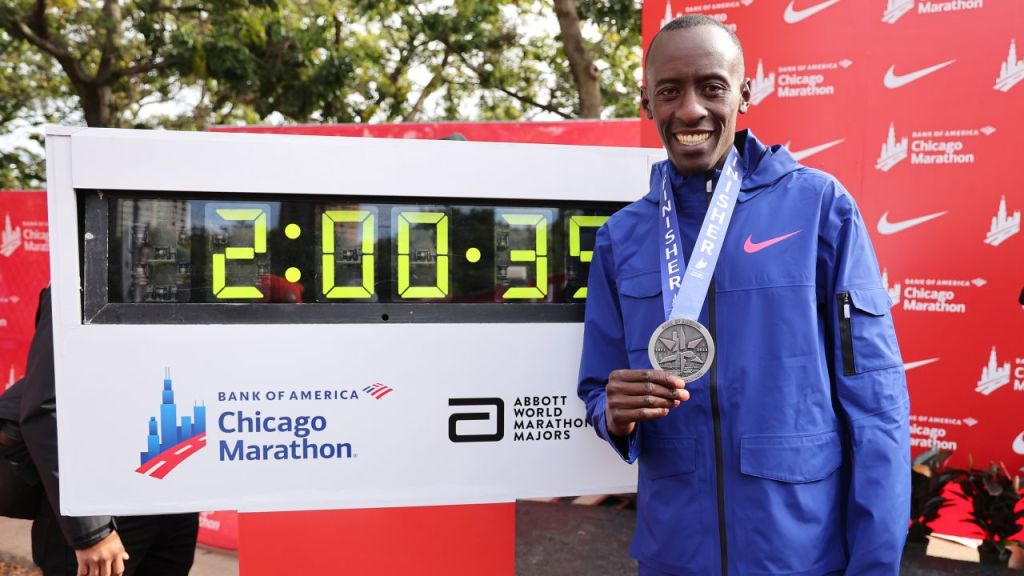
New York, Boston, and the Olympics in August represent another: variable conditions, uneven terrain, tactical attrition, the objective being to beat the field and the output being outcome.
These are not the same test producing different results. They are different tests rewarding different skills. One favors rhythm and efficiency. The other favors adaptability, patience, judgment, and risk. Yet the current rankings place both on a single scale—one now tilted further toward the first.
This is not to suggest paced races can’t be thrilling, too — London 2026 proved that when Sawe and Yomif Kejelcha battled into the last 2K, with both finishing under two hours.
“It is not only what you run, but who you beat. That’s why it’s called a race.”
The Neutrality Argument
World Athletics would argue the system is internally consistent. It measures one thing—performance quality as expressed through time—and applies that measure uniformly. Apples to apples.
But time is not a stable unit of measurement across marathon courses. A 2:04:40 in Valencia and a 2:07:39 in New York were not produced on the same scale with different numbers. They were produced under fundamentally different conditions—pacing infrastructure, course profile, weather, field dynamics. Treating them as commensurable is like comparing a wind‑legal 100 meters to one run into a headwind and concluding the times speak for themselves.
The system isn’t rating apples to apples. It’s rating Valencia apples to New York oranges, then insisting the scale is neutral because it only measures weight.
The second defense is that the market already sorts the distinction. Fast runners go to Valencia, racers go to New York, and the ecosystem self‑balances. Appearance fees, prize money, and prestige keep competition marathons viable.
That is true today. The question is whether it remains true as ranking pressure compounds. A young Kenyan with a contract clause tied to his ranking cannot spend three months preparing for a tactical battle in New York when a paced effort in Valencia returns 70 more points. Over time, fewer athletes develop racing skills at the elite level. The competition marathons hollow out—not all at once, but gradually—until New York and Boston are fast but not deep, and competition becomes a second‑tier product by default.
Prestige attracts athletes. Rankings shape which athletes those are, and what they practice becoming.
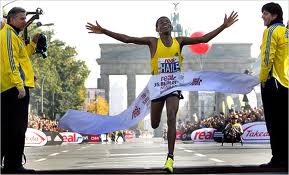
Eliud Kipchoge won two Olympic gold medals and is rightly called the greatest marathoner ever. Yet he never attempted Boston or New York in his prime. Haile Gebrselassie and Kenenisa Bekele—record holders, GOAT candidates—also never ran Boston or New York during their prime years. That should give us pause.
What Should Rankings Reward?
The question is definitional: What should a marathon ranking reward?
If the answer is preferentially time, the logical endpoint is ever‑greater control—more pacers, more technology, more standardization. At some point, why not simply dome the course or time‑trial every elite ala the Tour de France?
If the answer is competition, then unpredictability is not a flaw to be engineered away; it is the whole point of the enterprise. Beating a world‑class field on a difficult course in difficult conditions is not the same act as executing even splits in ideal circumstances. Both require excellence. They do not require the same excellence.
World Athletics was right to address distortions in the previous system. But reducing placing scores solved one imbalance while creating another. A better recalibration would preserve time as a critical measure while restoring competitive value:
- Scale placing points according to strength of field, not race label alone.
- Provide modest recognition for championship‑style courses where tactics replace pacing.
- Retain the two‑score minimum for marathons but require one result from a designated competition marathon.
The objective is not to diminish fast running. It is to recognize that marathon greatness has always involved more than running fast. It is not only what you run, but who you beat. That’s why it’s called a race.
The Narrowing of Excellence
World Athletics’ head Sebastian Coe has said he does not want to stifle innovation. Innovation is not the threat. Narrowing the definition of excellence is.
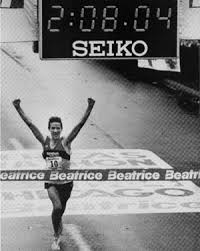
In 1984, Steve Jones broke the world record in Chicago, running 2:08:05. One week later, in brutal heat and humidity, Orlando Pizzolato won New York in 2:14:53 despite stopping six times. Are we to assume Jonesy would have won in New York because he ran six minutes faster on a flat course in cool weather the week before? The performances were different because the tests were different. Yet modern rankings increasingly treat them as variations of the same thing.
We are measuring a smaller slice of performance with ever‑greater precision and mistaking it for the whole. At that point the marathon begins to resemble a laboratory exercise more than a contest.
I began by distinguishing runners from racers. The 2026 rankings did not invent that divide. But they are helping to institutionalize it. Unless we decide that both forms of excellence deserve equal value, the sport will continue rewarding time at the expense of competition—and that would short‑change the most intriguing element in any race: the moment an athlete decides to go all‑in, and the rest of us inch closer to the edge of our seats.
END


A terrific article. This distinction — what some of call “racers vs pacers” — it’s something that is truly forgotten and sometimes even ignored when people are simply chatting about race performances. I myself fall into the “racer” category, as a friend pointed out to me after he observed my pattern of taking on difficult courses and relying on competitive strategies mid-race instead of keeping eyes on my dumb little Timex watch and ticking off even splits. I’m not saying one technique is better than the other but the difference between the two styles is, I think, being forgotten as the world of super shoes and pacers seems to take untoward importance.
Great piece as always Toni. I think some of this is on the majors. I’d like to see them add and drop rabbits. In South Africa, it’s a big deal if you can win Comrades in an up year as well as a down year.
I’d like to have NYC, Chicago, etc not have rabbits some year. The ultimate marathoner would be someone who could do it all – WR, win flat rabbitted races, win flat unrabbited races, win hilly races without and with rabbits.
Kipchoge did the first three. He never did any of the final 2. As great as he was, we need to view him as like Pete Sampras – there was a huge hole on his CV – he couldn’t win on “clay” in Boston/NYC. Could he have won in Boston/NYC in his prime, i’m not sure. I doubt it. He got killed in Boston the one time he ran it and that was 7 months after his WR in berlin (and 5 months before another Berlin win).
Unlike the Olympics the World Championships marathon doesn’t mean much these days.