
In my last post — I TEACH COMPETITION — I described how a teacher’s mindset — the one I brought into the broadcast booth nearly fifty years ago — still shapes how I call a race. Here’s a comparative lesson in what that looks like.
Foot racing and poker may seem to have little in common. One is played at full throttle on a track or road using human power as the discriminator. The other is conducted seated around a table using playing cards and poker chips. But both present competitors with incomplete information requiring astute resource management.
In both racing and poker, you know your own resources, but you don’t know exactly what your opponents have. And every decision changes the odds of what comes next.
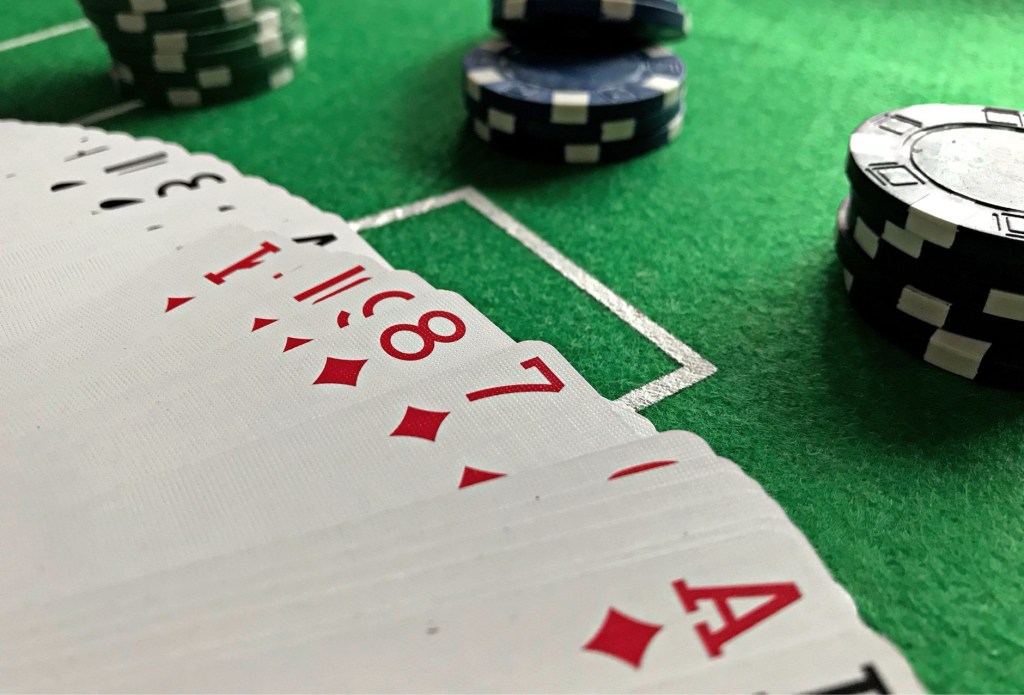
The stack. A runner’s energy is the poker stack. You begin a race with a finite number of chips (fitness), and every surge costs some of them. You can call a small bet and stay in the hand. But you can’t call every bet. Eventually, you go broke before the river (last lap/mile).
The all-in. Three-time Falmouth champion Bill Rodgers once described the key moment in a race this way: “You are already going hard, then somebody makes a move. You don’t want to go, but there is no two kilometers ahead. There is only this, and this is for victory.”
That’s someone pushing all-in when everyone is already short-stacked. You don’t want to call. But if you fold now, you are likely folding the race.
Position. In poker, the best position is the button, the last player to act. Betting last means you see everyone else’s move before you have to make yours. In racing, good position is at the rail, shielded from the wind, and in the draft. The runner tucked behind another runner spends less energy than the one doing the work up front, and he gets the same edge as the button: he watches what everyone else does before he has to answer. That’s why the decisive move often comes from second or third rather than first.
The leader has already been spending his stack, and he’s the one acting blind — unless the stadium has Jumbotrons. Then the analogy breaks down, because he can just look up and see the field behind him. I think that’s a real loss. It turns a blind bet into a calculated one, and the race loses some intrigue in the trade.
Without Jumbotrons you can still win from the front. But it’s a dicier bet and your hand better be strong.
Bluffs. Not every surge is an attempt to win the race. Some are attempts to gather information. Go hard for 100 meters and see who covers easily. Who hesitates? Whose shoulders tighten? Whose face shows signs of a grimace? It’s a probe bet.
Average announcers call every surge as though it were the winning move. A better announcer asks what the move was designed to accomplish. Sometimes the answer is nothing yet. The runner is simply asking a question.
Tells. Poker players watch for physical clues. So do experienced racers and watchers. In running, the tells might be a change in arm carriage, a tightening of the shoulders, a runner drifting off the rail, a glance down at the legs, or a slight alteration in cadence. The best runners can conceal almost everything. That’s part of what makes them dangerous. They may look completely composed while deciding whether to put the race away.
Pot odds. This may be the most important comparison. A runner racing for place thinks: If I go with this move, I might blow up and finish eighth instead of third. A champion—or someone willing to race like one—thinks: If I don’t go now, my chance of winning goes to zero. So he goes. The math is the same as calling with a big enough pot. The risk is real, but the reward justifies the call.
Where the analogy breaks.
In poker, you can fold and keep your chips for tomorrow. In running, you can’t hide. Your cards are your physiology, your preparation, your confidence, and your ability to tolerate discomfort. There is no lucky river card waiting at mile 24, or with 200 meters to go in the mile. You either did the training and have the reserves, or you didn’t and don’t. And when you don’t, the pain is public.
That’s what I want to make visible when I call a race. Not simply who is moving faster, but why someone is moving, what it costs, what information a move reveals, and what decision may be coming next.
Once you know what to look for, the position, the tell, the bluff, the pot odds, a race stops looking like people just running hard, with victory or defeat waiting at the finish. It starts looking like a hand being played.
There is one other wrinkle in the analogy. Deep into a race, when you need your wits most, clear thinking becomes harder. Fatigue clouds attention and beggars precision. The body is screaming for mercy while the mind is trying to decide whether this is the moment to go. That’s one way champions separate themselves: knowing when the moment has arrived, and having the courage and reserves to act despite the price in pain.
That’s what teaching competition really means, not describing the moves, but showing people how to read the hand. Once you can see it, you’re not just watching a race anymore. You’re watching decisions get made and played out.
You’ll see all of it in the Falmouth miles Saturday night: the probe bets after the pacer falls off, the tells in lap three, the positioning at the bell and—if the race unfolds as it might—the all-in at 200 to go.
END


Toni,
I improved my racing as I aged (certainly not my PR’s 😅) by employing some of the ways I pretended to be strong when I was really tired.
There are so many tricks (or ways of bluffing) I learned by one on one conversations with super elite distance athletes.
One I remember was an athlete would come up on the shoulder of another and say, with a positive, imperative voice ” You’re looking good” and then powering ahead without looking back. Another I recall watching at Bloomsday long ago as I did the color for TV from the lead vehicle.
It was around the 5.5 mile mark after “Doomsday Hill” (I might be slightly off on distance). Jon Sinclair and another athlete just a step in front were leading. I noticed Jon slip to the side, put his head down and race the next 400m in 60 seconds. I knew how he thought and knew he wanted to crush the athlete there and not depend on the last 400m and it worked.
Your previous essay and this one now stand as two of my favorites!