
The ups giveth and the downs taketh away. It is the arc of life on this temporal plane.This past week, two more big names were brought down by the Athletics Integrity Unit. First, the AIU banned Ethiopia’s Ruti Aga, the 2019 Tokyo Marathon champion, for six years after a case involving a prohibited substance and a forged prescription she offered to explain it. Then, on Friday, Kenya’s Peres Jepchirchir, the Olympic and reigning world marathon champion, was provisionally suspended after an out-of-competition sample returned an adverse finding for EPO.

Jepchirchir’s case is not a final verdict, and it must run its course. But within days, two cases involving some of the most decorated women in the marathon raised a question professional road running can no longer leave unanswered: How many times can the sport ask people to renew their faith in its champions? How often can they, themselves?
The roll call of cheats continues to unfurl like Jack Kerouac‘s On the Road manuscript. What once shocked us now barely registers. And that may be the most grievous sign of all.
The Boom That Built a Culture, Not a Sport
To understand how we got here, it helps to remember the promise and the hope.
Against the backdrop of Watergate and the Arab oil embargo, the running boom took off like a rocket. Almost nobody saw it coming. Frank Shorter‘s Olympic marathon victory in 1972 helped light the fuse. For most who followed him onto the roads, there wasn’t a penny in it. The reward was in the doing and the striving. After years of protesting just about everything, it was time for my generation to be for something.
Then the second-stage booster fired. Events multiplied to meet the demand, and New York City’s five-borough marathon offered the model: the city as arena, the race as urban adventure for people seeking purpose, health, and community. The boom built a vast participatory culture. What remained unknown was whether it would build an equally durable professional sport.
For years, the money at the top was hidden beneath the table, carried in white envelopes and dispensed in hotel hallways and bedrooms. Everyone knew what was going on, but the rules required everyone to pretend otherwise.
Eventually the hypocrisy became unsustainable. Athletes pushed for the right to earn a living, governing bodies resisted surrendering control, and so they agreed on a way to pay athletes while skirting the word professional.
<Paying athletes and building a professional sport are not the same thing.>
When above-board money came into view, it was a major step forward. The people whose performances gave the sport its highest expression deserved to be recognized financially. But paying athletes and building a professional sport are not the same thing.
What failed to develop alongside the money was a coherent structure: one that could make runners recognizable, give the public a reason to follow their careers, and align the events’ commercial interests with shared responsibility. Other major sports have leagues, commissioners, unions, tours, and teams with contracts on the line. Road running built a marketplace instead: thousands of independent contractors racing at hundreds of unaffiliated events.
The result was a succession of champions the broader public scarcely knew before the next race produced yet another. Their anonymity was not simply the athletes’ failure. It was the industry’s.
The Price of a Fragmented System
Ban the runner, and the sport could act as though the problem had been addressed, while the agent, coach, pharmacist, doctor, and federation carried on.
Into this unregulated ecosystem came doping, and the damage accumulated. Testing grew more sophisticated, but the underlying problem did not change: athletes racing across borders, represented by different agents, supported by different training groups and clinicians, competing at events with different interests and resources.
Responsibility landed on the individual who could be tested. Ban the runner, and the sport could act as though the problem had been addressed, while the agent, coach, pharmacist, doctor, event, and federation carried on.
Bans mattered, of course. Clean athletes deserved protection, results deserved correction, and cheating required consequences. But consider the arithmetic from the athlete’s side. The money usually arrives long before the test result, and it rarely comes back. Earlier pre-ban results generally stand. For a runner whose winnings have already bought houses and secured a family’s future, a damaged reputation may seem a tolerable price, particularly when the public scarcely knew the name to begin with.
And consider the example set above them. Lamine Diack, who headed the sport’s world governing body before Sebastian Coe, was convicted in France of corruption linked to the concealment of Russian doping cases. When the people writing the rules treat their positions as a source of private fortune, the sport has little moral standing to ask its poorest participants to be its cleanest and most upright.
None of that excuses an athlete who dopes. Nor does an athlete’s doping absolve the institutions. Runners are responsible for what they do; the sport is responsible for the conditions under which they compete. What has been missing is a structure that makes responsibility harder to pass off.
The economics already show the strain. During its first ten series, the Abbott World Marathon Majors paid its men’s and women’s champions $500,000 each. Since 2022, the series winner has received $50,000. Some of that money was redistributed deeper into the standings and to wheelchair athletes, but the headline reward for winning the world’s premier series had fallen to a tenth of what it was.
Doping makes a difficult proposition harder still: an event can promote a champion, celebrate the performance, only to see the result called into question months or years later. Each case becomes another withdrawal from the sport’s account of public trust.
And so the industry keeps returning to the same question: If elite athletes don’t move bib number sales — as many in the industry suggest — and we can’t trust them to be clean, why are we paying them at all?
Cleveland’s Lesson: Performance Isn’t Enough
The Revco Cleveland Marathon and 10K was one of the first double-race events of the running boom. In its early years under race director Jack Staph, it became one of the sport’s signature weekends in May, with world-class marathons and 10Ks that were even more world-class. For many years, I joined the team at WKYC, the city’s NBC affiliate, for the live television coverage. Marathon winners ran in the 2:11 to 2:16 range, and in 2000 Russia’s Pavel Kokin ran 2:10:29, a course record that still stands.
Before long, as fields began migrating from the marathon to the 10K, organizers decided to focus their professional attention on the 10K alone.
In 2003, Richard Roberts, a 22-year-old college student from Mansfield, Ohio, won the marathon in 2:28:59, the first American man in nine years to take the Cleveland Marathon title. That same morning, Kenyans swept the 10K, led by Gilbert Okari in 28:18. The next morning, The Cleveland Plain Dealer gave Roberts more attention than it had given the far faster Russian and East African winners before him.
<The running boom gave millions of people a reason to cross a starting line. Professional road racing needed to give those same people a reason to care who crossed the finish line first.>
The local runner came with a story readers could recognize. The international stars had too often been presented as little more than names, countries, and finishing times. That was not proof that elite racing had no value. It was evidence that the sport had failed to explain its value, or to systematically leverage its champions.
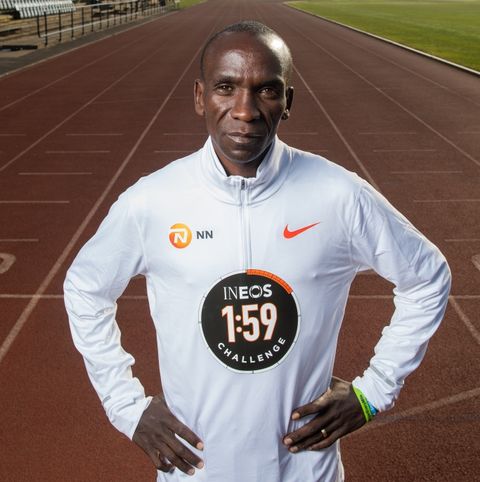
Eliud Kipchoge did break through, but look what it required: more than a decade at the top, two Olympic golds, the Breaking2 Project — with all of Nike‘s storytelling machinery behind it — the INEOS 1:59 Challenge, plus a persona people could attach to. That is not a system producing recognizable stars. That is one extraordinary career plus outside capital forcing recognition through.
The running boom gave millions of people a reason to cross a starting line. Professional road racing needed to give those same people a reason to care who crossed the finish line first when they stopped being home country heroes. For too long, it was just assumed one interest would naturally produce the other. It didn’t.
The Starting Line Will Survive. What About the Finish?
Now each new doping case asks the public to invest its faith again. Whatever the outcome of Jepchirchir’s case, the larger problem remains. The danger is not simply that another champion will be banned. That’s a given. It is that fewer people will pay attention to who fills the vacancy. And when another record is broken, doubt will cross the line in a close second.
The issue is whether anyone still cares enough about the front of the race for professional road running to flourish as a sport rather than merely survive as an adjunct to mass-participation events. Call it professional road running’s Gravity’s Rainbow: a brilliant ascent whose promise the sport mistook for a permanent trajectory.
This fall, runners will gather at the sport’s starting lines in greater numbers than ever. But at the leading edge, professional road racing can no longer assume they will be watching what happens up front.
END

