
This morning I got up, and the first NFL game was already on. It was being played in London, and the kickoff was 6:30 a.m. Pacific. If I wanted to, I could watch football straight through until ten o’clock tonight.
I won’t. And that is the point.
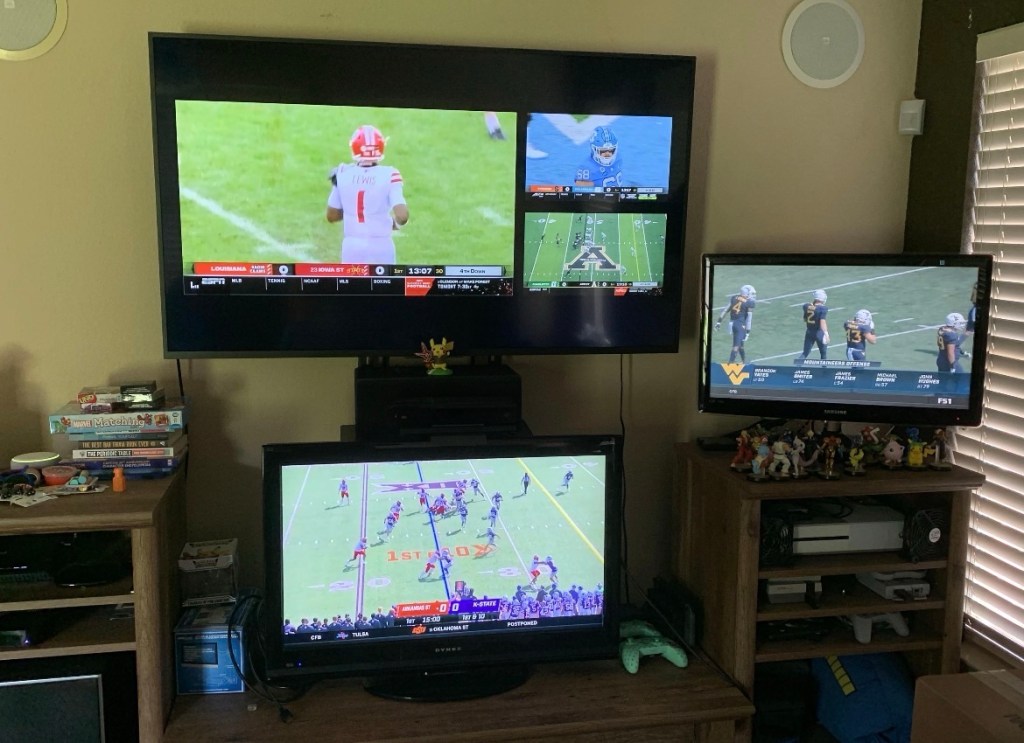
My friend Pat called from Boston to talk about this saturation in today’s sports culture. We got to remembering.
When we were kids, there was so little sports on television that we’d watch anything they put in front of us. The Saturday Game of the Week. ABC’s Wide World of Sports, with its cliff divers and barrel jumpers. Stock cars roaring around southern tracks, featuring Richard Petty and Cale Yarborough. It didn’t matter. It was sports, it was rare, and we were grateful for it.
The World Series was played in the early afternoon then. So we’d sneak our transistor radios into class. We threaded the earpiece up through our shirtsleeves, propped our elbows on the desk, and rested our heads on one hand. Meanwhile, the teacher pretended not to know.
Scarcity created desire. We had to work to get our games, and the work made them matter.
Today, the World Series starts at eight o’clock on the East Coast. How many kids fall in love with a sport whose biggest moments happen after they’ve gone to bed?
The old map of sports was small enough to memorize. The NHL had six teams. Baseball had sixteen. The seasons were distinct: baseball in summer, football in fall, hockey and basketball in winter.
Now every Sunbelt city has a hockey team. The NBA crowns its champion in late June. On Saturdays, five college games air at once while the WNBA playoffs run on another channel.
We used to say you couldn’t see the forest for the trees. Now there’s so much forest you can’t see a single tree.
And where is any of it? Network, cable, Prime, Netflix, Peacock? The answer changes every season. You need a guide just to find the game.
Then there’s continuity, or the lack of it. Players used to spend whole careers in one city. Whole generations knew a man as a Cardinal or a Red Sox. Now free agency, the transfer portal, and NIL money move players faster than fans can learn their names. NFL teams must win while their quarterback is still on a rookie deal, before the salary cap squeezes everyone else out.
So kids attach to something else: individual players, fantasy rosters, highlight clips. And increasingly, the bet. With gambling everywhere, many no longer care who wins. They care whether some player goes over his rebound total in the third quarter. The game becomes a delivery system for wagers.
Last night, I was watching the Padres and the Brewers in the opening game of the National League Division Series. This was my home team, with a trip to the NLCS at stake. Toya came out of the bedroom, where she’d been watching a Netflix movie, and asked what happened to the game.
I’d turned it off in the seventh inning with the score tied 2-2. It was 100°F in San Diego, so I’d been inside watching sports all day.
Abundance hadn’t made me love sports more. It had stuffed me like the Christmas goose. Either way, I had no more appetite.
Sports are just one example. Dinner arrives via DoorDash, everything else via Amazon. When something is always available, it stops being special.
That’s why I keep coming back to running. (Didn’t think I’d get there, did you?)
Running has always been a way to get away from all that. No schedule to follow, no channel to find, no subscription to renew, no roster to memorize. I don’t have to watch anybody else do it. I can simply go out and do it myself and find a measure of fulfillment.
After a lifetime of watching sports, I find something grounding about that. Running asks for my active involvement rather than simply my consumption. It gives me something to do rather than something else to watch.
Jerry Seinfeld once joked that we’re really rooting for laundry. Now even the laundry changes.
Go, team! Whoever you are.
END


Hope you had a chance to watch both the Diamond League finals and the World Ultimate Championships. I did but I had mixed feelings about having both, even though they had different ways of getting into them. It did allow for fans to get to see them live when only one week apart. Your thoughts?