
Celebrating the 50th anniversary of its iconic five-borough format, the 2026 TCS New York City Marathon was as good an advertisement for unpaced racing as we are likely to see in this day and age of primarily rabbit-assisted contests. Could the runners have gone faster with pacers on such a perfect day? Absolutely. Did it matter in the least? Not one whit.
Racing, by its nature, presents athletes with a series of questions to answer, making it a contest of the mind as well as the flesh. A rabbited affair, until the pacers step off, asks mainly one: Can you hold this pace? Those first 15 or 18 miles are a prologue. In an unpaced race, as Sherlock Holmes might have said, the game is afoot from the gun.
After a moderate opening 10K (30:52 /2:10:15 pace), American hopeful Zouhair Talbi’s move on the Pulaski Bridge at halfway (1:04:01) split the pack. It was the opening salvo in a recurring surge-and-return strategy that highlighted the second 13.1 miles of the famous five-borough layout.
Several other men made similar serious bids for the lead in the second half. Each time, the lead pack either reeled them in or the runner backed off, and each time the same questions arose: How serious is this move? Should I be the next to go?
Back in 2000, Abdelkader El Mouaziz of Morocco attacked on that same bridge and was never caught, winning in 2:10:09.
This time, the answer came late. When the ESPN2 coverage finally returned to the men after the stirring women’s battle, Sweden’s Andreas Almgren, running his first marathon, was in a three-man battle in Central Park with Italy’s Yemaneberhan Crippa and defending champion Benson Kipruto, who was hoping to become the first back-to-back New York champion since fellow Kenyan Geoffrey Mutai in 2013. The American, Talbi, had just fallen off as the race entered Central Park off 5th Avenue at 90th Street.

The defender, Kipruto, was the next to go, leaving only the two Europeans, Crippa of Italy and Almgren of Sweden. Each tested the other.
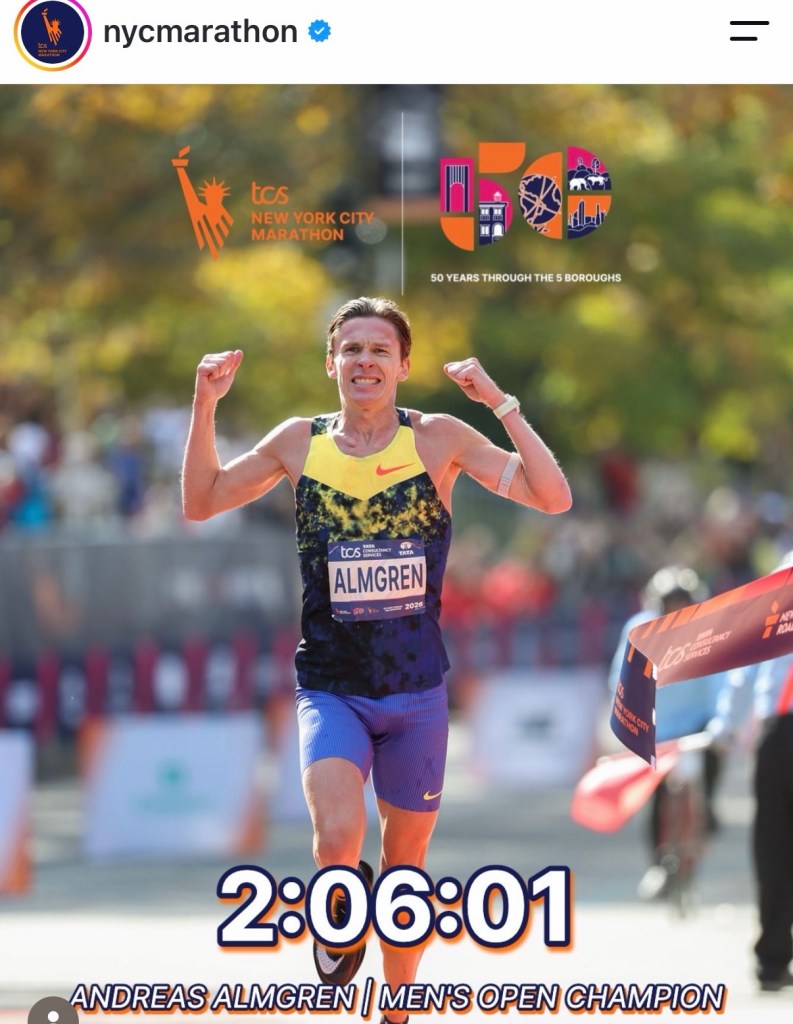
Then, as they passed through the cordon of hollering spectators along both sides of Central Park South, Almgren finally broke Crippa and loped the final 800 meters to victory in 2:06:01. Holding the tape was the original king of New York City, 1976 – 1979 five-borough champion Bill Rodgers.
The Italian was second in 2:06:14. Lesotho’s Kamohelo Mofolo passed Kipruto at the line for third in 2:06:26 on his 21st birthday. Talbi, who led at more checkpoints than anyone, was the top American in sixth in 2:06:43.
The women gave us just as much drama. 2024 champion Sheila Chepkirui of Kenya controlled much of the final eight miles, yet never comfortably. Hellen Obiri, the defending champion, dogged her the entire way, with American Jess McClain and Kenya’s Mercy Chelangat still in the hunt and hoping.
In the end, it came down to the two Kenyan champions, with McClain just a few agonizing seconds behind, running an inspired race.
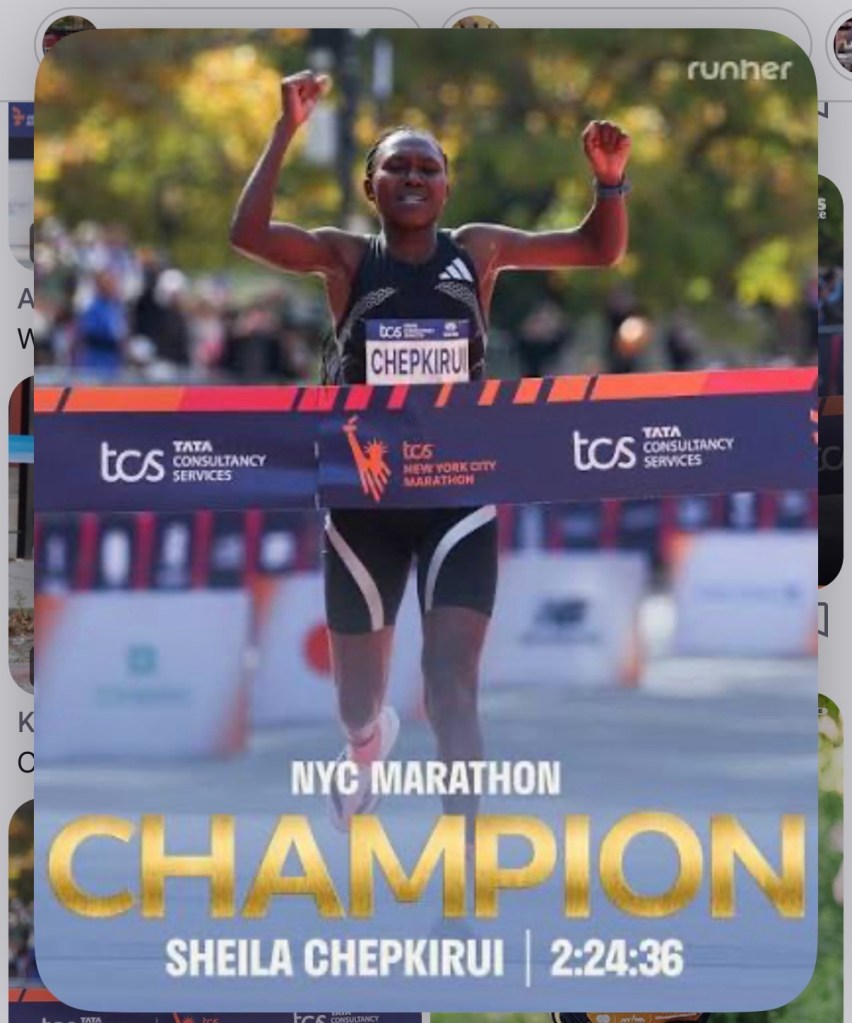
Entering the final stretch as the course reentered Central Park off Columbus Circle, Obiri made her big push, a shift in gears that had won her many a title on the grass, the track, and the roads. But Chepkirui would not yield. She broke Obiri over the final 385 yards to win her second New York title in 2:24:36.
Jess McClain closed like a lioness, passing Obiri in the final few strides for second, six seconds back, ending the American podium drought that stretched back to 2018. Obiri was third, less than half a second behind McClain.
This kind of attack-and-response uncertainty is what is largely absent from a paced race — by design, because energy expenditure needs to be as controlled as possible for the fastest finishing time to be achieved. Hence, the race follows the same script as Groundhog Day. The pacers take them to halfway at a predetermined clip, a second pacer lasts to 25K, and with luck a third gets them to 30K. Then comes the 5K shakeout to 35K, and only then does the real race begin.
Yes, paced races post their eye-popping times at the end of the day. But the road to those times is old and worn — and the results haven’t always withstood close scrutiny.
New York dropped pacemakers in 2007 (I had something to do with that, arguing television preferred the drama of the unknown over the predictability of scripted content). And Almgren chose this hilly course for his debut for precisely that same reason. His 2:06:01, with no rabbits to follow but questions to answer, was only 63 seconds outside Tamirat Tola’s course record.
The event isn’t called the New York City Marathon Time Trial. It’s called the New York City Marathon, and it’s a race. In 2026, it gave us a beauty in both the men’s and women’s fields.
It’s worth remembering, the race is what it is. The time is just what it took. And maybe, just maybe, a reemphasis on pure racing might help dampen — even if just a little — the culture of performance-at-any-cost that has contributed to the scourge of PED use.
“The race is what it is. The time is just what it took.”
This is not to suggest there shouldn’t be time trials or paced races. Just not as a steady diet. So thank you, New York Road Runners, for keeping faith in the legacy of racing you’ve built over the last 50 years on this glorious five-borough course. Onward to the next half century.
END


The NFL has re-discovered the running back and MLB has re-discovered baseball (as opposed to home run derby). I hope this is a race compels running to re-discover racing instead of time trialing.