
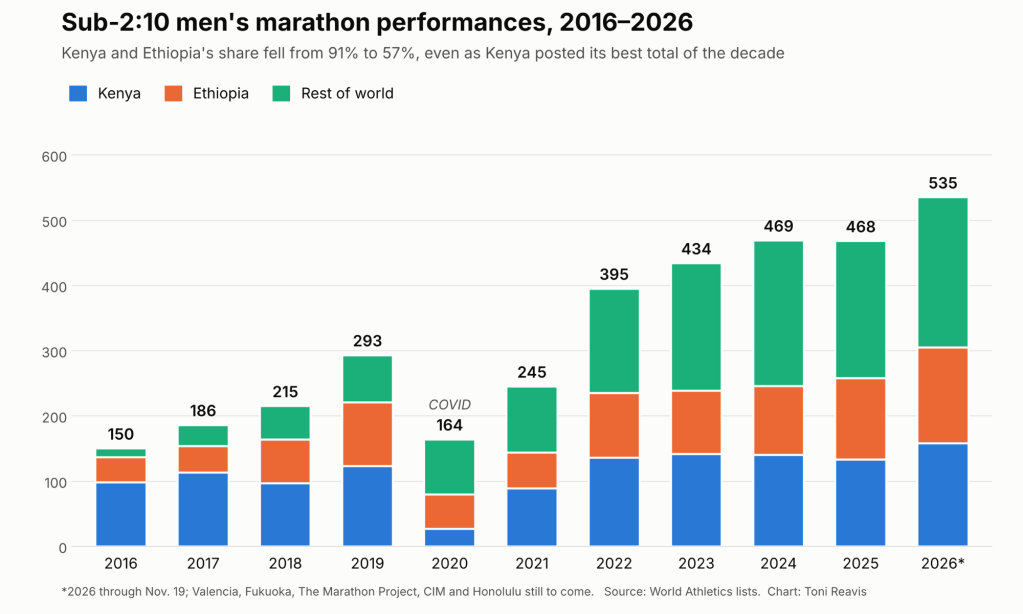
A decade ago, breaking 2:10 for the marathon was an elite accomplishment reserved largely for East Africa’s finest. In 2016, the first year of the super-shoe era — when just a handful of athletes had access to the new technology — 112 men combined for 150 sub-2:10 performances worldwide.
Kenyans accounted for 98 of them and Ethiopians another 39. Together, they produced 91% of the world’s sub-2:10s. The rest of the world managed just 13.
Fast forward to 2026, and the numbers reveal just how dramatically the event has changed. As of November 19th, 413 men have recorded 535 sub-2:10 performances. With Valencia, Fukuoka, The Marathon Project in Chandler, Arizona, the California International Marathon in Sacramento, and Honolulu still to come, the year-end total could approach 600, four times the 2016 figure.
Even history’s first legal sub-two-hour marathon, Sabastian Sawe’s 1:59:30 world record in London, wasn’t even unique on the day it happened.
Like Sir Edmund Hillary atop Everest in 1953 with Tenzing Norgay at his side, Sawe had company in London: Ethiopia’s Yomif Kejelcha followed him under 2:00:00, just 11 seconds behind as he crossed the finish line, with Uganda’s Jacob Kiplimo in third, only 28 seconds off the once-unimaginable number.
In terms of depth, Kenya remains the dominant marathon nation, producing 158 sub-2:10 performances so far in 2026 before December’s races, but Ethiopia has closed the gap with 147. Together they account for 57% of the world’s total, down from 91% a decade ago.
Beyond East Africa, the rest of the world has gone from 13 sub-2:10s in 2016 to roughly 230 to date. Japan alone has contributed 66, while nations across Europe, North America, and Asia added unprecedented numbers to the global tally.
“Once the two-hour wall was breached, there’s no magical number left to focus on.”
The numbers illustrate a sport that has become broader rather than simply faster. In 2016, the 150th-best performance in the world was 2:09:59. This year, to date, it is 2:06:42.
Super shoes have undoubtedly been a major contributor, but so has the quieter revolution in fueling: hydrogel drinks that let runners absorb far more carbohydrate mid-race, and sodium bicarbonate, long a recipe for stomach trouble, now packaged to be race-ready — though its value over 26.2 miles is still debated. Add advances in training, pacing, and recovery, and the 2016 runner was competing with a different toolkit altogether. And the runners in earlier eras might as well have been driving Model Ts in a Formula 1 race.
What once was an exclusive standard achieved by a relatively small group of runners is now a benchmark reached by hundreds each year. Kenya and Ethiopia still set the pace, but the marathon’s center of gravity has expanded far beyond East Africa.
Just look to Andreas Almgren’s win in New York City earlier this month. The Swede became the first man born outside Africa to win a World Marathon Major since Yuki Kawauchi in Boston 2018, while topping a podium with no Kenyan or Ethiopian on it, as four Americans broke 2:08 and still finished no higher than sixth.
In today’s world, the extraordinary growth of global depth has transformed the event from a specialized domain into one of the most competitive disciplines in world sport.
The defining story of modern marathoning is not the chase for the next barrier to fall. Once the two-hour wall was breached, there’s no magical number left to focus on. Hopefully, that will encourage competition for competition’s sake, where times will be just the measure of the effort rather than the goal of the enterprise.
The chase now is for a clean era to begin. But two shadows remain. World Athletics still rewards time over competition in its ranking points system.
And in the same month the sub-2:10 yearly count rose to 535, two more Kenyan stars, Olympic and world champion Peres Jepchirchir and 2026 World Road Running Championships silver medalist Veronica Loleo, were banned for EPO.
I will post a more focused column on the women’s side soon, where the only sub-2:10 in history remains Ruth Chepngetich’s 2:09:56 world record from Chicago in 2024, a mark that still stands even as Chepngetich serves her own doping ban.
Physicists tell us time’s arrow runs only one way. Times won’t be coming back down to 2016 levels again. Only our faith in them might, unless the sport stays vigilant, and others follow the lead of the Abbott World Marathon Majors, which has barred Jepchirchir from its races for life.
END

