
A text came in from Greg Meyer on a bright October morning. Since Greg won the Chicago Marathon in 1982 and Boston in 1983, I thought he might be reaching out to discuss the strong American men’s showing in Chicago on Sunday (Young in 7th, Hicks in 8th, Mauri in 10th, and Rupp in 11th).
Instead, Greg had a question about a homeschooled cross-country program in his native Grand Rapids, Michigan, that had an eligibility problem.
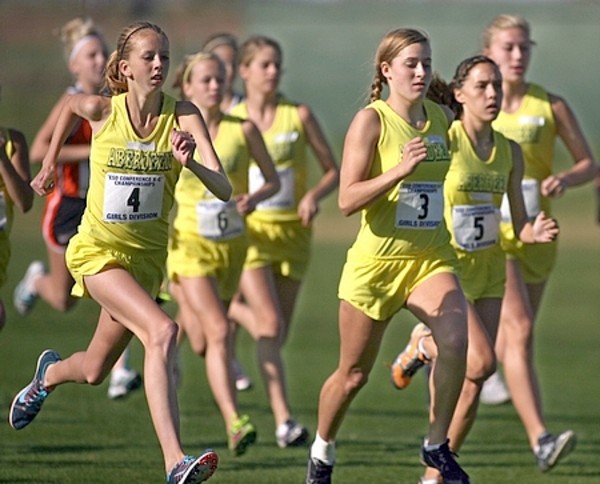
He wrote how the Peregrine Falcons team was good enough to compete in invitationals around Michigan and even ranked second in the state. Yet they could not compete in Nike’s regional or national cross-country events because NXN requires club teams competing in regionals to be composed of runners from the same state-approved high school — to prevent super-clubs or all-star teams from dominating state-based high schools. As such, the doorman at Nike’s championship had a list of approved names, and the homeschooled Michigan team wasn’t on it. Greg asked if I would be willing to champion their cause.
A Landscape Without Equilibrium
I told him I could understand the frustration the kids must feel, but from what I could see, they were caught in a changing landscape where they had outrun the existing rules.
Nike is a shoe and apparel company, I wrote, not a sanctioning body. To judge every unaffiliated team in America on its own merits, the company would need a whole new wing, a staff of adjudicators and an appeals process, a governing body grafted onto a marketing department. In order to have the system function, Nike has to rely on the existing state associations because that is the only gate that scales.
The rule excluding the GR homeschool team may look arbitrary from the outside, especially when a team has proved it can compete. But the alternative is to ask Nike to decide, one case at a time, which independent programs are legitimate, which eligibility rules are sound and which exceptions should be granted. A single compelling case would not solve that problem; it would create the next hundred.
So the burden falls where the rub exists, on the new educational models, which have teams but not traditional classrooms. They need to build a bridge that links them to the accreditation that would allow their kids to compete where their talents might take them. That means organizing collectively and forging a recognized pathway with the state associations, whether through affiliate membership or a federation of their own, so their athletes are protected before the season starts rather than rescued after it ends.
What we are looking at is a landscape that has not yet reached equilibrium. The old structure no longer fits the territory, and the new structure has not formed to replace it. In that interval, the people who pay are sixteen and seventeen years old.
The First Tremor: A Cheer Squad in 1999
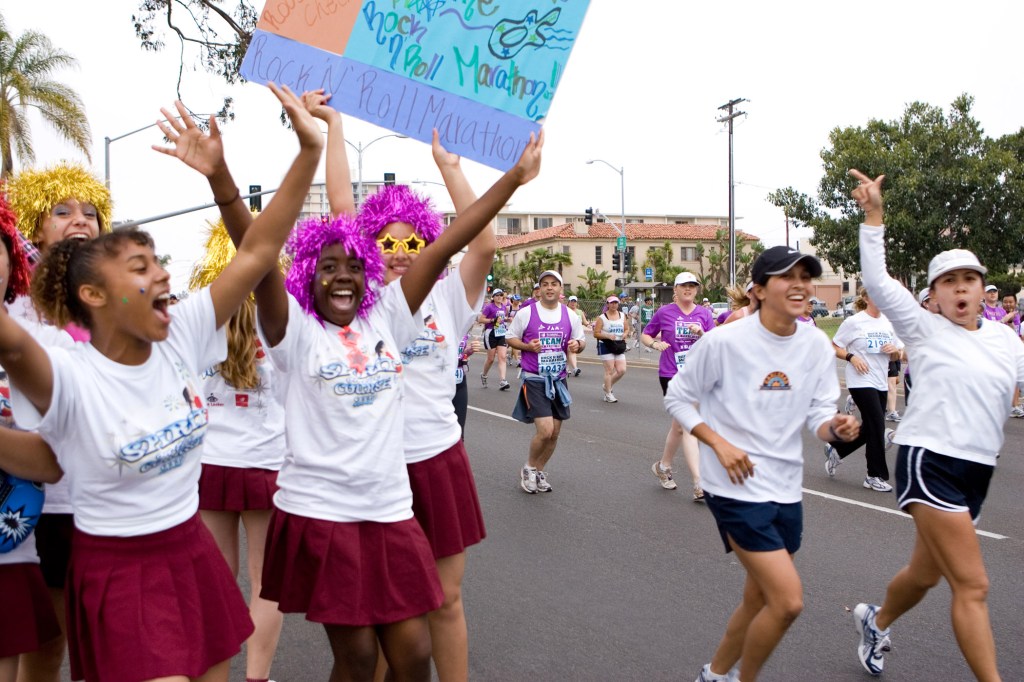
When the late Tim Murphy and Elite Racing launched the Rock ‘n’ Roll Marathon here in San Diego in 1998, he reimagined the marathon not as a speed event but as entertainment, a journey to be enjoyed mile by mile. That first year brought Huey Lewis and the News, the Lovin’ Spoonful and Pat Benatar to headline the post-race concert. Out on the course, local bands provided entertainment at every mile. The next year, to fill the gaps between the bands, Tim recruited high school cheer squads to line the course, and the runners voted on the best.
As part of our television coverage, we went to Junípero Serra High in Tierrasanta, the school near where I live now, to do a story on its cheer squad. The girls practiced at the school, wore the school colors and competed against other schools. But the coach in charge did not work for the school at all. The parents had hired her, and the parents paid her.
Then I learned it wasn’t only the cheer squads. A good deal of coaching already worked that way. The school supplied the gym, the colors, and the Friday night identity; the expertise and the money came from outside. The institution was still providing the venue and a brand, but the families were becoming the financial engine.
That arrangement was not an isolated curiosity. It was the latest turn in a long American story, one that had steadily moved athletics under institutional oversight but was now beginning to drift back out.
History Lesson
Public education first took hold in Massachusetts in the 1630s and 1640s, but Horace Mann’s campaign for free, universal schools didn’t follow until two centuries later, in the 1830s.
The system came first. The athletic structures came later.
Interscholastic athletics emerged in the latter half of the nineteenth century. In 1859, students at Worcester High School in Massachusetts formed a baseball team, an event often identified as the beginning of high school athletics.
The first high school leagues followed. The New York Interscholastic Athletic Association, formed in the spring of 1879 to conduct a track and field meet, pioneered the league model. Other organizations followed, including the Interacademic Athletic Association in Philadelphia, established in early 1887 and one of the earliest permanent interscholastic football leagues.
The pattern was familiar: students created the activity, families and schools sustained it, and institutions eventually built rules around it.
When the Insurgents Became the Gatekeepers
There is a deeper irony here. For most of the twentieth century there was no national high school cross-country championship at all. The state meet was the ceiling, because the governing bodies were organized state by state and stopped at the border.
That arrangement itself developed gradually, league by league and then state by state. The New Jersey Interscholastic Athletic Association, formed in 1896, was a league of a handful of schools; the statewide association that governs New Jersey today was not founded until 1918.
The National Federation of State High School Associations, now the central national coordinating body, began on May 14, 1920, during a meeting in Chicago attended by representatives from Illinois, Indiana, Iowa, Michigan and Wisconsin. Its primary purpose was to address problems arising from high school contests organized by colleges and universities.
The system was built in layers: schools, leagues, state associations and, eventually, a national federation. Each layer solved a problem created by the one before it. Each also created a new boundary.
It was a private company that changed the national landscape. The national championship now called the Brooks XC Championships, staged mostly in San Diego since 1979, gave American high school runners their first national stage. Kinney sponsored it first, then Foot Locker for decades, until Foot Locker walked away in 2025 and Brooks rescued it.

Nike co-sponsored the meet through much of the Foot Locker years, and paid much of the bill while Foot Locker carried the name. When Nike suggested adding a team competition, Foot Locker declined. So Nike went off and built its own national championship in Portland, Oregon, in 2004, staged a week or two before Foot Locker. I had the privilege of calling those Nike races for their first dozen or so years.
So the very organization now shutting out a homeschool team in Michigan was itself a disruptor once. The insurgent of one generation became the establishment of the next, and the thing that broke the old boundary established the new one.
The gate swung shut from the other side before as well. In the early years of Nike’s championship, a couple of states, including my home state of Missouri, would not allow their kids to travel to a corporate-sponsored event after the state meet. A Missouri runner was kept home because the state would not let them go.
Today, a Grand Rapids team is kept home because Nike will not let them in. Same young athletes, locked out from opposite directions.
Missouri eventually relented. The restrictions eased, and today all fifty states can send their kids to try to qualify in regional meets. The adjustment came, but too late for some of the athletes who had been denied the opportunity.
Two Ways to Fall Out of Step
It would be easy to lump every institution that lags behind reality into one heading. But there are two very different ways to fall out of step.
The first is sheer stubbornness. The Boston Athletic Association was the classic case, clinging to the amateur ideal out of conviction and class reflex, resisting changes it could plainly see coming. They lost a 75-year-old indoor track meet and nearly their iconic marathon by clinging to their outdated amateur ethic. Missouri’s early refusal to allow their athletes to travel to NXN belongs in the same column. That is a failure of will.
The second is being overtaken. It would be easy to paint Nike as the villain in the GR case, a role it has inhabited in the past. But Nike isn’t resisting inclusion; it’s lacking a workable mechanism to accommodate teams outside the established system. The ground is moving faster than governance can track. You cannot pour a foundation while the earth is still shifting.

The numbers show how fast it has shifted. Roughly two million American children were homeschooled around 2010. Six years later, that number had crept up to about 2.3 million. But following the pandemic, estimates put the number at 3.4 to 3.7 million, or six to seven percent of all school-age children. The precise figures depend on the year and the method of counting, but the direction is unmistakable: homeschooling has become a much larger part of the American educational landscape.
A foot-dragging institution that can choose differently and won’t is one thing. An institution overtaken by rapid change that may be willing to choose differently, but lacks a workable way forward, is another.
The Loud End: College and NIL
At the top of the pyramid, the same broader shift in institutional authority is impossible to miss, because there it is measured in money. Name, image and likeness (NIL) payments, tethered to the gravity of the NFL and its television billions, have changed college football’s old logic almost overnight.
For a century, college was the waystation and the pros were the destination. You endured the unpaid college years to earn your shot at the pro money. Finally, the hypocrisy of the system that failed to compensate the players who generated the billions of dollars in revenue in college sports became too great to ignore. Now a player can earn substantial money while still in school, changing the financial calculation that once made the NFL the obvious next step.
For a few seasons the transfer portal resembled the Wild West, with few practical limits on how many athletes could move or how quickly. The sport has since moved toward a more regulated system. But its equilibrium only came after the disorder forced it.
The college athlete has now gained leverage inside the institution, while at the high school level families are building athletic alternatives outside it. The mechanisms differ, but both developments challenge the institution’s former control over the terms of participation.
The Iceberg
At the high school level there is no comparable money for athletes, at least not on the scale transforming college sports. So the shift moves quietly, with little to announce it. It becomes visible at the moment of friction, when a team in Michigan emerges but is shut out of an event it would otherwise walk into. Their exclusion is the signal.
That makes the quiet case especially revealing. In college you can squint and say it is all about the dollars. In Grand Rapids there are no dollars, only a structure that cannot recognize a legitimate competitor. Strip away the money and you see the mechanism itself. The question is whether the quiet end will remain quiet as the number of athletes outside traditional school systems grows.
These changes move like icebergs: slow, massive and existing mostly beneath the surface. They don’t show themselves until some poor ship sails by and has its underbelly torn open. The Peregrine Falcons homeschool team in Grand Rapids is that ship, tiny though it is.
The visible tip is small, one team and one lost invitation. Beneath it lies a broader shift in how authority and responsibility are distributed: a parent-paid cheer coach in 1999, the rise of homeschool consortiums, and the NIL money reshaping college athletics. We tend to argue about the tip and miss the mass beneath it.
This is not a story of wrong and right. NXN has given thousands of young athletes an experience they will remember the rest of their lives.
Institutions can adapt, as Missouri eventually did, but adaptation requires a structure that can handle more than one compelling exception. Until that structure exists, the gate will remain closed because no one has yet built a fair and workable way to open it.
Adaptation takes time, and the people caught in the interval cannot get that time back. In Grand Rapids, the Peregrine Falcons are young runners who did everything asked of them and still found the gate closed. Perhaps their exclusion will become the impetus for changing the rule.
END

