
In the mid‑1950s in St. Ann, Missouri, my world was St. Girard Lane. You didn’t need a park permit or a race bib to belong; you just needed to go outside.
In those post-World War II years, we kids were as plentiful as fireflies flickering on an hot summer’s evening. We played whatever the pavement allowed. One ball, one bat, a neighborhood full of kids. We’d invent rules on the fly: hit the ball, throw it back, watch it roll back down the street, and if it clipped the bat lying on ground and hopped into the catcher’s hands, you were out. Nobody wrote that down. We were co‑authoring the game, minute by minute, until the streetlights came on or a parent called us in.
Then one day, somebody’s mom leaned out the front door and yelled, “Hey kids, Mickey Mouse is on TV!”
We all ran.
We sprinted not down the block but into living rooms, clustering around the new glowing box with the rabbit-ears antenna on top. It was the debut of The Mickey Mouse Club. I remember the feeling: the opening of the Mickey Mouse Club and the closing of playing in the street. Overnight, our common playground shifted from asphalt to airwaves. We stopped making things up together and started consuming something made for us, side by side but facing the same screen. That was my first paradigm shift.
At the time, it felt like magic, not loss. Who wouldn’t want perfect cartoons instead of chalk-drawn home plate and a scuffed ball? You just wanted what everyone else seems to want—no matter what it was. Only later do you realize what quietly disappeared: the improvisation, the arguments over whether you were safe or out, the shared authorship of the day.
Fast‑forward half a century. The glowing box got smaller and moved into our pockets. Television shrank the outside world into the living room. The digital revolution shrank it again, this time into the private theater of our individual heads. Scroll long enough and you can live an entire day in feeds and private messages, surrounded by people and yet functionally alone. The street wasn’t just empty of kids; increasingly, so were the parks, the gyms, the pickup games. Front porches became back decks. We traded the open, unpredictable social friction of the real world for the smooth, low‑friction loops of curated content.
Back in February 2016, I sat down with Peter Abraham, a marketing consultant and former executive with the Los Angeles Marathon, and he put his finger on what came next. He’d been working with a new wave of young running groups in LA—like Black List LA—crews most people had never heard of, yet collectively counting thousands of members. What struck him wasn’t their obsession with PRs or podiums. It was their obsession with each other.
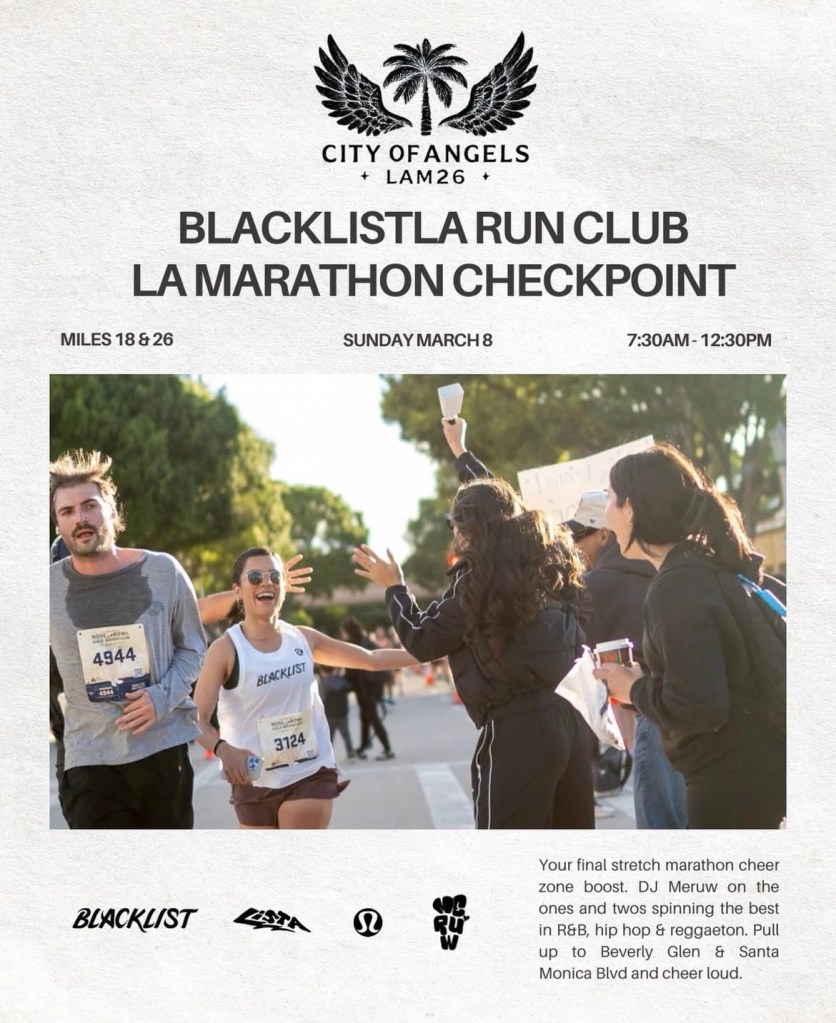
For these millennials, Peter told me, working out was “social first.” You didn’t go to the track to beat strangers; you went to the run to see your people.
These crews met at night at hip coffee shops, outside running stores. They’d run through downtown and then grab tacos. They posted the photos, sure, but the photos weren’t the point; they were receipts for having actually been there. The workout was the excuse, not the destination. Competition was present, but it was background noise. The main event was connection.
I heard in Peter’s description an echo of my own childhood street, but translated into a different century’s language. Back then, we didn’t think of ourselves as “seeking community.” We just walked outside and it was there. After decades of screens—first television, then the internet, then smartphones—community has become something you have to seek, organize, and sometimes fight for. The default is isolation. The opt‑in is togetherness.
And that brings us to this weekend. I’m in Los Angeles for the 41st Asics LA Marathon. On Sunday morning, tens of thousands of runners will line up, many of them from exactly the kind of social‑first crews Peter was talking about a decade ago. Back in 2016, Peter said that Black List LA had 14,000 followers on Instagram. Today it’s 28,800. The same story is unfolding in every big‑city race: New York, Chicago, Honolulu, Austin, Tokyo. The numbers keep climbing. For the 2026 London Marathon, there were 1.1 million requests for entry. One point one million people raising a digital hand to say: “I want to be out there, with others.”
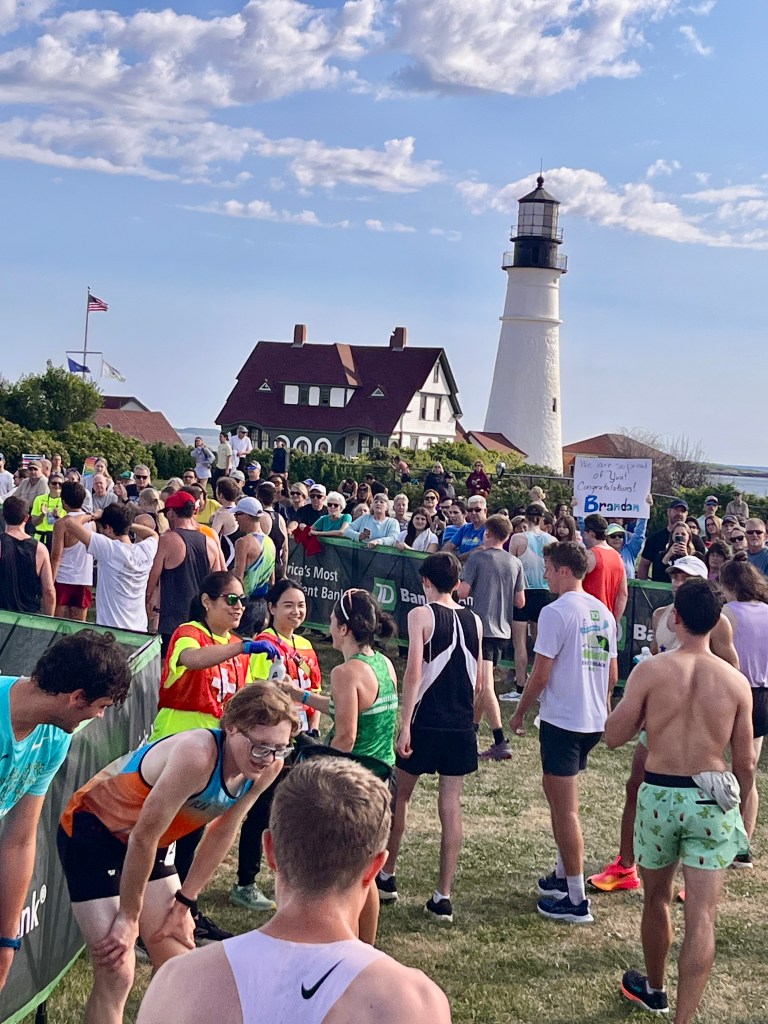
If races were only about winning, this would make no sense. The odds of breaking the tape are microscopic. The odds of being seen, known, and high‑fived are nearly guaranteed.
What you feel when you stand near the start line now is not a stadium’s worth of individual hero quests; it’s a swarm of small communities. Run crews in matching singlets, Students Run LA, Team World Vision, work friends with their office logo on their shirts, families wearing photos of someone they lost, charity teams carrying the names of people they’re running for. The old metrics of competition—time, place, ranking—are still there, but for most people they’re subplots. The main plot is: We are doing this together.
In a strange way, the long arc from my St. Ann street to today’s LA Marathon loops back on itself. We lost the street once when The Mickey Mouse Club pulled us indoors and handed us a pre‑packaged script. We lost it again when digital life pulled us even further inward, shrinking the public square into something you can swipe past with your thumb. Now, you can see millennials and Gen Z trying to reclaim a version of that street—not by turning off technology entirely, but by using it to gather bodies in the same place at the same time.
They form a group chat; they show up at 6 a.m. under a freeway. They post a photo; they lace up again next week.
Running, of all things, has become one of the most powerful tools for reversing the direction of the last seventy years. Where television and smartphones atomized our attention, running events collectivize our effort. You can’t outsource a marathon to an algorithm. You can’t binge‑watch mile 22. You have to feel every step, and you feel it more fully when someone is suffering beside you at exactly the same pace.
Peter Abraham saw this early, in those LA crews that were “driven by social first.” He understood that in a world awash in content, the scarcest commodity is not entertainment but embodied experience. The kids who grew up on glowing screens are now adults who will wake up at 4 a.m., stand in a cold corral, and run 26.2 miles—not to beat the stranger next to them, but to belong with them.
When I look at the start line at Dodger Stadium, I’ll see St. Girard Lane in St. Ann, Missouri, restored, just in a new shape.
The games are different. The distances are longer. The shoes are lighter and more expensive. But underneath it all is the same human need that once kept us out on the pavement until someone’s mother called us in. Only this time, the call isn’t “Mickey Mouse is on!” pulling us apart. It’s “On your mark!” calling us back together.
And when tens of thousands of people answer that call at once, in Los Angeles or London or Tokyo, you can almost hear the sound of a paradigm shifting—this time toward community, not away from it.
Good luck to all. You can watch on NBC4 or Telemundo, or Peacock. The race gets underway at 6:30 AM pacific daylight savings time.
END
 tonireavis.com
Wonderful perspective and write up! I remember a cell phone hitting my pocket in my teenage years and a smart phone in my twenties. I definitely have to focus when I am around kids to not pull out my phone and set the example I want to see of running around outside without a worry about anything else. Thanks for a great post!
Right on Toni!
bill
I would agree completely. Thankful that running, run/walk provides a wonderful way to socialize away for the little box.
Kathy