
Today, the NFL draft takes place in Pittsburgh, Pennsylvania. It’s where the top college football prospects get selected by pro teams in reverse order of last year’s standings. Each spring and fall, running goes through a similar ritual as the major marathons release their elite fields.
While the system is not based on any order of selection, running fans behave just like football fans: we wait for the elite‑field announcements, then debate which race won the recruiting season.
Back in 2012, I wrote a short draft about this very cycle. Rereading it now, on the eve of the 2026 TCS London Marathon, I’m struck by how little the underlying dynamics have shifted.
When the World Marathon Majors launched in 2006, the stated mission was bold: advance the sport, raise awareness of its athletes, and increase interest in elite racing. With a $500,000 biennial prize for one man and one woman, the concept delivered some of that promise, peaking in 2010 with the Sammy Wanjiru versus Tsegaye Kebede showdown in Chicago.
But even then, the races remained sovereign. Each Major kept its own recruiting strategy, its own budget, and its own full slate of races. The Majors’ banner unified the events, but not their actual arrangement.
In that old draft, I floated a simple question: What if Boston and London worked together for the benefit of the sport instead of competing?
What if, instead of splitting the same pool of A-level athletes, the Majors concentrated them? One year, all the top men to London and all the top women to Boston. The next year, switch. A true single-gender championship style race each spring, told cleanly, with nearly every great marathoner in that gender on one start line.
Imagine the clarity. Imagine the storylines. Even better, consider the potential for race coverage.
Because here’s the astonishing truth that was true in 2012 and remains true in 2026: there has never been a modern marathon where all the best men or all the best women in the world lined up in one place at one time. Not in the Majors. Not in the Olympics or World Championships, with their three-per-nation cap. Nowhere.
And as London approaches this Sunday, we can only speculate — because speculation is all the sport ever leaves us.
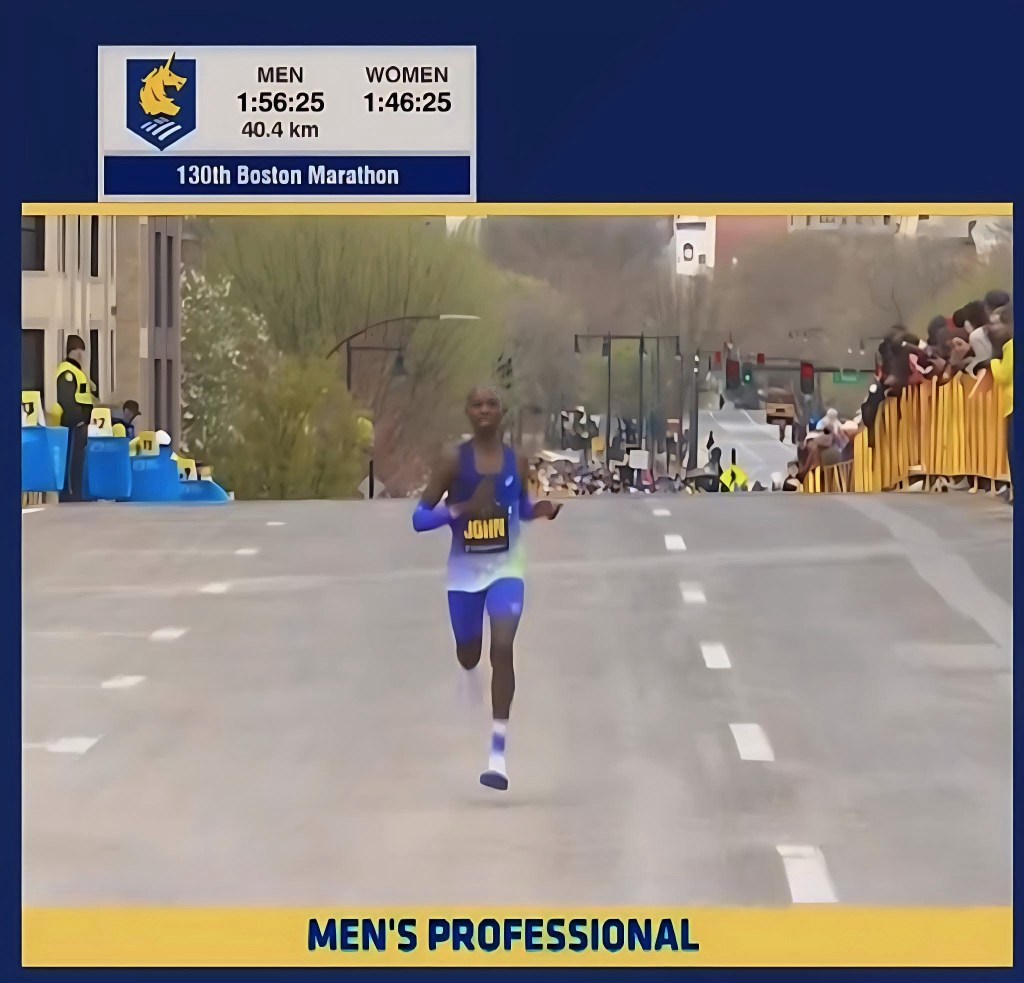
What if London headliners Simon Sawe and Jacob Kiplimo had been in Boston last Monday? Would John Korir have been running alone over the last 10K? Or, would he have been forced into a different gear, a different level of himself?
What we do know: Korir ran alone for the final six miles, surging past Milkesa Mengesha at 20 miles and never seeing another challenger. Almost exactly the same as in 2025. He later said he didn’t know he could run that fast, and that his only thought was to defend his title — not to chase a record. Yet even he wondered what might have happened had someone been there to go with him. Next time, he says, he will start focusing on the clock.
The same dynamic played out in the women’s race. Last year in Boston, two-time defending champion Hellen Obiri pushed her good friend Sharon Lokedi to a 2:17:22 course record, Obiri finishing just 19 seconds back in second. That was competition at its purest: two world-class athletes driving each other to a level neither could reach alone.
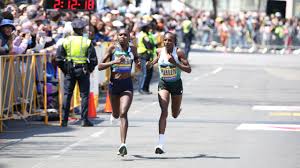
(AP Photo/ Jennifer McDermott)
This year, with better weather but no Obiri — she’ll be racing in London on Sunday — Lokedi, like Korir, loped the final fourth of the race entirely alone. She increased her pace steadily from Heartbreak Hill to Boylston, even throwing down a remarkable 14:48 split from 35–40K. But with the more conservative early pace and no one to force the issue, the women never took full advantage of the record conditions.
Korir believed that with help he might have approached a sub-2:01 finish. That’s the tease of the current system: the counterfactual is always more tantalizing than the race itself. The Majors split the talent; the IOC limits Olympic entries — even though there are no lane restrictions like on the track. The athletes scatter across appearance-fee opportunities like iron filings pulled by competing magnets. The result is a perpetual almost — a sport built on what might have been rather than the thing itself.
The same fragmentation shows up in how the races are covered. There was plenty of griping about this year’s Boston Marathon broadcast. That’s become its own spring tradition. But having been in that position for many years, I know exactly how hard that job is — and how invisible the challenges are to anyone watching from the couch.
Television isn’t covering a race. It is covering four races and an attending civic celebration: the men’s and women’s elite footraces, and the men’s and women’s wheelchair competitions. Each is a world-class event with its own tactics, its own protagonists, its own decisive moments. And yet, unlike the Tour de France — where every contender seems to have a dedicated moto, a helicopter, and a camera crew — ESPN2 has to cover all four with a finite number of cameras, motorcycles, transmission units, and staff. When you try to tell every story, you inevitably fail to tell any one of them completely.
If the broadcast focused all its assets on one footrace and one wheelchair race, alternating genders each year — the same logic the Majors themselves have never embraced — the coverage could deepen dramatically. More cameras on the leaders and the chase pack. More context. More storytelling. A cleaner, more coherent narrative allowed to engage viewers rather than every story constantly getting chopped up. It’s not a criticism of the people doing the work. It’s a criticism of the structure they’re forced to work within.
The same structural problem repeats itself in the fall. Chicago and New York sit just three weeks apart, chasing the same athletes with the same urgency. Chicago wants speed and records; New York wants stars and storylines. Both want the same headliners, and both want them in the same year. The result is predictable: Chicago gets half the top men and women, New York gets the other half — with a few siphoned off to Berlin — and neither race ever assembles the full cast.
It’s the spring problem all over again — two sovereign events, two separate recruiting budgets, two different philosophies, and no mechanism to concentrate talent to the point of critical mass.
The PGA Tour typically has several players locked in a tight battle over the final nine holes of a tournament. The reason is numbers. They begin Thursday morning with 156 players. By Sunday afternoon, there are still two, three, four players in the hunt. Road running never adopted a unifying critical mass formulation.
Instead, we get parallel excellence — impressive, admirable, but always incomplete.
Of course, the one caveat to this system is that both Boston and New York are not record-level race courses, while London and Chicago are. So the sport, which concentrates so much on time, leads people to the faster courses. If competition were the focus, the distinction wouldn’t be so great.
London will be magnificent, as it always is. Boston was magnificent, as it always is. Chicago and New York will be magnificent, as they always are. But none of them will answer the question that has hovered over the marathon for decades:
What would happen if everyone showed up?
We still don’t know. And that — fourteen years after that old draft — remains the most astonishing fact of all.
END
 tonireavis.com
That Boston is not a record-eligible course skews the appeal for record-seekers. Someone seeking a world or national record is likely to prefer London.
I realize that distinction is the limiting factor. Except for the Olympics and the world championships, the sport’s focus is almost entirely on finishing time. So they bring in a cast of pacesetters and remove pure competition as the animating engine. This focus has led to the anonymous (to the public) string of winners. The time is the goal not the competition. So we see athletes looking to avoid competition and going to the place where they can have the best chance to run a fast time. It’s helped kill the sport. The irony is as the times have gotten faster, the sport has diminished in public interest. Thanks for contributing.
Toni