
On the morning of the 130th Boston Marathon, I’ve been thinking about the strange elasticity of time and distance — how both stretch, compress, and reform under effort. Physics explains it with relativity. Runners experience it in the gut. Boston, more than any race, makes that tension visible.
The physics is elemental: the faster you move through space, the slower you move through time. You can study physics to understand the concept, or you can race and feel the dilation of time as the distance accumulates.
When you’re sitting still, time moves at its maximum rate for you. Once you begin moving through space, some of that spacetime motion is redirected. You still move forward in time, but more slowly than someone who remains at rest. The reason we don’t notice is that everything slows down together: the watch on our wrist, the beat of our heart, even the cadence of thought.
It is only when you compare your experience to someone else’s—someone moving differently—that the divergence appears. Your clock and their clock no longer agree. Your time and their time have split.
We are told to live in the moment. But whose moment would that be?
Time feels universal because our scale is too limited to internalize the discrepancies. There’s one clock suspended over the finish line. But effort exposes the lie. Your perception of time measures your struggle. Mine measures mine. They agree only in the abstract.
What physics proves mathematically, endurance reveals viscerally. And nowhere is that revelation more consequential than in Boston on Patriots’ Day.
In the early miles, time dilates. Hopkinton to Framingham vanishes almost without record—by design, by training, by the accumulated discipline of months spent teaching the body to hold back. The watch advances, but effort barely registers — knowing the same minute will slow and thicken later.
Over distance and effort, seconds become more deliberate. Distance no longer corresponds cleanly to progress. Two runners may pass the same mile marker at the same moment, yet inhabit entirely different races.
At the end of a marathon, time asserts itself. What once seemed smooth and continuous rises like a grade from a level road. Every decision deferred, every restraint ignored, every moment borrowed without repayment comes due.
This is why runners are taught to break races into components—so the enormity does not overwhelm our fragile conceptual framing. A marathon is not 26.2 miles so much as four consecutive 10Ks strung together.
At the top of Heartbreak Hill in 1982, Wayland, Mass. native Albertoh Salazar was running in the slipstream of Minnesota’s Dick Beardsley.
Salazar had snared the world record six months earlier in New York. In Boston, running his hometown marathon for the first time, he found himself locked in a life-and-death struggle against a man whose 10K PR was more than minute slower than his.
“I’d never felt worse in my life as a runner,” Al would admit afterward.
As they crested Heartbreak Hill, a well-meaning spectator yelled, “You’ve only got five miles left!”
To Salazar, on the verge of being dropped, miles felt crushing. In his weakened state, a mile was an enormous thing, much less five.
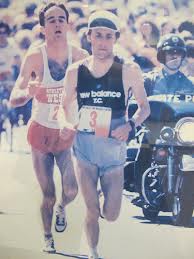
With the prospect of victory slipping away, he recalibrated. At their pace, five miles became roughly twenty-four minutes. While miles were devastating, minutes were manageable.
He could handle twenty-four small things, even if he couldn’t handle five large ones.
Salazar reshaped the remainder of the race into fragments of time, clung to his self-belief, and prevailed by two seconds in what author John Brant titled The Duel in the Sun, one of the greatest duels in marathon history.
The difference was not fitness. It was how one man chose to read the time he had left.
Today, it’s your turn. The weather will be the opposite of 1982, with borderline perfect racing conditions: cool air and a pressing tailwind. A day for records if the intention and competition align.
The clock will be the same.
The time will not. It never is.
END

