
Without a ball or a modicum of violence, the idioms of American sport, the marathon has never quite caught on with the public as primarily a sporting contest. In an age of fractured attention spans, the long, slow build, rather than a new shot, pitch, or play every 30 seconds, swims against a strong cultural current.
The marathon is a building drama that rewards close attention. But with multiple racing categories running at once, the tension in any one competition rarely builds like a nail-biter in the ninth inning at Fenway: the stadium tightening, Aroldis Chapman emerging from the bullpen, the count running full. Even fields stacked with champions and Olympians can get lost in their own shuffle before the drama reaches its denouement.
Yet the stories within the marathon are legion. It isn’t just about the elites up front who are often seen as enigmatic and hard to identify with. Still, there is a compelling story for every bib number on the course — just a matter of choosing where to look.
In its totality, the marathon remains a grand civic holiday, an expression of human striving, and a display of genuine camaraderie in a time of dislocation. It’s proof that people from many backgrounds can still find accord in movement and struggle, while showcasing how ease isn’t always a goal worth pursuing.
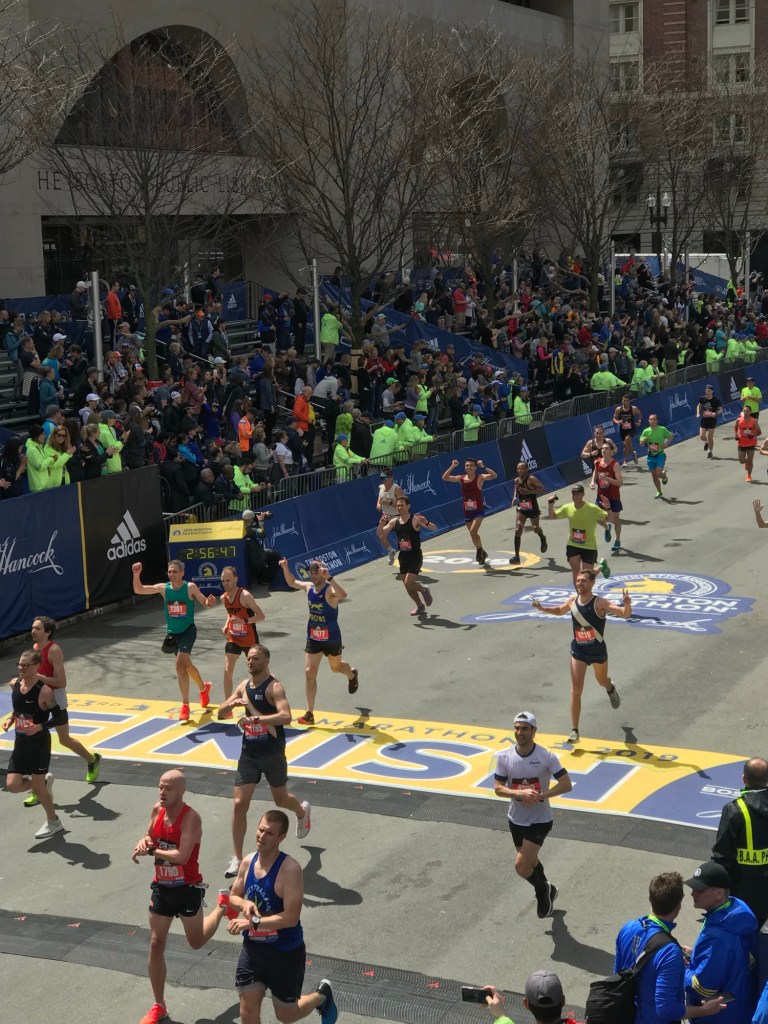
Boston Marathon finish line, Boylston Street. Clock: 2:56:47. Every finisher their own story.
In How to Read and Why, the late literary critic Harold Bloom wrote: “A pleasurable difficulty seems to me a plausible definition of the sublime.” He argued that deep reading offers a kind of secular transcendence — one of the few available to us outside the precarious experience we call falling in love.
Though a great man of letters, Professor Bloom evidently never experienced the transcendence of movement. If he had ever laced up and taken to the roads, he might have found that his definition of the sublime applied not only to texts but also to tempos. As in deep reading, long, purposeful running is pleasurable precisely because it requires effort, thought, and a willingness to confront difficulty. And in that confrontation, something ineffable is gained — something that can’t be bought on Amazon or gifted by another.
That’s what will come through in abundance this Monday in Boston and the following Sunday in London: the human struggle to find meaning and purpose in a chaotic world. That is where the marathon delivers most profoundly.
For the mantra of our breathing,
the rhythm of our pace,
provide lyric enough in cadence,
to engage our full embrace.
It may not be much in the grand scheme of things. But it is reward enough for many, and an actual achievement for all.
END

