
I don’t know if Australian Olympian Chris Wardlaw intended to start a fight – maybe he did. But he certainly articulated a feeling many lifelong observers of the sport have had but rarely say aloud. Yet his words cut straight to the heart of modern distance running:
Wardlaw is right about the math. And the math is where the trouble starts.
The Sawe Problem: When a Shoe Claim Lines Up Too Neatly
After Sabastian Sawe ran 1:59:30 in London — the first sub-2:00 marathon ever run on a record-eligible course — Adidas quietly released their number: their new prototype super shoe, the Adizero Adios Pro Evo 3, provides a 1.6% efficiency improvement over their previous model.
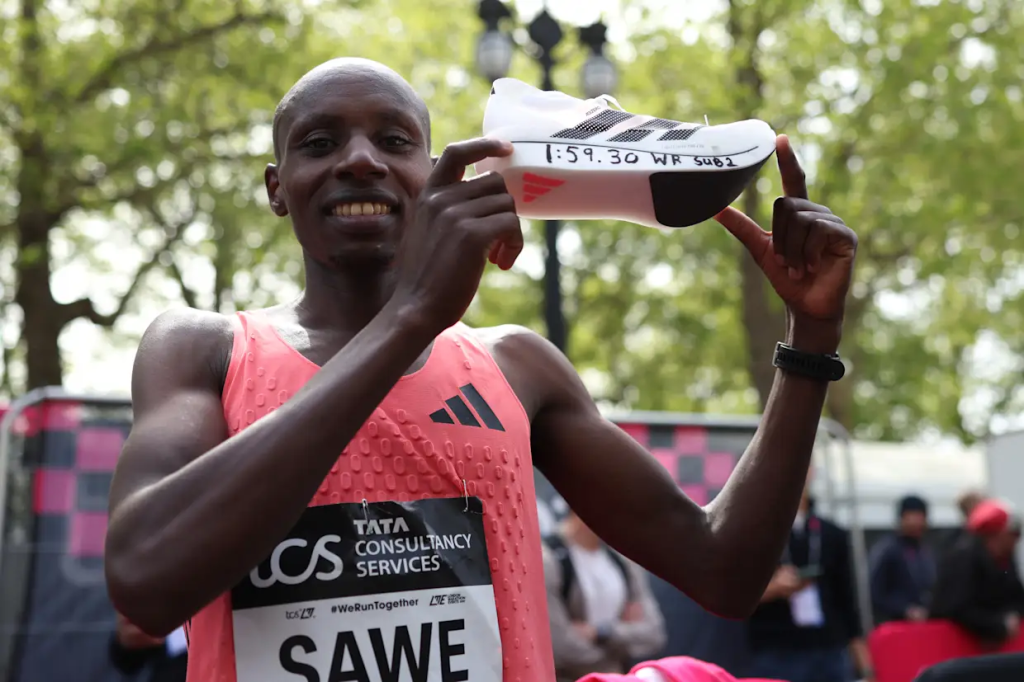
That’s a lab/marketing claim, not a race-day guarantee. But it’s a number. And numbers invite comparison.
The most honest comparison available isn’t between Sawe and some abstract baseline, or even Kelvin Kiptum‘s previous world record from Chicago 2023 (2:00:35). It’s between Sawe’s 2026 London run and Kelvin Kiptum’s 2023 London run — same course, same race, three years apart.
Kiptum ran his 2:01:25 course record in wet and rainy conditions. Sawe ran his 1:59:30 on a sunny morning, 9–15°C, textbook fast-marathon weather. If anything, conditions favored Sawe modestly — but both were record-runnable days, and the course remained the course.
So let’s look at where the 1:55 margin actually came from.
From 30k to 40k — the segment where both men broke from the field and raced for home — Kiptum ran 27:50 and Sawe ran 27:36. Fourteen seconds. Remarkably close, especially considering Sawe had Yomif Kejelcha pushing him through every kilometer of that stretch, while Kiptum was running essentially alone after his surge shattered the field.
Over the final 2.195 kilometers, Kiptum ran 6:12 and Sawe ran 5:51. Twenty-one seconds — the largest single-segment gap in the race, and the one most plausibly explained by competitive pressure, since Kejelcha was still with Sawe to the very end. Competitive pressure is often the final element that produces record times.
But the final 12.2k accounts for only 35 seconds of the 1:55 margin.
The remaining 80 seconds built up over the first 30 kilometers — the long, quiet accumulation phase, before either man made his decisive move, where the pacers did their work, no competitive pressure existed, and shoe efficiency compounded kilometer by kilometer, stride by stride, for two hours.
Kelvin Kiptum’s 2023 London course record was 2:01:25. Convert it to seconds: 7,285. Take Adidas’s claimed 1.6% efficiency gain: 117 seconds — just under 1:57. The shoe’s theoretical contribution is two seconds larger than the actual margin. But the split data tells us something more precise than the lab claim alone: the human-versus-human comparison at the sharp end of the race — where competitive pressure was real and measurable — was separated by 35 seconds. The other 80 seconds accumulated quietly, over 30 kilometers, where the only thing separating the two performances was training, conditions, and equipment.
We can’t say exactly how much of those 80 seconds was shoe-produced. But we can say this: the segment most likely to reflect pure human performance, 30–42k, showed the smallest gap. The segment most likely to reflect cumulative equipment advantage, 0–30k, showed the largest.
That’s not proof. But it’s the closest thing to evidence the sport currently allows us to examine.
And time is now hopelessly entangled with technology.
Greg LeMond Saw This Movie Before
When Lance Armstrong began dominating the Tour de France, Greg LeMond didn’t accuse him of doping outright. He simply looked at the available wattage numbers.
Armstrong was producing power outputs far beyond what LeMond had ever seen in his own era just over a decade earlier. LeMond’s conclusion was simple: “Evolution doesn’t work that fast.”
He wasn’t guessing. He was reading the data.
Cycling had a built-in truth serum: power meters. They tell you exactly how much work the athlete is producing, independent of the bike. So when the numbers jumped, LeMond knew something else had jumped too.
Running Has No Such Truth Serum
Running has no wattage meter. No crank. No force plate in the shoe. No way to separate:
- human metabolic power
- mechanical efficiency
- shoe rebound
- carbon plate leverage
- foam deformation
- aerodynamic drafting
- course conditions
Everything collapses into one number: time.
Wardlaw’s point is not nostalgia. It’s epistemology. The performance curve bent sharply around 2016–2017 with the introduction of carbon-plated super shoes, and it hasn’t bent back. We can’t say how much of today’s breakthroughs are human and how much are hardware — not because anyone is cheating, but because the sport has no instrument capable of separating the two.
This is worth dwelling on. Super shoes are legal. They’re available to every elite competitor. The sport chose to permit them — a little late in the game, perhaps — but that choice is defensible. What isn’t defensible is pretending that choice has no consequences for the integrity of the record book.
Swimming faced a similar dynamic with polyurethane super-suits. In 2009, FINA (now World Aquatics) voted to ban them after a year of record-shattering performances. The sport looked at what it had permitted and decided the records no longer meant what they were supposed to mean. Running looked at similar data and shrugged.
Part of what has made athletics universal is its capacity to compare performances across eras. Abebe Bikila to Derek Clayton to Khalid Khannouchi: we could argue those progressions — from 2:12 to 2:08 to 2:05 — because the instrument, the human body running on a road, remained roughly constant, though there were evident improvements in shoes, training, fueling, and pacing.
The current transformation, however, is a clear break from that continuity. Not through prohibition or scandal, but through permission allowing a tectonic change in technology. And permission, it turns out, can be just as corrosive to historical meaning as cheating.
What the Sport Refuses to Measure
Running still presents itself as the purest sport — just you and the road — while relying on equipment that delivers measurable, repeatable, lab-verified performance gains.
Cycling confronted its measurement problem decades ago. Running is still looking the other way.
Until the sport develops the equivalent of a power meter — some instrument that isolates the engine from the equipment — every new record will carry a caveat. Not because the athletes aren’t extraordinary. They certainly are.
But extraordinary at what, exactly? A 2021 study by Healey and Hoogkamer in Footwear Science tested runners in Nike Vaporfly shoes and found individual responses ranging from 11% more efficient to 11% less efficient in the same shoe — a 22% spread across the same piece of equipment. The lab average that shoe companies advertise hides an enormous range of individual responses. Some runners get massive gains. Some get nothing. Some get worse.
That means the race isn’t just human against human anymore. It’s human-plus-shoe-response against human-plus-shoe-response. And we have no way to know which athlete is getting the tailwind and which is fighting a headwind — from equipment that looks identical on both their feet.
Wardlaw has a suggestion: split the record books. Pre-super shoe era. Post-super shoe era. Acknowledge the discontinuity honestly rather than pretending the line of progression is unbroken. It’s a modest proposal. The sport could do it tomorrow.
But nobody likes asterisks. When Roger Maris hit 61 home runs in 1961, breaking Babe Ruth‘s record, there were calls to mark it with an asterisk because Maris had played a 162-game season to Ruth’s 154. The record books ultimately resisted. But notice the asymmetry: baseball wanted to asterisk a record for a scheduling difference that gave Maris more plate appearances. Running won’t asterisk records for equipment that delivers lab-verified mechanical gains on every single stride.
So what are we really measuring anymore? That’s the question that will float above every subsequent addition to the record book. And the longer the sport refuses to ask it, the less the records will mean.
Chris Wardlaw isn’t a dinosaur. He’s one of the few willing to say the quiet part out loud.
END
 tonireavis.com
Thanks for the reply. But $300 super suits worn once not too dissimilar from $500 super shoes worn twice. By that logic, Shoes oughta be banned too. Besides, what fun is sport if you can’t argue about it?
Thanks for reading, though.
Toni
This is getting so old. Who cares if you can’t easily compare. It’s a different era. Calling him a dinosaur is an insult to dinosaurs. Looking at a list of just times is the laziest way to analyze the past. Unfortunately way to common.
Walter George ran 4:12.6 in 1886! One of the greatest performances ever.
Ryun is probably the greatest miler ever but by Wardlaw’s simplistic way to look at history he only ran 3:51.
And who cares about the swimsuit nonsense. The reason they banned them is they cost $300 each and could be used only once! Hardly an apt comparison.