
Geoffrey Mutai’s otherworldly 2011 stood as one of the great individual years in marathon history. His 2:03:02 in Boston in the spring was the fastest marathon ever run at the time, besting Haile Gebrselassie’s 2008 world record in Berlin by 57 seconds. It then survived as the Boston record for 15 years, including a decade into the Super Shoe era. Six months later, his 2:05:06 in New York City stood for 12 years, and then was only bested by eight seconds in 2023.
Mutai’s 2011 was something akin to the great 400-meter hurdler Edwin Moses referring to Usain Bolt as “a person who doesn’t belong to the limitations of their time.”
But as with all records, Mutai’s marks were only a matter of time.
The grande dame of running, Madame Marathon, has had her skirts ruffled over the last decade, maybe even been a little disrespected. An event that once struck fear in the hearts of the brave has been turned into just another equation to be solved.
Yesterday, Kenya’s John Korir further cemented his name in Boston lore with not only a successful defense of his title, but a shattering of the course record in 2:01:52—blistering the second half in 60:02.
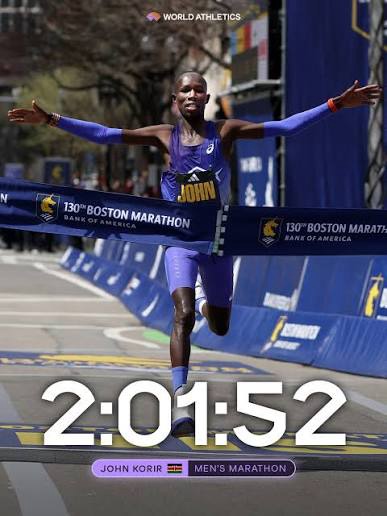
The combination of increased professional opportunities, a wider—though more regionally focused—talent base, a revolution in shoe technology, improved training and coaching, scientific fueling that combats muscle fatigue, pacers aplenty—and we know what else—have combined to strip the old queen of distances of her defenses.
At the dawn of the 21st century, Morocco’s Khalid Khannouchi posted a world record 2:05:42 in Chicago on October 24, 1999.
The 100th best time of 1999 was set on the same day in Reims, France at 2:11:33 by Fegadu Degefu of Ethiopia.
Twenty years later, in the last full pre-Covid year, 2019, the top time in the world was run by Kenenisa Bekele on September 29th in Berlin at 2:01:41, just two seconds off Eliud Kipchoge’s then world record—which was run on the same course the year before.
Not to get too far into weeds, but Bekele’s 2:01:41 was 3.15% faster than Khannouchi’s 2:05:42 from 1999, while Albert Korir’s* 100th best of 2019, 2:08:03, was 2.66% ahead of Degefu’s 100th best in 1999.
Yesterday, we saw John Korir break Geoffrey Mutai’s once impregnable Boston course record by 1:10, an improvement of 0.95%.

As always, I like to see what the numbers have to say before opining. Here, then, are the modern-day record jumps in Boston.
BOSTON
The Modern-Day Men’s Record Jumps (Chronological)
• 1947: Suh Yun-Bok | 2:25:39 — 3.31% better than Les Pawson’s 2:30:38 in 1941
• 1967: Dave McKenzie | 2:22:18 — 2.30% better than Suh’s 2:25:39 in 1947
• 1970: Ron Hill | 2:10:30 — 8.29% better than McKenzie’s 2:22:18 in 1967
• 1975: Bill Rodgers | 2:09:55 — 0.45% better than Hill’s 2:10:30 in 1970
• 1982: Alberto Salazar | 2:08:52 — 0.45% better than Rodgers’ 2:09:27 in 1979
• 1986: Rob de Castella | 2:07:51 — 0.79% better than Salazar’s 2:08:52 in 1982
• 1994: Cosmas Ndeti | 2:07:15 — 0.47% better than de Castella’s 2:07:51 in 1986
• 2006: R.K. Cheruiyot | 2:07:14 — 0.13% better than Ndeti’s 2:07:15 in 1994
• 2010: R. Kiprono Cheruiyot | 2:05:52 — 1.07% better than R.K. Cheruiyot’s 2:07:14 in 2006
• 2011: Geoffrey Mutai | 2:03:02 — 2.25% better than Cheruiyot’s 2:05:52 in 2010
• 2026: John Korir | 2:01:52 — 0.95% better than Mutai’s 2:03:02 in 2011
Records In Order of Magnitude
(Ranking the greatest percentage improvements in Boston history)
1. Ron Hill (1970) — 8.29%
2. Suh Yun-Bok (1947) — 3.31%
3. Dave McKenzie (1967) — 2.30%
4. Geoffrey Mutai (2011) — 2.25%
5. Robert Kiprono Cheruiyot (2010) — 1.07%
6. John Korir (2026) — 0.95%
7. Rob de Castella (1986) — 0.79%
8. Cosmas Ndeti (1994) — 0.47%
9. Bill Rodgers (1975) — 0.45%
10. Alberto Salazar (1982) — 0.45%
11. Robert Kipkoech Cheruiyot (2006) — 0.13%
What the numbers say
Look at the pattern and Madame Marathon starts talking back. Records don’t fall in a straight line — they fall in avalanches. Avalanches don’t start with one snowflake. They start when the whole slope is ready to slide. We saw it when the four-minute barrier was first broken in the mile. We’ve seen it again in the marathon.
You get 20-plus years of nips and nibbles of less than 1%, then some combination of belief, conditions, and technology blows the doors off.
Geoffrey Mutai’s 2:03:02 in 2011 was shocking on the day. But a number of Kenyans from that 2010-2012 window — Moses Mosop, Patrick Makau, Wilson Kipsang — all ran 2:03-2:04. Makau set the WR 2:03:38 five months later in Berlin. The whole top end moved together.
What Mutai had in Boston was a serious tailwind, 45°F, low humidity — basically a wind tunnel. Rival Moses Mosop pushed him all the way down Boylston Street, finishing just four seconds behind.
Mutai was 29, peak age, heading to another era-defining course record in NYC that fall in 2:05:06.
For years, Mutai’s 2011 Boston performance looked like a super-shoe time before super shoes. When the era fully matured by 2019, it was the functional equivalent of handing every Major League Baseball player an aluminum bat. And yet, Mutai’s time remained.
Yesterday, John Korir’s 2:01:52 returned it to a first-generation super shoe time.
⸻
The Shift
The quieter stat sits deeper in the field: the 100th-best time moved from 2:11:33 in 1999 to 2:08:03 in 2019 (source: World Athletics). The front-end moved 3.15% faster. The 100th man moved 2.66% faster. The whole bell curve slid.
In 1999, 2:08:03 was 26th best in the world. In 2019 it was 100th. In 2025 it was over 200th.
Boston used to be a coronation for one king every decade. Now dozens arrive believing 2:04 is the minimum requirement.
That’s not disrespect. That’s professional depth.
The marathon’s defenses aren’t gone, but they have been deconstructed. We’re not cutting records by 11:48 anymore, because there isn’t 11:48 left at 4:40 per mile.
Yesterday’s results in Boston didn’t diminish the grand dame, they recalibrated her. They showed that Mutai wasn’t a mirage — he was an early explorer.
It took 15 years for the sport to close the Mutai gap, and when it did, it only found 0.95% improvement.
Madame Marathon hasn’t been conquered so much as decoded. Trepidation gave way to preparation. Racing flats gave way to super shoes. Exclusivity gave way to depth. Trophies gave way to prize and appearance fees.
The next breakthrough won’t look like Ron Hill’s 8.29% reduction. It will look like April 20, 2026 — incremental, compressed, and still hard-earned.
And when it comes, it won’t be a surprise.
The numbers will have said it first.
END
*Albert Korir was given a five-year ban by the Athletics Integrity Unit on March 30, 2026 for three confirmed positive tests for CERA (an EPO-type substance).
.
 tonireavis.com
love it when you get mathematical. Especially over the decades. Thanks !