
History is rarely so visible in its making. But that is what we saw unfold in London on April 26, 2026.
As two men sped along the streets of the English capital, the hand of history awaited at the Mall, stylus at the ready, record book open. It last marked this chapter in October 2023 in Chicago for the late Kelvin Kiptum — a name that would have been written again save for his tragic passing two years ago.
In recent years, with rapid advances in shoe technology and improved fueling, history has been especially active on the roads and the track.
Distance racing has been transformed from a pure test of endurance into an extended examination of speed.
After Sabastian Sawe’s historic 1:59:30 performance in London — the first record-eligible sub-two-hour marathon — what remains is what famed radio star Paul Harvey called “the rest of the story.”
If Sawe comes back in the fall and calls upon history’s hand again, we may yet witness the greatest single year in marathon history. Even something close to London would put him in the running for that top spot. The likeliest stage is Berlin: Chicago is a Nike race; Berlin sits just 60 miles from Adidas headquarters in Herzogenaurach.
The shortlist for the greatest marathon seasons ever is endlessly fascinating, and there are many ways to weigh it.
As of mid-2026, here is how I’d rank them — not just by the clock, but by what each year changed in the sport: barrier, competition, and longevity.
TOP 10
1. Kelvin Kiptum (2023)
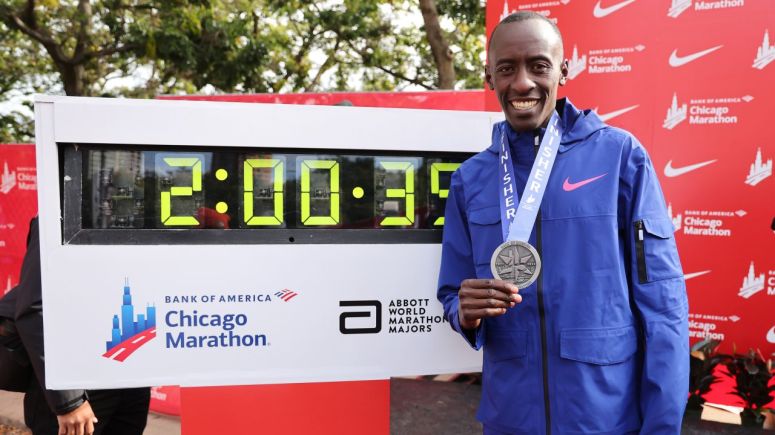
No real argument.
• Beat Eliud Kipchoge head-to-head in London with a course record 2:01:25.
• Then took Kipchoge’s world record down in Chicago with 2:00:35 in only his third marathon.
• The combination of age, upside, and seasonal completeness is unmatched.
This is the cleanest modern perfect season.
_____
2. Geoffrey Mutai (2011)
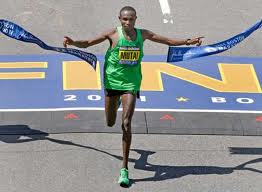
No official world record, but if the question is what moved the sport, this is hard to argue against.
• Boston 2:03:02 was seismic, 2:47 under the previous CR, even with the tailwind and Boston not being record-eligible.
• He followed it with a 2:05:06 course record by 2:39 in New York, on a course that punishes rhythm runners.
• Both marks stood for years (15 & 12) and changed the standard of what was possible.
No matter what the book says, Boston cannot be treated as second-class, nor Mr. Mutai.
_____
3. Eliud Kipchoge (2018)
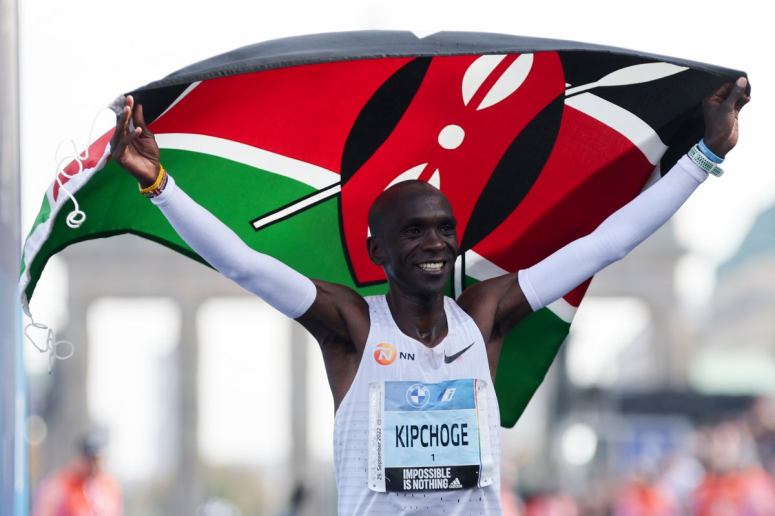
• Won London in 2:04:17 under heat stress.
• Then ran 2:01:39 in Berlin, taking 1:18 off Dennis Kimetto’s world record.
• The margin and the time both normalized 2:01 as a realistic ceiling. Bracketed 2018 with historic exhibitions in 2017 & 2019.
Berlin lacked tension, but the impact was enormous.
_____
4. Khalid Khannouchi (2002)
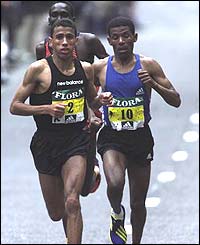
• Later won Chicago in 2:05:56.
• Became the first man to break his own marathon world record.
That London field was one of the deepest ever assembled. One of history’s most under-rated all time greats.
_____
5. Paul Tergat (2003)

• Won London in the spring.
• In Berlin, ran 2:04:55, becoming the first man under 2:05.
• Beat Sammy Korir in a race where both went under the previous world record.
Tergat changed the mental boundary of the event. That mattered as much as the time.
_____
6. Wilson Kipsang (2013)
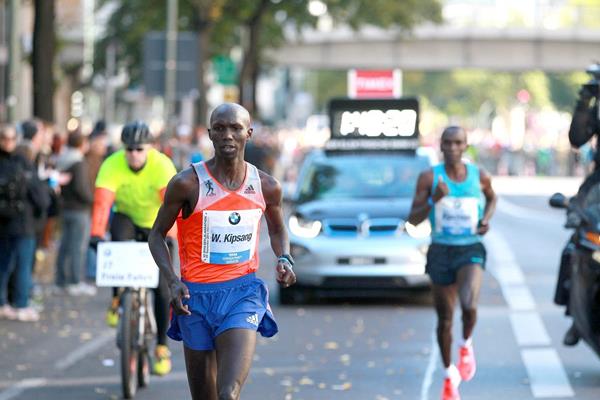
• Won London in 2:04:44 in a genuinely competitive field.
• Then set the world record in Berlin at 2:03:23.
• It is a spring-fall major double anchored by a world record.
Structurally, this is the closest thing to Kiptum’s case, but just a tad less historic.
_____
7. Frank Shorter (1972)
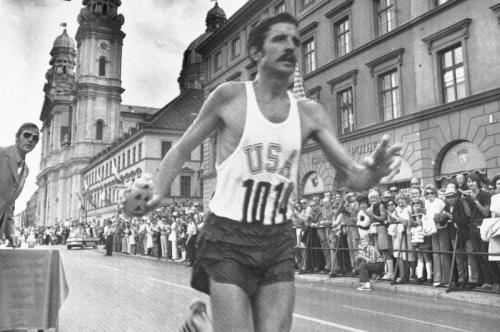
• Won the Olympic Trials in Eugene (tied with Kenny Moore).
• Took Olympic gold in Munich in a tactical masterclass.
• Closed the year with an American record victory in Fukuoka.
The times do not compare to later eras, but in historical force, Shorter’s ’72 was foundational.
_____
8. Sammy Wanjiru (2009)
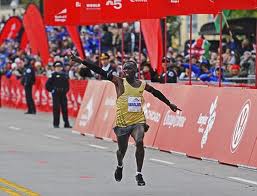
• Followed his front-running Olympic gold in Beijing in 2008 with:
• Win in London in 2:05:10.
• Then set the Chicago course record in 2:05:41.
He was a pure racer, and the 61:15 opening half in London hinted at what the sport would later become.
_____
9. Steve Jones (1985)
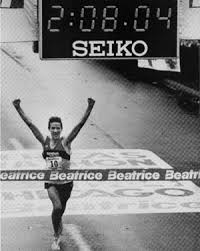
• Won London in 2:08:16 after an unruly, old-school battle with Olympic bronze medalist Charlie Spedding.
• Then produced the unforgettable 2:07:13 in Chicago, missing the world record by one second. But, like Wanjiru in London 2009, went out at a suicidal pace. 61:42 was the eighth fastest half marathon ever run at the time, and it was only his first half split!
Jones’ Chicago run was a performance bigger than the stopwatch.
_____
10. Alberto Salazar (1982)
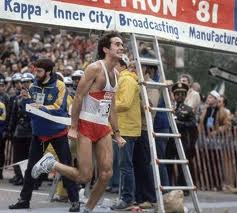
• Won Boston’s “Duel in the Sun” over Dick Beardsley by two seconds.
• Followed with another classic duel in New York City against Rodolfo Gomez, winning by just four ticks.
• No world record, but an enduring model of championship racing.
Salazar’s year remains one of the purest examples of marathon toughness.
Honorable Mention
Rob de Castella’s 1983 deserves serious consideration: Rotterdam win against De Castella and Lopes in April, then World Championship gold in Helsinki in August. Two very different race types, won both at the highest level.
Bill Rodgers in 1979 also has a strong case for sustained cultural and competitive authority. Second Boston — New York City double (1978), also second Boston course record (1975).
Carlos Lopes in 1984 and 1985 belongs in the wider conversation as well, especially given Olympic gold and Rotterdam world record overall quality of his racing.
Dennis Kimetto (2013)
- A win in Tokyo in Feb. (2:06:50)
- Chicago win in Oct. (fast) 2:03:45
- But DNF in London between
- And overshadowed by Wilson Kipsang’s Berlin WR
SIDEBAR: The Longest Droughts
Just like the women’s 800m — the longest standing track world record today — there have been times when the marathon record held tough as a barnacle, too.
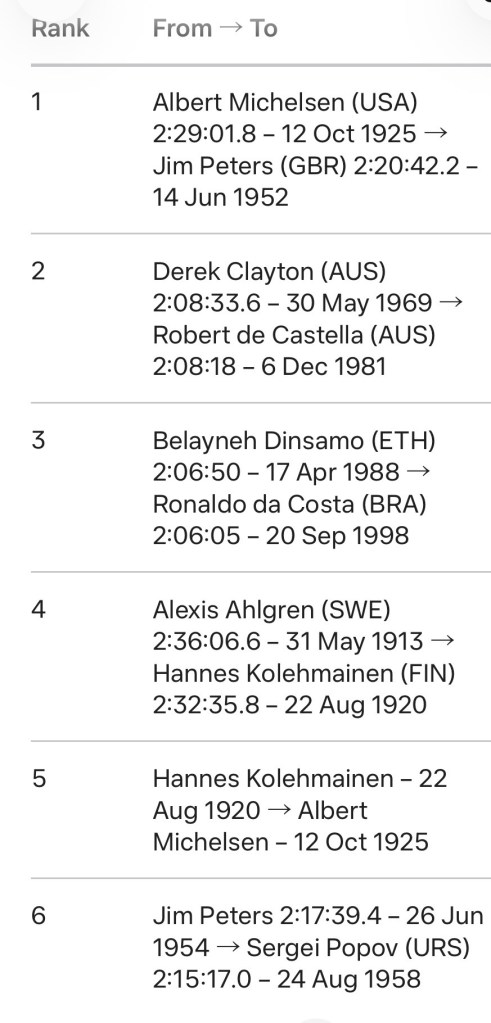
Clayton to DeCastella = 12 years, 6 months
Dinsimo to da Cost = 10 years, 5 months
END
 tonireavis.com
Shoes and a lot more money for winning has sent a bolt of energy to marathon racing. Who knows, maybe a 4:15/mile for 26.2 miles might be the next big thing.
Jonsey’s 1985 race is even more amazing since he had no pacers after 2 miles. Still ran 1:35:22 for 20 and the race that year finished going south on Lake Shore Drive which can be windy. Also there was no clock telling him the pace. Still number 1. Also his half that year would have been only 1 minute behind Sawe.