
A loaded 1500m final exposes a system built for time trials, not racing
Before the race began, my wife and I looked at the field and said, “There are five or six guys who could win this.”
That’s how loaded the men’s 1500m final was in Brussels last night.
The Brussels Diamond League final was the third meeting in two weeks in which many of the same runners would test one another. No secrets. In Silesia on August 23, Ethan Strand beat Cole Hocker and Jakob Ingebrigtsen to win in 3:30.77. Four days later in Zürich, Hocker won in 3:31.71, with Jakob fifth and Strand tenth in 3:32.95.
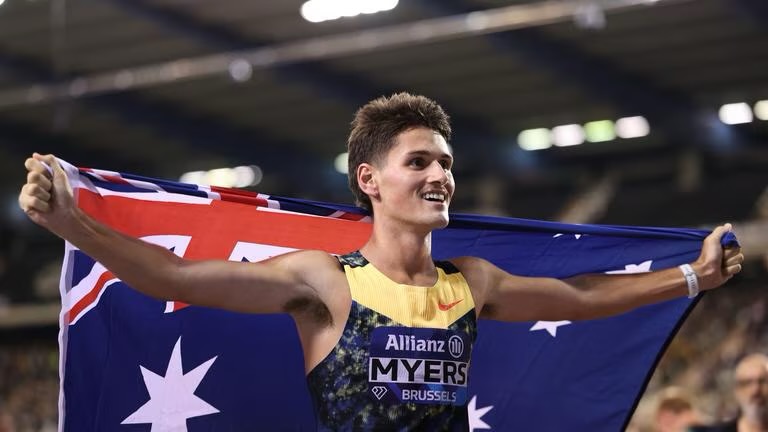
Then came Brussels. On day one of the two-day Diamond League finals, 20-year-old Aussie Cameron Myers timed his move perfectly, winning in 3:30.14, just four hundredths ahead of Kenya’s 19-year-old Phanuel Koech. Strand was third in 3:30.50, with Jakob fourth in 3:30.52. Hocker, the Olympic champion, was seventh in 3:30.80. Just the kind of blanket finish you could care coming.
Three races. Three different winners. The same basic collection of talent. That is what made the Brussels race intriguing.
The story afterwards should’ve been about the racing, and how narrow the margins were. Instead, the headline was Ingebrigtsen calling the field cowards for how they ran the race.

“Sh***y. Terrible. Extremely disappointing. Racing against a bunch of cowards. It’s only Cameron who did a good race.”
Ingebrigtsen believes “there’s honor in the way you win.” He’s not wrong. But they don’t pay off how you run; they pay off how you finish.
Every runner plays to his strength; he’d be a fool not to. And the higher the stakes, the more guarded the field is likely to be.
The blame — if there is any to be given — lies with a system that has taught us, going back as far as any of us can remember — to Coe and Ovett in the late ’70s, exchanging world records but never once racing each other — what a “good” 1500-meter/mile race is supposed to look like.
For decades, the Diamond League has been built as a time-trial circuit, while the World Championships and Olympics are competition-based. Meeting directors pay appearance money, hire designated pacers, turn on the Wavelight and offer time bonuses that can be worth more than the win bonus itself.
Why?
Because Brussels, Monaco, Eugene — they sell tickets and television on the promise of fast times and records. The Memorial Van Damme wanted a 3:26 or 3:27, not a 3:30 tactical battle.
Throughout the season, these guys are conditioned to run in single file behind rabbits, hitting 55-second quarters and glancing at green and blue pacing lights on the rail. The rhythm is about hitting the red line then holding on for dear life.
And Ingebrigtsen is the ultimate product of that system. He is the best middle-distance time trialer in the world, and when at full power, one hell of a racer, too. The two-time Olympic champion (gold in Tokyo 2021 1500m; gold in Paris 2024 5000m) ran 3:26.73 last year. He can do it as well as anyone.
Then comes the one race that is supposed to be a race — the final — and suddenly the rules change, and thinking under pressure becomes paramount, not just raw horsepower.
Jakob has experienced that disappointment before. In the 2022 and 2023 World Championship finals, he lost to Jake Wightman and Josh Kerr. Again in Paris at 1500m, he finished fourth after a crazy-fast start left him vulnerable, before getting run down by Hocker, Kerr, and Yared Neguse.
Brussels is billed as a championship — the Diamond League’s own season finale, the race that crowns a trophy winner. But nothing about how it’s staged and sold lets go of the time-trial instincts built up over the previous four months: the lights, the commentary, the broadcast graphics, the meet promotion.
The sport spends the regular season telling athletes and fans that fast is good, then acts surprised when a championship-style final is won by someone who makes better decisions when the pace slows.
And that is what the results of these three races tell us. Strand could win in Silesia, finish tenth four days later in Zürich, then run 3:30.50 for third in Brussels. Hocker could win in Zürich and finish seventh in Brussels. Jakob could finish fourth in Silesia, fifth in Zürich and fourth again in Brussels.
The talent didn’t suddenly change. The races did. That distinction matters.
Besides, Jakob’s gripe wasn’t only about the field. It was about Christian Jackson, the pacemaker who trains alongside Cole Hocker, going out at 3:27 pace and nobody except Ingebrigsten — including Hocker — going with him. When Jackson exited, Jakob was left on his own to do the leading .
“We’re trying to win but with Cole, the pacemaker was swapped out for his own teammate,” he said afterward. “So from now on he is in no position to make any changes or decisions in the 1500m because he fooled us.”
Except Jackson’s assignment was public before the gun ever went off, splits and all. Nobody fooled anybody.
Jakob put himself right where he normally does — on the front. When Jackson pulled off, that left him with a target on his back and not enough left in the tank to get away from the piercing arrows. That’s not a moral failure by everyone else. That’s smart racing.
The Diamond League has to decide: If you want a race, stage a race. No pacers in a final. No Wavelight in a final. No time bonuses in a final. Double the money for winning and nothing for time. Winner takes the Diamond trophy. That’s it.
You want to win $100,000? Fine. Beat 11 other world-class runners from the gun to the tape, however slow it goes. Right now we do the opposite. We tell fans from May to August that good track is fast track, then wonder why they are confused when the Olympic final goes 3:50 and the best tactician wins.
Matt Centrowitz’s gold in Rio in 3:50 required making decisions under crisis. A 3:27 in Monaco requires holding a pace. One favors the strength runner. One favors the kicker.
Cam Myers proved in Brussels that he could do both. He could sit on the rail with 200 meters to go, have faith a lane would open, and then have the gear to take advantage of it. He didn’t need to control the race to win it. If Jakob had that extra gear, he would have won. He didn’t.
He had the strength to do it in the 5000 meters at the European Championships, but not in the 1500 here, at least not against this field on this night.
That’s not cowardice from the others. That’s both his inclination and limitation in this event, against these opponents, in his current fitness just nine months after Achilles surgery (correction: seven months, via surgeon, Dr. Amol Saxena, making J.I.’s competitive spirit even more impressive).
World Athletics wants the theatre of Myers beating Koech by four hundredths. That is the sport. But it keeps staging the event to produce something else. And when the race refuses to cooperate, the weakness is exposed in the system — not in the field.
END


Hey Toni,
As always your commentary is well thought and right on point. I don’t think any reasonable student of the sport expected Jakob to be in top form so soon after Achilles surgery. The fact that he’s running 3:30 and 13:15 (in a tactical victory) is absolutely remarkable.
He can complain all he wants, but nobody owes him a damn thing…..
Barry J. Lee
Well said. I agree that finals, whether they be Olympic, WC, US, European, Commonwealth, or DL, should be unpacked with no wavelights. Let them race.
You got it a bit wrong. Ingebrigtsen doesn’t mind no pacers. He took it out in Paris Olympics and almost won and probably would have if the first lap hadn’t been so fast as he later said. Ingebrigtsen was upset as the understanding apparently was that Hocker was going to follow his mate to a fast pace. But Hocker just sat back which confused everyone. No one knows who asked for the fast pace the rabbit set. 55, 1:52 It certainly wasn’t Ingebrigtsen.
Racing is about thinking. Pacing is about not thinking. So the second people go into a race with pre-existing expectations of how it’s supposed to go, then those expectations don’t take place, they say they were confused. If you get rid of pacers, nobody’s confused. At his best, Jakob can do it anyway you want it, from the front, the middle, or the end. He’s not in that shape right now. He didn’t have to go to the front behind the pacer. That’s just his natural inclination. My point is to stop with the pre-existing pacing plans, and just shoot the gun and have the contenders race. Best man on the day wins. No confusion. Thanks for contributing.
Toni
That would get boring pretty fast on the DL. Lots of races but nothing memorable. Just another 1500 grind. Following is a huge advantage and unless you are way faster than everyone you aren’t going to lead. The WRs are great and what people remember. And for that you need pacers. The championships should be unpaced. The sport needs both.
This is exactly my point: “He took it out in Paris Olympics and almost won and probably would have if the first lap hadn’t been so fast.”
But he’s the one that made it fast! In other words, tactical error that cost him a medal, likely gold. Who did think he was, Rudisha in London in the 800?