
Thirteen years ago, September 16, 2013, I wrote a blogpost, DUMBING DOWN, SLOWING DOWN, prompted by two stories that seemed unrelated: former Supreme Court Justice Sandra Day O’Connor warning that fewer than a third of American eighth-graders could identify what the Declaration of Independence actually declared, and Competitor Group quietly dropping elite athletes from its Rock ’n’ Roll Marathon series. I argued then that both pointed to the same cultural shift — a country that had stopped keeping score, in the classroom and on the race course, at roughly the same time.
On September 15, 2026, the New York Times delivered the sequel.
An M.I.T. Report Warns A.I. Is Causing ‘Cognitive Surrender.’ Universities Are in a Bind. (It’s behind a paywall)
The article highlighted an MIT report on AI in higher education that found students turning to chatbots “at the first hint of struggle.” The trend has created what researchers call the “illusion of learning.” A separate study of more than 26,000 Chinese secondary-school students was even sharper: students who used AI to help with their homework saw their homework scores rise, but their scores on exams taken without AI assistance fell about twenty percent.
Not every decline shares a common cause. Some of the marathon slowdown is simple arithmetic: participation has widened dramatically since the first running boom. A larger, more democratic participation field will always produce slower averages than a small group of self-selected early adopters. That’s not decline; that’s inclusion, and a good thing.
But underneath the arithmetic, something else changed. In the first boom, top Americans were also top in the world. Frank Shorter, Bill Rodgers, Joan Benoit Samuelson and Alberto Salazar weren’t distant figures; they were proof of what was attainable, and attainability fueled the chase for speed across the spectrum. Heroes matter.
But the financial pressure on runners was lighter, too. For instance, my last semester’s tuition at Washington University in St. Louis was $1,250 in 1973. Today, tuition alone is more than $35,000 a semester. In the 1970s, low financial overhead gave us the freedom to find out how fast we could run simply for the sake of finding out.
Today the calculus is different. People arrive at running already carrying more pressure than they can easily manage — from work, from school, from you name it. Life itself is a vise. Have you tracked housing costs? People are not seeking another pressure cooker; they need a decompression chamber.
In this environment, the finish line, alone, becomes the goal, not the clock.
“The finish line, alone, becomes the goal, not the clock.”
That isn’t a moral failing; it’s a rational response to a harder daily grind. But it does mean the engine — the hunger to see how fast you personally can go — isn’t pinning the tachometer at the redline like it did in 1978.
This is where the AI story rhymes with the running story.
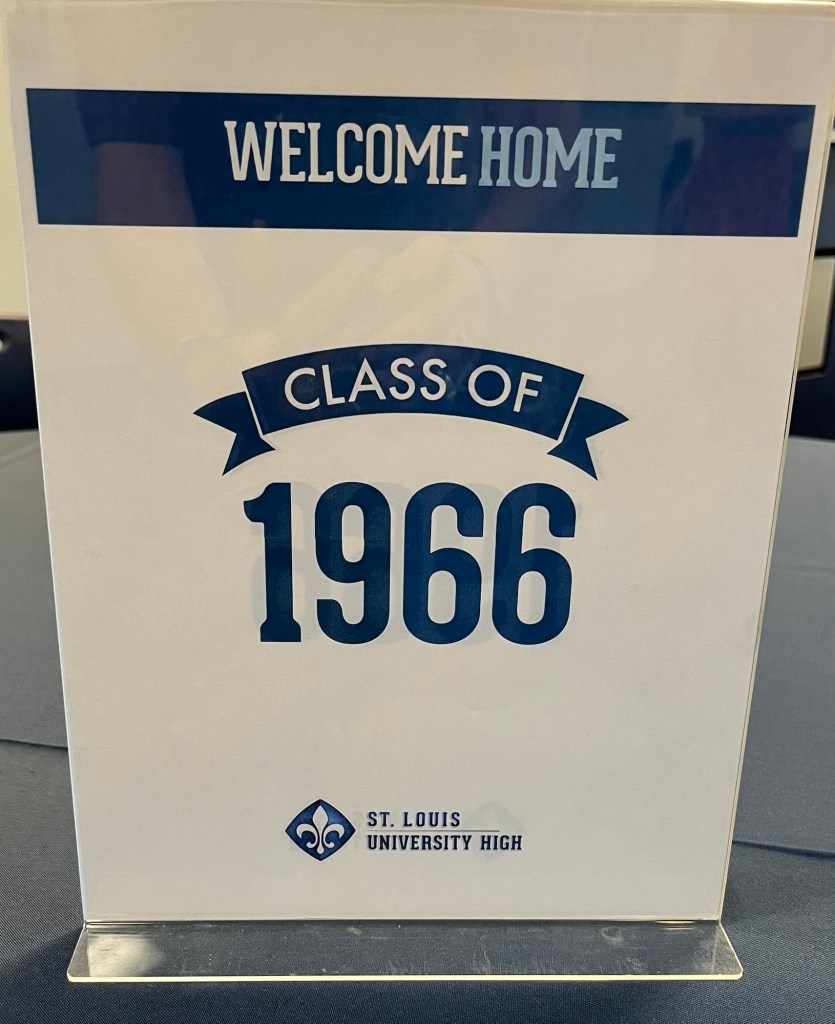
I just returned from my 60th high school reunion. At St. Louis University High, a Jesuit prep school, the rigor was fundamental. We all talked about it last Saturday night as we reminisced: diagramming sentences, Latin studies to sharpen our English, showing your work in math, learning to use a slide rule.
All of that ground-level processing created friction — the friction that builds comprehension.
It’s no different than training into oxygen debt to expand your capacity, pushing against your limit in the hunt to notch your next PB. In each case, the rigor was the point.
Remove the friction and you can still produce an essay, still cross a finish line, still appear to have accomplished the thing. But as the MIT researcher put it, “You basically didn’t engage any of the memory networks that would actually help you remember.”
Tests aren’t the goal; they’re the gauge.
I’ve kept a daily journal since 1982 — 287 volumes and counting. When people ask how I can still summon splits and finishing times from decades ago — Steve Jones’s 1:01:42 half-marathon split at Chicago in 1985, for instance — the answer is simple: I wrote it down myself, by hand, at the time.
The act of writing built a separate pathway to the fact that reading someone else’s media guide never could.
Two roads to a fact beat one.
The initial generation of the fact is what makes it retrievable under pressure, on air, in real time, the exact quality an AI-assisted student and a media-guide broadcaster both skip.
Thirteen years later, the danger was never that we became slower or less educated by some single-cause mechanism. The danger lies in a culture that quietly decides, convenience by convenience, app by app, that the hard part was the obstacle rather than the mechanism that produced lasting success.
Our cognitive and athletic decline didn’t happen by chance; we engineered it by design. By removing difficulty from training and rigor from learning, we starved the furnace where the nation’s democratic steel is forged.
Keeping score was eliminated because someone might lose. Now, forget cursive — that’s long been abandoned — simply drafting your own sentences can be bypassed because an app can do it for you without the accompanying strain.
After years of removing the very friction that made us stronger, we find ourselves confronted by a technology capable of sanding down every last wrinkle. Is it any wonder an existential fear of AI has metastasized?
END


Even after adjusting for inflation, $1250 in 1973 is still only $9,829.23 today – less than a third of that $35,000/semester tuition. 😦
Good observation and cause for reflection, Toni. We are a dynamic sport with so much data which is there to be mined and can be used to benefit health and lifestyle. It would be interesting to see— for example — to study the running patterns & progressions and demographics and statistics against the constant of the Charles River / Esplanade (analyses and takeaways). – Jack
Toni, on a slightly different note, and that is how working as a team in both school studies and on the playing field has created more success, too. People in Engineering studies were often seen working on their calculus together, as I remember. The team-building of any cross-country or track team can be like that.
And so a BIG shout-out to our US teams, seeing 5 US men in the top 7 of the World Ultimate Champs 5000m, and to the women and men’s US teams at the World Road Champs 1/2 marathon, a silver for the women (beating the Ethiopians!) and bronze for the men, as well as the team medal for the road mile, led by Neguse. We felt true American pride in all that.
Anon,
Yes, U.S. running fortunes have certainly been on the rise in recent years, fueled by newly developed training groups and support mechanisms. And belief in the power of working together. Thanks for reminding us how well Team USA fared in Copenhagen.