
With its emphasis on time and distance, athletics, perhaps more than any other sport, is tied to its record book. Sadly, it hasn’t always been to its advantage. World records are rare enough to make them extraordinary events. Yet the pressure to produce them—and the temptation to find help beyond training and talent—has proven to be equally extraordinary. So when a record falls, there is always that first rush of excitement, followed by the less exciting wait for the test results.
But when records fall the way they did Thursday night in Zürich at Letzigrund Stadium, the sport reminds us why it can still take our breath away.
The Weltklasse meeting is the final regular-season Wanda Diamond League meeting of the year, and historically one of athletics’ great record-producing venues. Before Thursday night, 27 world records had been set at the Zürich meeting.
Then, in the space of 40 minutes, two more fell.
Thursday night (08/27/2026) delivered the kind of meeting that comes along only occasionally: two world records in the hurdles, a pole-vault competition unlike anything we had seen before, and another near miss at one of the oldest records in the book.
It started with the men’s 400m hurdles.
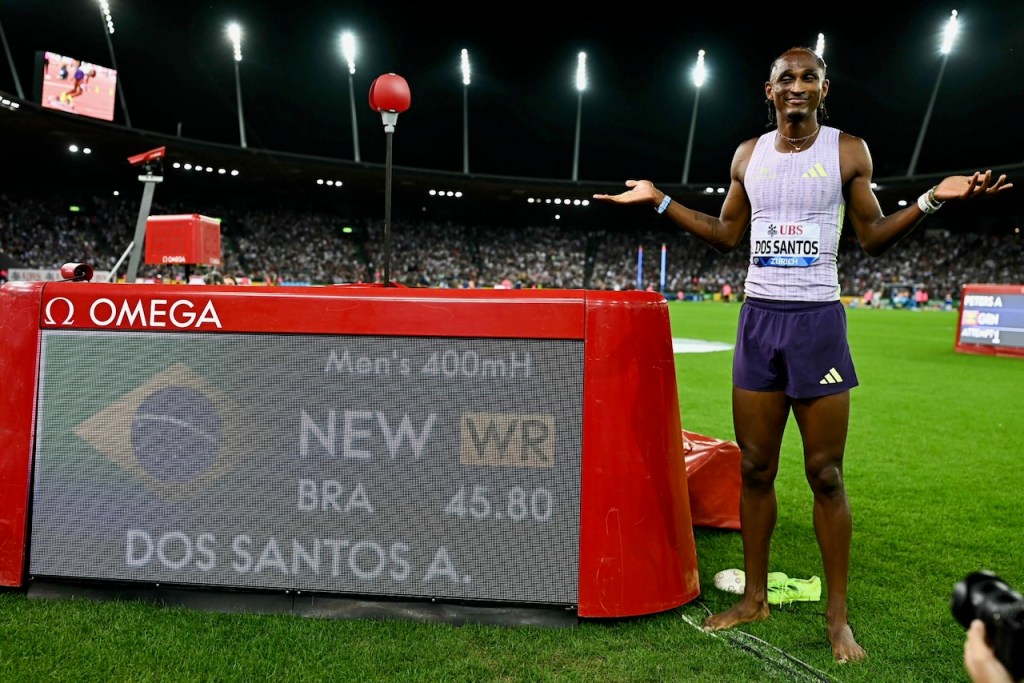
Brazil’s Alison dos Santos attacked from the gun and ran away from the field, breaking Karsten Warholm’s 2021 world record of 45.94 by 14 hundredths with a stunning 45.80.
Dos Santos had been taking the measure of Norway’s Warholm throughout the season, but usually by coming from behind the front-running Viking over the final 50 to 75 meters. In Zürich, he took a page from Warholm’s book and attacked early.
Warholm finished second in 46.69 and seemed a little stunned to see his five-year-old record disappear.
Less than 40 minutes later, it happened again.
The women’s hurdles—both the 100 and 400—have been standout events for years. Even as one generation has replaced another, the talent has remained high.
In the shorter race, America’s Masai Russell, the Olympic champion in Paris, flashed to a world record of 12.09 seconds. It lowered the previous mark of 12.12 set by Nigeria’s Tobi Amusan in 2022.

Foto: © IMAGO/Chai von der Laage
With the wind reading 0.0 m/s, Russell made her margin over the final hurdle as Amusan finished second in 12.23. It was the same satisfying scenario as in the men’s 400m hurdles: the new record holder beating the old one in the race that transferred the crown.
Two world records in 40 minutes would have been enough for any meeting.
But Zürich wasn’t finished.
Letzigrund Stadium had produced its 29th world record. Then came the men’s pole vault—and the attempt at number 30.
It was a duel between two of the three greatest pole vaulters of the era, Greece’s Manolo Karalis and Sweden’s Mondo Duplantis, the world-record holder.
We can’t dismiss Sergey Bubka from the conversation, either. His final outdoor world record of 6.14 meters has long since been displaced, but his place in the history of the event remains secure. Renaud Lavillenie, too, remains part of that lineage.
Duplantis, however, has turned the world record into something approaching a personal possession. He broke it for the 15th time at his own Mondo Classic in Uppsala on March 12, clearing 6.31 meters on his first attempt.
A week ago in Lausanne, Duplantis called the competition there the greatest pole-vaulting competition ever. He cleared 6.21 meters while Karalis cleared 6.16.
Zürich topped even that.
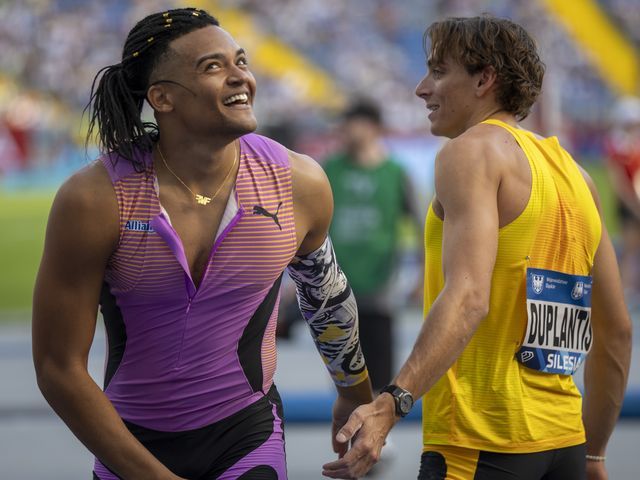
Photo: Eurosport.fr
Karalis and Duplantis became the first two athletes in history to clear 6.20 meters or higher in the same competition.
Karalis had already established himself as the second-best vaulter in history with his 6.17-meter clearance indoors this winter, putting him within striking distance of Duplantis. In Zürich, he made the pressure real.
Karalis cleared 6.20.
Duplantis answered at 6.25.
Then both men turned their attention to 6.32.
Duplantis made three attempts to raise his own world record by another centimeter. Karalis, having skipped 6.25, also took three shots at 6.32. Neither man could quite get there.
Still, the competition had produced something no pole-vault competition had produced before: two men over 6.20 meters — and a third, Norway’s Sondre Guttormsen, over 6m.
And then came Switzerland’s own Audrey Werro to cap the evening.
Werro has been conducting her own assault on the women’s 800m record book throughout 2026. On Thursday night, she made another significant move.
After moving past the Netherlands’ Femke Broeders-Bol at the top of the stretch, Werro charged home in 1:53.70—the third-fastest performance in history, and a Diamond League record.
That put her just 0.42 seconds from the 1:53.28 record set by Czechoslovakia’s Jarmila Kratochvilova in 1983, a mark that for decades has seemed almost impregnable.
Now it doesn’t look quite so inviolate.
That may be the larger story from Zürich.
Athletics remains a sport searching for its own sorcerer’s stone, something that can turn exceptional performances into broader public interest. The sport has a strong and loyal niche following, but it continues to search for a way back into the larger sporting conversation.
Staging its new Ultimate Championships in Budapest, September 11–13, World Athletics will offer a $10 million prize purse in another effort to expand that audience.
Money alone can manufacture fascination. But performances on top of it is even better.
For one night in Zürich, the bar kept moving higher, making the Diamond League final next week in Brussels and then the Ultimate Championships even more intriguing.
END

